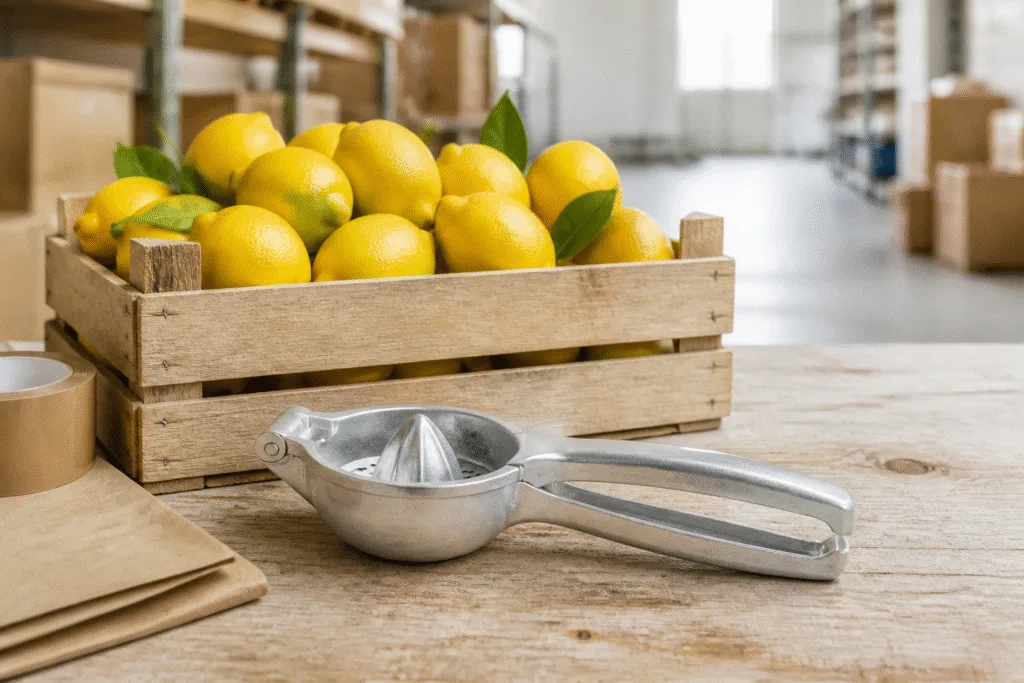
Buying lemon squeezers in bulk is not simply a matter of finding the lowest unit price. For wholesalers, distributors, hospitality suppliers, and private label brands, the real challenge is finding a product that combines reliable performance, suitable materials, consistent quality, efficient packaging, and a supply model that can support repeat orders.
A lemon squeezer may be a small kitchen or bar tool, but its design directly affects usability, durability, and customer satisfaction. When purchasing hundreds or thousands of units, small differences in casting quality, handle design, surface finishing, or packaging can become significant commercial issues.
This guide explains what B2B buyers should consider when sourcing lemon squeezers wholesale, from material selection and product design to supplier evaluation, customization, quality control, and bulk pricing.
Why Lemon Squeezers Are a Practical Wholesale Product
Lemon squeezers serve several different customer groups, including home kitchen users, restaurants, cafés, bars, hotels, catering businesses, and kitchenware retailers.
For wholesale buyers, this creates multiple sales opportunities without requiring a highly complicated product.
A good lemon squeezer should be:
- Easy to operate
- Durable enough for repeated use
- Comfortable to hold
- Efficient at extracting juice
- Easy to clean
- Suitable for its intended application
- Consistent across large production runs
For retail brands, product appearance also matters. A simple change in surface finish, color, handle shape, or packaging can help create a product line that fits a specific market.
For foodservice distributors, durability and operating efficiency may be more important than decorative features.
The right specification therefore depends on where the product will be sold and how customers are expected to use it.
What Types of Lemon Squeezers Can Buyers Source Wholesale?
Different product designs serve different applications. Before requesting a quotation, buyers should identify the product type that best matches their target market.
Aluminum Lemon Squeezers
Aluminum alloy is widely used for manually operated citrus presses because it allows manufacturers to produce relatively strong and lightweight structures.
For B2B buyers, aluminum models can be suitable for retail kitchenware, bar tools, hospitality supplies, and promotional product lines.
Important specifications include:
- Aluminum alloy grade
- Product weight
- Overall dimensions
- Handle structure
- Surface treatment
- Hinge design
- Bowl capacity
- Packaging method
A buyer should not evaluate an aluminum squeezer based on material name alone. The actual casting quality, wall thickness, finishing, and structural design also influence the final product.
Stainless Steel Lemon Squeezers
Stainless steel models are another option for buyers who prioritize corrosion resistance and a metallic appearance.
They may be suitable for kitchenware brands and professional foodservice applications where stainless steel is preferred.
However, stainless steel and aluminum products have different weight, manufacturing, finishing, and cost characteristics. Buyers should compare complete product specifications rather than simply comparing material prices.
2-in-1 Lemon and Lime Squeezers
Multi-purpose designs can target customers who regularly use both lemons and limes.
For retailers, a 2-in-1 design can provide a clearer product benefit than a basic single-purpose model. The important consideration is whether the design actually performs well with the intended fruit sizes.
Commercial Lemon Squeezers
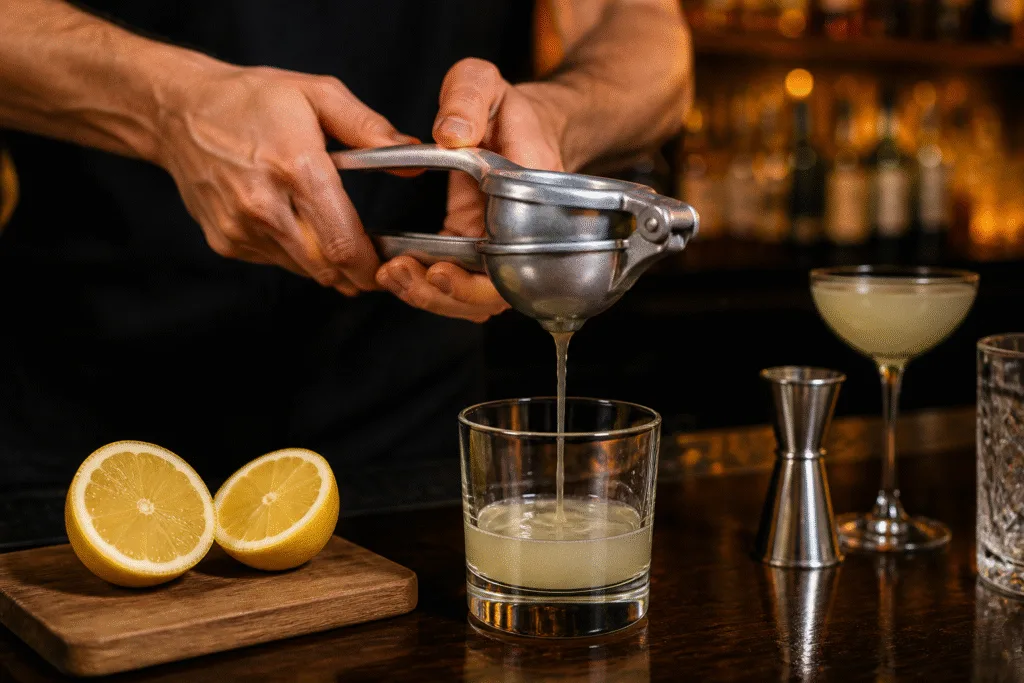
Commercial users may operate a squeezer repeatedly throughout the day.
For bars, restaurants, and beverage stations, buyers should pay particular attention to:
- Structural strength
- Handle comfort
- Hinge durability
- Juice extraction efficiency
- Cleaning requirements
- Surface durability
A product designed for occasional household use does not necessarily have the same requirements as one intended for continuous commercial operation.
What Materials Should You Choose?
Material selection affects product weight, durability, appearance, manufacturing process, and cost.
| Material | Typical advantages | Considerations for buyers |
|---|---|---|
| Aluminum alloy | Lightweight, castable, flexible for product design | Surface treatment and food-contact requirements need attention |
| Stainless steel | Corrosion resistance and durable metallic appearance | Usually heavier and may have different production costs |
| Zinc alloy | Good casting performance and detailed shapes | Weight and finishing requirements should be evaluated |
| Food-grade plastic | Lightweight and potentially lower cost | May have different durability and positioning |
For a B2B order, the material should be selected according to the product’s intended market rather than price alone.
If the product will be positioned as a durable metal kitchen or bar tool, aluminum alloy can provide a useful balance between weight, structural performance, and design flexibility.
What Should B2B Buyers Check Before Placing a Bulk Order?
A wholesale quotation should never be evaluated using unit price alone.
1. Product Specifications
Confirm the complete specification before comparing suppliers.
This may include:
- Material
- Dimensions
- Weight
- Capacity
- Color
- Surface finish
- Handle design
- Packaging
- Carton quantity
Two products that appear similar in photographs can have significantly different specifications.
2. Sample Quality
Always evaluate samples before moving into mass production when the order is commercially important.
Check:
- Casting quality
- Surface smoothness
- Edge finishing
- Handle alignment
- Hinge movement
- Juice extraction
- Overall weight
- Packaging quality
The production sample should also be compared against the final approved specification.
3. Production Consistency
A good sample does not automatically guarantee consistent mass production.
Ask the supplier how quality is controlled during production.
For cast metal products, inspection may cover dimensions, surface defects, trimming, machining, finishing, assembly, and functional performance.
4. Packaging
Packaging becomes particularly important when purchasing large quantities.
Buyers should confirm:
- Individual packaging
- Logo requirements
- Retail box dimensions
- Inner carton protection
- Master carton quantity
- Carton dimensions
- Shipping marks
Good packaging can reduce product damage during international transportation and make the product easier to sell through retail channels.
Aluminum vs Stainless Steel Lemon Squeezers
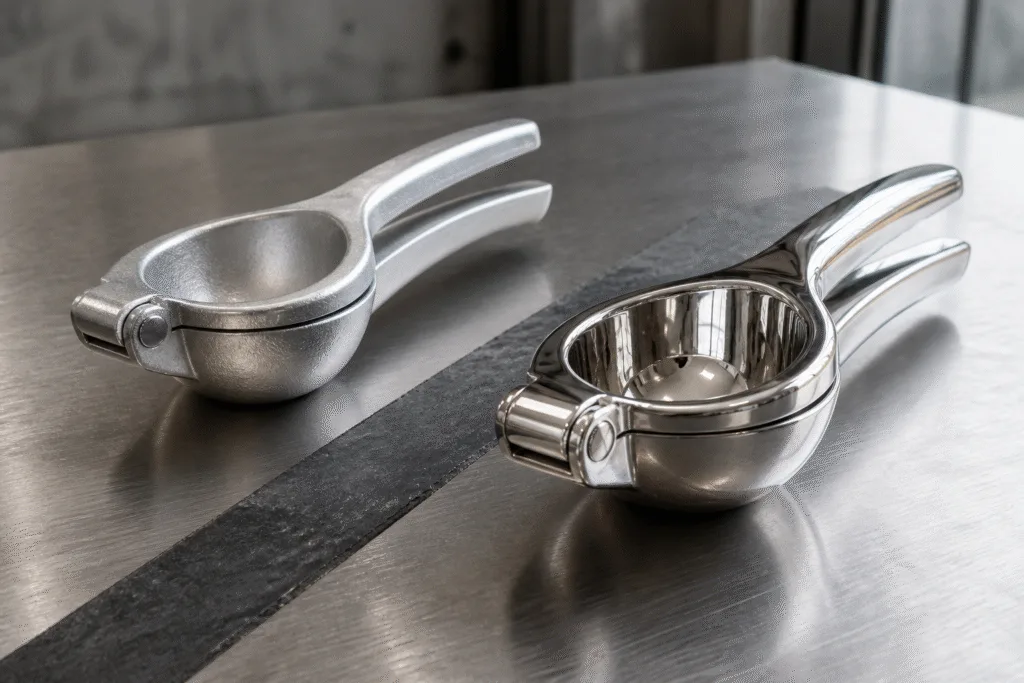
The choice between aluminum and stainless steel should be based on the intended market.
Aluminum can be attractive when the buyer wants a lightweight cast-metal product with flexible design possibilities.
Stainless steel may be more appropriate when the target customer expects a heavier metallic product or specifically prefers stainless steel.
There is no single material that fits every wholesale application.
Instead, buyers should consider four factors together:
target market + expected usage + product positioning + target cost
This approach is more useful than selecting a material simply because it is cheaper.
What Makes a Lemon Squeezer Suitable for Commercial Use?
Commercial users typically care about more than appearance.
A restaurant or bar may use the same tool repeatedly during busy service periods. If the handle becomes uncomfortable, the hinge develops excessive movement, or the product becomes difficult to clean, the operational cost can quickly exceed the original purchase price.
For commercial applications, buyers should therefore evaluate:
Durability
The body, handle, and moving parts should withstand repeated operation.
Ergonomics
The handle should provide a comfortable grip and allow users to apply sufficient pressure without unnecessary effort.
Functional design
The pressing chamber should work effectively with the intended lemon or lime sizes.
Cleaning
The product should not have unnecessary areas where pulp and juice can accumulate.
Surface quality
Finishing should be consistent and appropriate for the intended application.
These details are particularly important when sourcing products for hospitality distributors or professional barware programs.
How to Choose a Wholesale Lemon Squeezer Supplier
A supplier’s ability to quote a competitive price is only one part of the evaluation.
B2B buyers should examine the supplier across several areas.
Manufacturing Capability
Ask whether the supplier controls important production stages internally or relies heavily on outside subcontractors.
For cast-metal products, capabilities such as mold development, die casting, trimming, machining, polishing, finishing, assembly, and inspection can affect both quality and lead time.
OEM and ODM Capability
If you plan to build a private label product, confirm whether the supplier can support:
- Product modification
- Logo application
- Custom colors
- Surface finishes
- Packaging
- Mold development
- Product drawings
- Prototype development
A supplier that can support these stages directly can simplify communication during product development.
Quality Control
Ask what inspection procedures are used before shipment.
Depending on the product, this can include dimensional inspection, appearance inspection, assembly inspection, functional testing, and packaging inspection.
Communication
For international B2B orders, communication is part of supplier performance.
The supplier should be able to clearly confirm specifications, samples, MOQ, production schedule, packaging requirements, and shipping arrangements.
Wholesale Lemon Squeezer Pricing: What Affects the Cost?
There is no universal wholesale price for a lemon squeezer.
The final cost depends on several variables:
- Material
- Product weight
- Product size
- Mold requirements
- Surface finishing
- Logo customization
- Packaging
- Order quantity
- Product complexity
- Quality requirements
Public B2B listings show that aluminum lemon squeezers can appear at substantially different price points depending on MOQ, design, customization, and supplier specifications. This is why comparing only the headline unit price can produce misleading results.
For example, a lower-priced product may use a simpler design or packaging specification, while a higher-priced product may include custom finishing, heavier construction, or retail-ready packaging.
For a meaningful comparison, buyers should request quotations using the same specification.
Custom Lemon Squeezer Options for Private Label Brands
Private label buyers often need more than an existing catalog product.
A custom lemon squeezer can be developed around a specific brand identity or target market.
Common customization options include:
Logo
Depending on the surface and product design, branding may use methods such as laser engraving, pad printing, or other suitable marking techniques.
Color and Surface Finish
Different finishes can change the visual positioning of the product.
For example, a retailer may want a classic metallic appearance, while another brand may prefer a specific branded color.
Product Design
Customization can include:
- Handle shape
- Product dimensions
- Functional structure
- Bowl size
- Ergonomic features
- Color
- Surface treatment
Packaging
Retail packaging can include branded boxes, inserts, labels, barcode information, and other market-specific requirements.
A complete product brief should be prepared before production. This helps the supplier understand the intended market, specifications, packaging, branding, and target price.
Common Quality Problems in Bulk Lemon Squeezers
Several problems can appear when quality control is not sufficiently controlled.
Rough Edges
Poor trimming or finishing can leave sharp or uncomfortable edges.
Uneven Surface Finishing
Inconsistent polishing, coating, or other surface treatment can make products from the same order look different.
Poor Handle Alignment
Incorrect assembly may affect both appearance and usability.
Loose or Stiff Hinges
The hinge needs to provide controlled movement. Excessive looseness or resistance can affect the user experience.
Inconsistent Product Weight
Large variations in product weight can indicate inconsistent production or specification control.
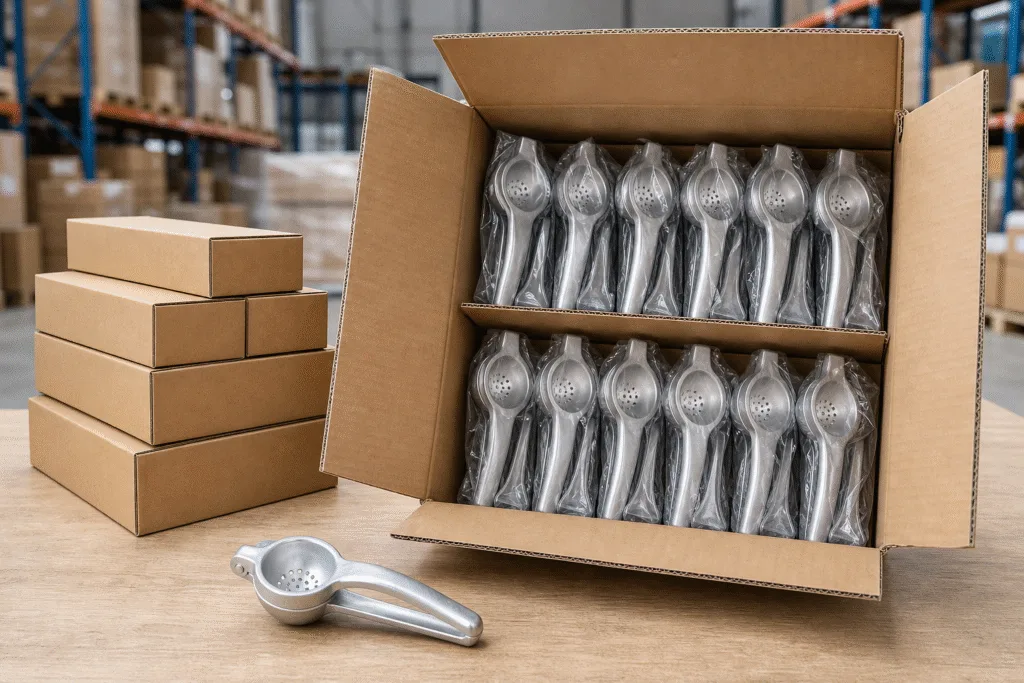
Packaging Damage
Even a well-made product can arrive damaged if individual and master-carton packaging are inadequate.
For wholesale buyers, quality inspection should therefore cover the entire product rather than focusing only on appearance.
How LeeYuen Supports Bulk and Custom Orders
LeeYuen Kitchenware provides aluminum and zinc alloy kitchen products for global B2B buyers, with OEM/ODM capabilities covering product development, mold development, manufacturing, finishing, assembly, and quality control. Its current product range includes several lemon squeezer designs, including 2-in-1 models, aluminum models, ergonomic designs, bird-shape designs, and stainless steel options.
For buyers developing a private label line, the sourcing process can start with an existing product and then move toward customization based on the required material, design, branding, finishing, and packaging.
This approach can reduce unnecessary development work while still allowing brands to create a product suited to their target market.
A Practical Checklist for Wholesale Buyers
Before confirming a bulk lemon squeezer order, review the following:
- Material confirmed
- Product dimensions confirmed
- Product weight confirmed
- Function tested
- Sample approved
- Surface finish approved
- Logo method confirmed
- Packaging confirmed
- MOQ confirmed
- Production lead time confirmed
- Quality inspection requirements confirmed
- Carton specifications confirmed
- Shipping requirements confirmed
A clear checklist reduces misunderstandings between the buyer and supplier and makes repeat purchasing easier.
FAQs About Lemon Squeezer Wholesale
What is the best material for a wholesale lemon squeezer?
The best material depends on the application. Aluminum alloy, stainless steel, zinc alloy, and food-grade plastic each have different characteristics in terms of weight, durability, design flexibility, appearance, and cost.
Can I customize a lemon squeezer with my own logo?
Yes. Many B2B suppliers offer logo customization for bulk orders. Available methods depend on the product material, surface, and branding requirements.
Can lemon squeezers be used in restaurants and bars?
Yes. Manual lemon squeezers are commonly suitable for beverage preparation and foodservice applications, provided the selected model is designed for the expected frequency and conditions of use.
Can I order samples before a wholesale order?
Sample evaluation is recommended before mass production. Buyers can use samples to verify dimensions, material, operation, finishing, and packaging requirements.
What information should I provide when requesting a quotation?
At minimum, provide the product model or drawing, material, estimated quantity, logo requirements, packaging requirements, destination market, and any specific quality or compliance requirements.
How can I compare two lemon squeezer suppliers?
Use the same product specification when requesting quotations. Compare not only unit price, but also sample quality, material, production capability, MOQ, customization, packaging, lead time, and quality control.
Final Thoughts
Wholesale lemon squeezer sourcing is ultimately a product specification and supply-chain decision rather than a simple price comparison.
For distributors and retailers, the right product needs to balance functionality, durability, appearance, packaging, and target cost. For private label brands, the supplier’s ability to support customization and consistent mass production becomes equally important.
Starting with a clear product specification, testing samples, checking production capability, and confirming quality requirements before mass production can help buyers build a more reliable sourcing process.
For brands looking for aluminum lemon squeezers, custom designs, or OEM/ODM production, working directly with an experienced manufacturer can also simplify the transition from product concept to bulk order.