Finding a reliable kitchenware supplier is an important step for wholesalers, importers, distributors, retailers, and private label brands operating in the global kitchenware market.
The right supplier can help a business maintain consistent product quality, competitive costs, reliable delivery schedules, and stable inventory. The wrong supplier, however, can create problems such as inconsistent quality, production delays, unclear communication, and unexpected additional costs.
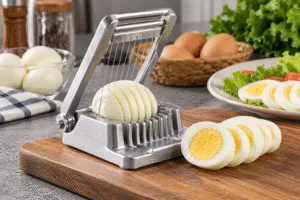
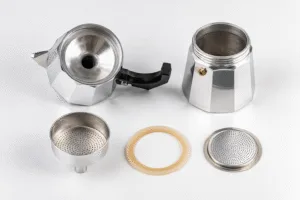
For buyers sourcing products such as garlic presses, lemon squeezers, walnut crackers, ice cream scoops, meat tenderizers, pizza cutters, moka pots, and other kitchen tools, supplier selection should go beyond comparing product prices.
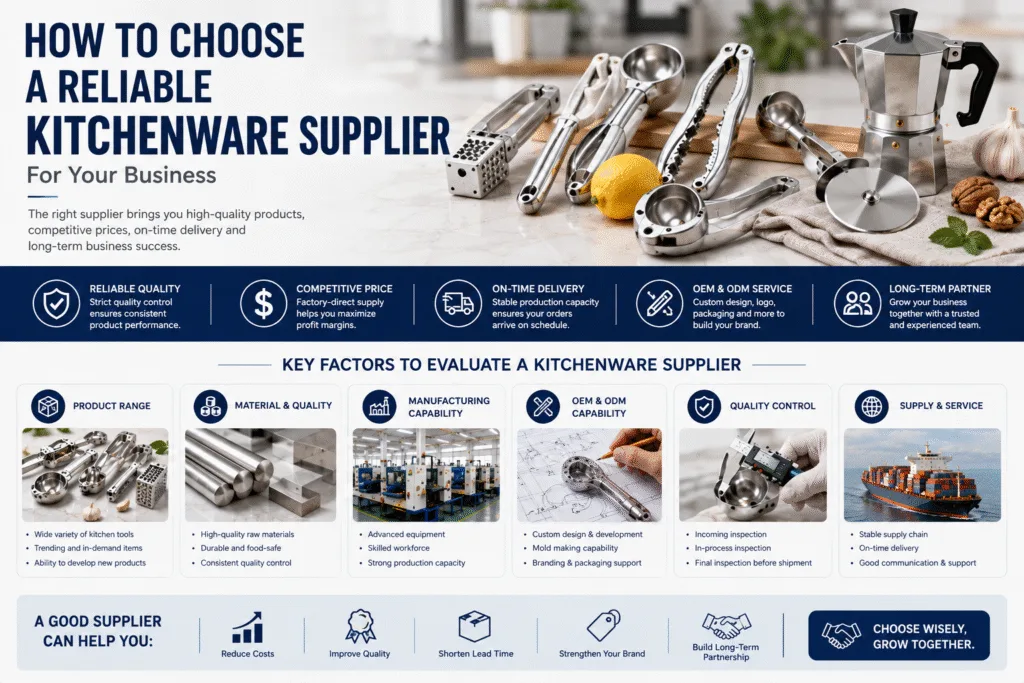
A professional kitchenware supplier should be evaluated according to its product capabilities, manufacturing resources, quality control, customization services, production capacity, packaging capabilities, and ability to support long-term orders.
This guide explains how B2B buyers can find and evaluate a reliable kitchenware supplier for wholesale, retail, OEM, ODM, and private label projects.
What Is a Kitchenware Supplier?
A kitchenware supplier is a company that provides kitchen tools, utensils, cookware, accessories, or related products to businesses.
A supplier may be:
- A direct manufacturer
- A kitchenware factory
- An OEM supplier
- An ODM supplier
- A trading company
- A distributor
- A wholesale supplier
These business models can have different advantages.
For example, a direct manufacturer may provide stronger control over production and customization, while a trading company may offer access to a broader range of products.
Therefore, buyers should not judge a supplier only by its business title. Instead, they should evaluate whether the supplier can meet their specific product, quality, quantity, customization, and delivery requirements.
Why Choosing the Right Kitchenware Supplier Matters
The supplier you choose can directly influence your business operations.
Product Quality
Consistent quality is essential for maintaining customer satisfaction and protecting your brand reputation.
A reliable supplier should have clear procedures for controlling product dimensions, materials, surface quality, assembly, and functionality.
Pricing
Competitive pricing is important for wholesalers and retailers, but the lowest quotation does not always represent the lowest total cost.
Defective products, delayed shipments, packaging problems, and inconsistent production can increase the real cost of sourcing.
Delivery
A supplier should have sufficient production capacity to meet agreed delivery schedules.
Late deliveries can result in:
- Stock shortages
- Missed sales opportunities
- Delayed product launches
- Retail supply problems
Product Development
For customized kitchenware, suppliers with engineering and OEM/ODM capabilities can help buyers develop products more efficiently.
Long-Term Supply
A good supplier should be able to support repeat orders and potentially increase production as the buyer’s business grows.
Kitchenware Supplier vs Kitchenware Manufacturer
The terms supplier and manufacturer are sometimes used interchangeably, but they are not always the same.
A kitchenware manufacturer directly produces products or manages production through its own manufacturing facilities.
A kitchenware supplier may provide products directly from its own factory or source products from other manufacturers.
| Factor | Manufacturer | Supplier |
|---|---|---|
| Direct production | Usually | May or may not |
| Manufacturing control | Usually high | Depends on business model |
| Product range | Often specialized | Can be broader |
| Customization | Often strong | Depends on capabilities |
| OEM services | Common among manufacturers | Depends on supplier |
| ODM services | Available from some manufacturers | Depends on supplier |
| Engineering support | Usually available | Varies |
Neither model is automatically better.
The important consideration is whether the supplier can consistently provide the products and services your business requires.
What to Look for in a Kitchenware Supplier
Before selecting a supplier, buyers should evaluate several key areas.
1. Product Range
First, determine whether the supplier has experience with the products you need.
For example, if your business sells aluminum kitchen tools, look for a supplier with experience in products such as:
- Garlic presses
- Lemon squeezers
- Nutcrackers
- Ice cream scoops
- Meat tenderizers
- Pizza cutters
- Other aluminum kitchen tools
A supplier with relevant product experience is more likely to understand the manufacturing and quality requirements involved.
2. Material Capabilities
Different kitchenware products require different materials.
Common materials include:
- Aluminum alloy
- Stainless steel
- Zinc alloy
- Carbon steel
- Plastic
- Silicone
- Wood
Buyers should confirm what materials the supplier can work with and whether the materials are appropriate for the intended application.
For aluminum kitchen tools, buyers should also ask about the alloy specifications and manufacturing process.
3. Manufacturing Capabilities
If the supplier is also a direct manufacturer, evaluate its production capabilities.
Relevant technologies may include:
- Aluminum die casting
- CNC machining
- Metal stamping
- Injection molding
- Polishing
- Surface finishing
- Assembly
An integrated supplier with multiple capabilities can simplify communication and production management.
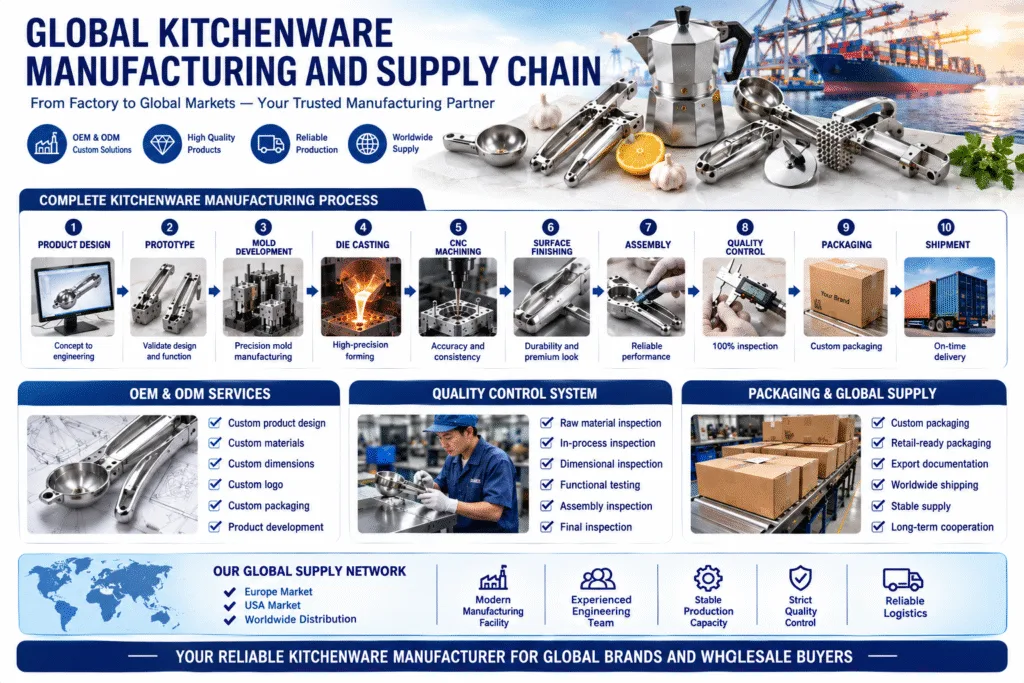
For example, an aluminum kitchen tool may go through:
Mold Development → Die Casting → CNC Machining → Polishing → Assembly → Quality Control → Packaging
Having these processes coordinated within one manufacturing organization can reduce unnecessary communication between multiple suppliers.
4. OEM and ODM Services
Customization is becoming increasingly important for kitchenware brands.
A professional kitchenware supplier may offer OEM or ODM services such as:
- Custom product designs
- Custom dimensions
- Custom materials
- Custom finishes
- Custom logos
- Custom colors
- Custom packaging
OEM is generally suitable when the buyer already has a product design or specification.
ODM can be useful when the buyer wants the supplier to participate more actively in product development.
5. MOQ
Minimum order quantity, or MOQ, is an important consideration for B2B buyers.
MOQ may depend on:
- Product type
- Material
- Mold requirements
- Production process
- Packaging
- Order volume
A supplier with an extremely high MOQ may not be suitable for a small or growing brand.
On the other hand, very low MOQ requirements may come with higher unit costs.
Buyers should compare MOQ and unit pricing together rather than considering either factor independently.
6. Production Capacity
Production capacity becomes particularly important when a product starts selling successfully.
A supplier may be able to handle a small trial order but struggle to support a larger order later.
Ask potential suppliers about:
- Monthly production capacity
- Equipment
- Number of production lines
- Workforce
- Production lead time
- Peak-season capacity
The supplier should have sufficient capacity to support both current and potential future orders.
7. Quality Control
Quality control should be evaluated before placing a large order.
A professional supplier may implement inspection procedures at multiple stages.
Incoming Material Inspection
Materials are checked before entering production.
Production Inspection
Products are inspected during manufacturing.
Functional Testing
Finished products are tested according to their intended use.
Assembly Inspection
Components are checked after assembly.
Final Inspection
Finished products are inspected before packaging and shipment.
Buyers should ask for details about these procedures instead of relying solely on general claims about “strict quality control.”
8. Product Samples
Samples are one of the most useful tools for evaluating a kitchenware supplier.
Before placing a large order, buyers should examine:
- Product dimensions
- Weight
- Material
- Surface finish
- Function
- Assembly
- Packaging
For customized products, the sample should be compared against the approved drawings or specifications.
A sample approval process can help establish a clear quality reference for mass production.
9. Packaging Capabilities
Packaging is often overlooked during supplier selection.
However, poor packaging can result in:
- Scratches
- Dents
- Broken components
- Incorrect labels
- Transportation damage
A professional kitchenware supplier should be able to discuss:
- Individual packaging
- Retail packaging
- Carton packaging
- Protective materials
- Labels
- Carton quantities
- Custom packaging
For private label brands, custom packaging can also help create a consistent brand identity.
Kitchenware Supplier for Wholesale Buyers
Wholesale buyers typically prioritize:
- Competitive prices
- Stable quality
- MOQ
- Production capacity
- Reliable lead times
- Packaging
- Repeat-order capability
A suitable wholesale kitchenware supplier should be able to provide consistent products across multiple orders.
This is particularly important for distributors and importers that need regular inventory replenishment.
Kitchenware Supplier for Private Label Brands
Private label businesses have additional requirements.
A private label kitchenware supplier may need to support:
- Custom logos
- Custom packaging
- Custom colors
- Product modifications
- Product development
- Retail-ready packaging
For private label brands, supplier consistency is particularly important because the final product is sold under the buyer’s brand.
How to Evaluate a Kitchenware Supplier
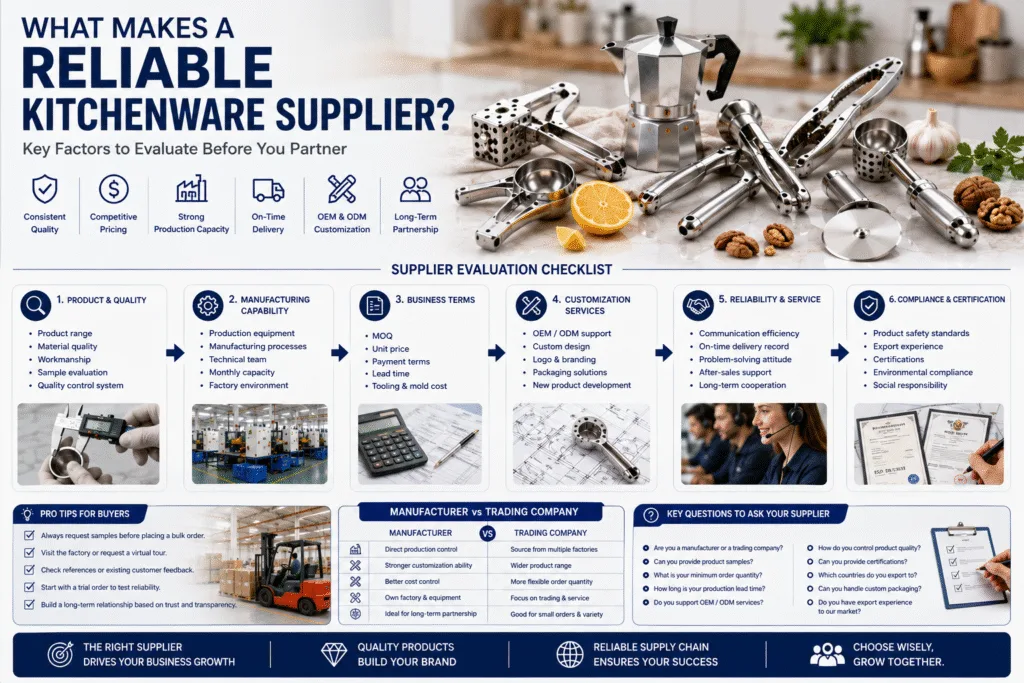
A structured evaluation system can make supplier selection easier.
Consider scoring suppliers based on:
| Evaluation Factor | Importance |
|---|---|
| Product quality | Very High |
| Manufacturing capability | Very High |
| Price | High |
| MOQ | High |
| Production capacity | High |
| OEM/ODM capability | High |
| Quality control | Very High |
| Lead time | High |
| Packaging | Medium |
| Communication | High |
| Export experience | Medium |
This approach helps buyers avoid selecting suppliers based only on price.
How to Verify a Kitchenware Supplier
Before placing a large order, buyers should verify the supplier as much as possible.
Check the Product Samples
Evaluate the actual products rather than relying only on product photographs.
Review Factory Capabilities
If the supplier claims to be a manufacturer, ask about:
- Factory location
- Production equipment
- Manufacturing processes
- Quality control
- Production capacity
Request Product Specifications
Make sure the supplier can provide clear information about:
- Materials
- Dimensions
- Weight
- Finishing
- Packaging
Ask About Previous Export Markets
Experience with international customers can indicate that the supplier understands export-oriented requirements.
Conduct a Factory Audit When Appropriate
For large or long-term projects, a factory visit or third-party audit can provide additional confidence.
Common Mistakes When Choosing a Kitchenware Supplier
Choosing Only the Cheapest Supplier
The lowest price may come with compromises in quality, service, production capacity, or delivery reliability.
Not Checking Samples
Product photos cannot replace physical samples.
Ignoring MOQ
A supplier may offer attractive pricing but require order quantities that are too high for your business.
Not Checking Production Capacity
A supplier that cannot scale with your business may create supply problems later.
Failing to Define Specifications
Unclear specifications can lead to disagreements about product quality.
Ignoring Packaging
Products can be damaged during international transportation if packaging is not properly designed.
Focusing Only on the First Order
A long-term supplier should be capable of supporting repeat production.
How to Build a Long-Term Relationship With a Kitchenware Supplier
A successful supplier relationship requires cooperation from both sides.
Buyers should provide:
- Clear product specifications
- Approved samples
- Packaging requirements
- Forecasts where possible
- Realistic delivery expectations
Suppliers should provide:
- Clear quotations
- Production schedules
- Quality information
- Technical feedback
- Timely communication
Regular communication can help both sides identify problems before they become major issues.
Why Integrated Kitchenware Suppliers Can Add Value
An integrated kitchenware supplier can coordinate several stages of production.
For aluminum kitchen tools, the process may include:
Product Development → Mold Manufacturing → Aluminum Die Casting → CNC Machining → Polishing → Assembly → QC → Packaging
This type of production structure can provide several advantages.
Better Communication
Engineering and production teams can communicate directly.
Better Process Control
Manufacturing processes can be coordinated more closely.
Faster Problem Solving
Production issues can be reviewed by the relevant technical teams.
Better Customization
Custom products can be developed with fewer external manufacturing links.
For B2B buyers developing customized kitchen tools, these advantages can be important when building a long-term supply chain.
How to Compare Multiple Kitchenware Suppliers
Instead of choosing the first supplier that responds, buyers can compare several potential suppliers.
Create a supplier comparison sheet covering:
- Product quality
- Sample quality
- Unit price
- MOQ
- Tooling cost
- Production capacity
- Lead time
- OEM/ODM capabilities
- Packaging
- Communication
- Quality control
- Export experience
The final decision should consider the overall value rather than the lowest quotation.
A supplier offering slightly higher prices may provide better long-term value if it delivers consistent quality and reliable service.
The Importance of Communication
Communication is particularly important for international kitchenware sourcing.
A supplier should be able to communicate clearly about:
- Product specifications
- Manufacturing issues
- Production schedules
- Packaging
- Quality problems
- Shipping schedules
Good communication can prevent small misunderstandings from becoming expensive production problems.
For customized products, technical communication is even more important because drawings, samples, dimensions, materials, and finishing requirements need to be clearly understood.