Ice cream scoops look like a simple commodity, but sourcing them at commercial scale is anything but. Material choice, casting quality, the trigger mechanism, and the manufacturer’s mold capability all determine whether a scoop holds up to years of daily use in a busy parlor — or bends, scratches, and gets returned.
This guide walks B2B buyers, importers, distributors, and private-label brands through everything you need to know about sourcing and producing ice cream scoops: product types, materials, the aluminum die-casting production process, what to check when you buy, how to compare manufacturers against suppliers, cost drivers, OEM options, and the quality problems that separate a professional factory from a reseller.
Why Ice Cream Scoops Are an Important B2B Kitchen Tool
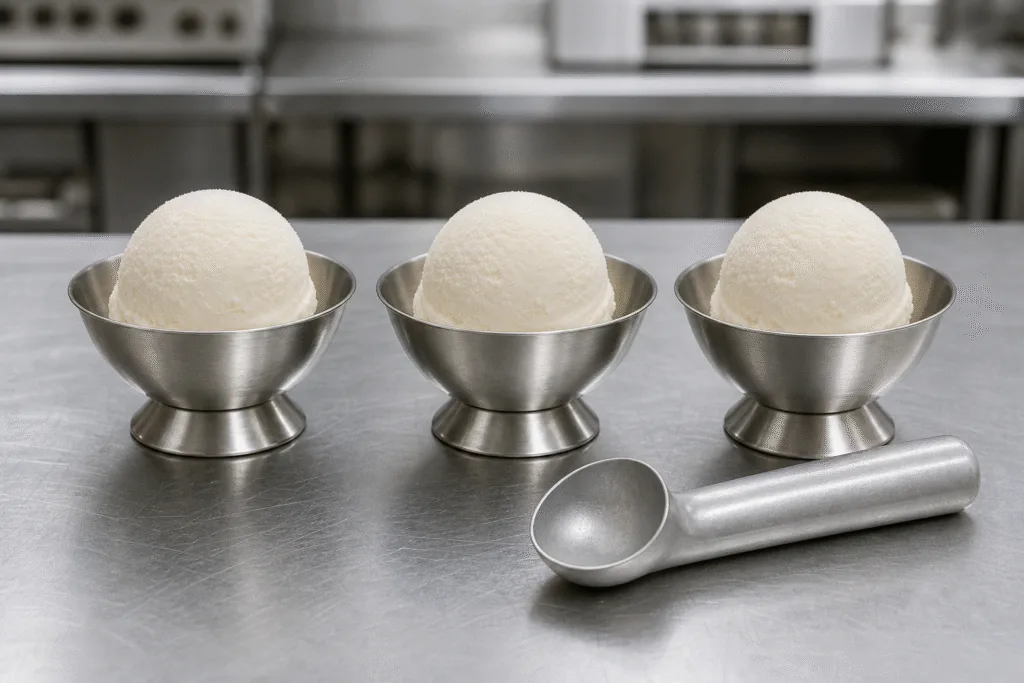
An ice cream scoop is a small tool, but it sits at the center of a large and recurring commercial market.
In food service, the scoop is a portion-control and cost-control instrument. Ice cream parlors, gelaterias, dessert bars, and soft-serve counters sell by the scoop. A consistent scoop size means consistent food cost, consistent pricing, and predictable margins. A scoop that delivers uneven or oversized portions quietly leaks profit every single day.
In commercial kitchens and hospitality, durability and hygiene matter. Hotel buffets, cruise lines, cafés, and catering operations need scoops that withstand continuous use in sub-zero freezers, survive industrial dishwashers, and meet food-contact safety standards. Here the trigger-release mechanism and the material quality are what separate a professional tool from a household gadget.
In wholesale and retail, it is a fast-moving, repeat SKU. Restaurant supply chains, kitchenware importers, and e-commerce gadget retailers stock ice cream scoops because they sell quickly and need replenishing. For a distributor, the scoop is a volume product with reliable turnover; for a brand, it is an ideal candidate for OEM and private-label programs.
For an ice cream scoop manufacturer, the commercial opportunity is clear: a high-demand product that rewards precise casting, consistent quality, and flexible OEM support. That is why the scoops we produce at LeeYuen Kitchenware are engineered for commercial environments, not just home kitchens.
What Types of Ice Cream Scoops Can Manufacturers Produce?
The term “ice cream scoop” covers several distinct product families. A qualified manufacturer should be able to produce all of them, because each serves a different use case and price point.
Traditional Ice Cream Scoops
Traditional scoops are the simplest design: a solid, rounded bowl attached to a handle, with no moving release mechanism. The user scoops, then either shakes the scoop or uses a small mechanical lever to free the ball. They are inexpensive to produce, easy to clean, and still common in home kitchens and low-volume service settings. In a B2B context, they are the entry-level, budget SKU.
Trigger Ice Cream Scoops
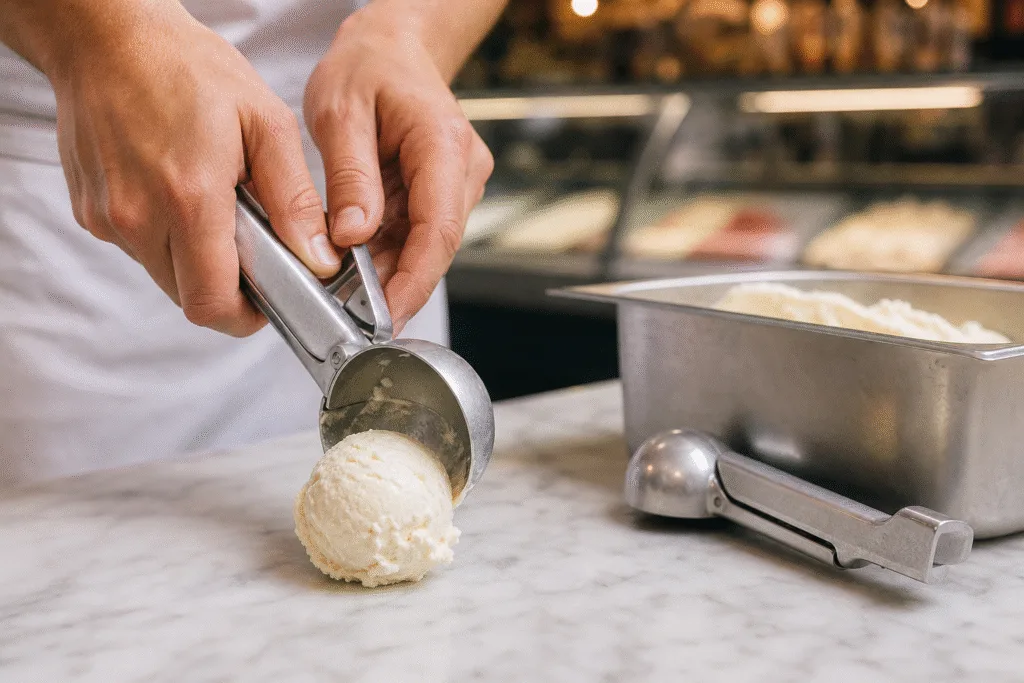
Trigger (or “squeeze”) scoops add a thumb-operated lever connected to a curved sweep blade inside the bowl. Squeezing the trigger drags the blade along the inner surface and cleanly releases the ball in one motion. This is the workhorse of commercial service — no shaking, no sticking, and much faster scooping at high volume. The trigger arm and sweep blade add moving parts, so precision casting and proper fit are critical to a smooth, wobble-free action.
Commercial Ice Cream Scoops
Commercial scoops are the heavy-duty tier: thicker walls, reinforced handles, and often a heat-conductive defrosting fluid sealed inside the handle. That fluid draws warmth from the operator’s hand down to the bowl, making it easier to cut through hard-frozen product. Portion control is built into the sizing (typically marked in the U.S. portion-scoop numbering system, where the number indicates scoops per quart). These are designed for continuous, all-day use.
Aluminum Ice Cream Scoops
Aluminum scoops are the classic: a die-cast aluminum bowl (often with a matching cast handle) that is lightweight, fast to warm against frozen product, and inexpensive to cast at scale. Historically the standard in ice cream parlors, aluminum scoops remain popular in food service and as a cost-effective wholesale SKU. Because aluminum is die-cast, it is also one of the most flexible types to customize — a natural fit for a factory whose core process is aluminum die casting, which we cover in more detail below.
What Materials Are Used to Make Ice Cream Scoops?
Material choice drives weight, feel, durability, surface finish, manufacturing method, and cost. Most scoops use one of three metals.
Aluminum Alloy
Aluminum is produced by die casting — molten alloy is injected into a steel mold under high pressure. This makes it the cheapest metal to produce at volume and the easiest to form into complex, one-piece shapes. Aluminum scoops are lightweight, conduct heat well (warming quickly against frozen dessert), and take anodizing or coating well. The trade-off is that raw aluminum is softer than steel, so the best aluminum scoops are made from a proper die-casting alloy (such as ADC12/A380 class alloys) with a good surface finish, not pure aluminum.
Stainless Steel
Stainless steel (typically 304 food-grade, sometimes 430 or 201) is the premium choice. It is stronger, harder, and more corrosion-resistant than aluminum, and it is the safest material for direct food contact and repeated dishwasher exposure. Stainless scoops are usually produced by casting the bowl (investment or sand casting) or by deep-drawing/stamping sheet, then welding or riveting a handle. They cost more than aluminum and are heavier, but they look and feel higher-end.
Zinc Alloy and Other Materials
Zinc alloy (Zamak/ZAMAK class) is frequently used for handles and trigger mechanisms rather than the bowl itself. It die-casts with excellent detail and takes plating (chrome, gold-tone, nickel) beautifully, which is why many premium-looking scoops pair a stainless or aluminum bowl with a zinc alloy trigger handle. Other materials appear in components: ABS or other plastics for grips and thumb rests, food-grade silicone for seals, and heat-conductive gel for defrosting-fluid handles.
Material Comparison
| Factor | Aluminum Alloy | Stainless Steel | Zinc Alloy (Handle) |
|---|---|---|---|
| Weight | Lightest | Heavier | Mid |
| Strength | Moderate | High | Moderate-high |
| Durability | Good (with alloy + finish) | Excellent | Good |
| Surface finish | Anodized / coated / polished | Mirror polish, brushed | Plated (chrome, gold, nickel) |
| Manufacturing process | Die casting | Casting or stamping + weld | Die casting |
| Cost | Lowest at volume | Higher | Mid (plating adds cost) |
For high-volume, cost-sensitive food-service lines, aluminum is the workhorse. For premium retail and visible-service use, stainless steel is the upgrade. Zinc alloy earns its place in the trigger and handle, where fine detail and plating appearance matter most.
How Are Aluminum Ice Cream Scoops Manufactured?
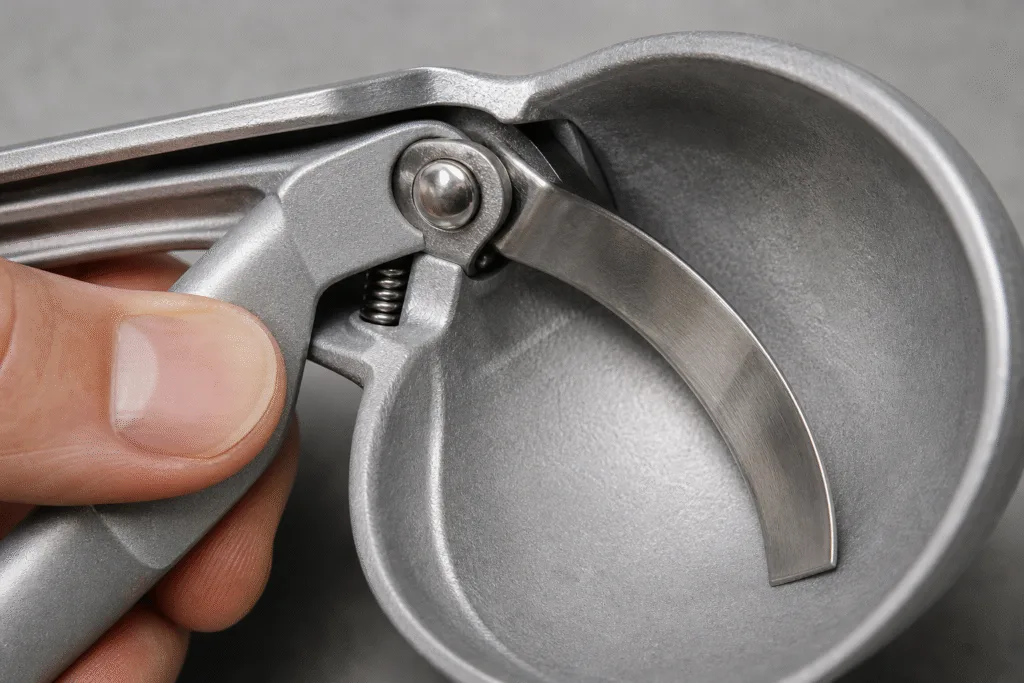
This is the most important section of this guide, because aluminum die casting is where a real ice cream scoop manufacturer distinguishes itself from a trading company. If you are buying aluminum scoops, the following eight stages determine the product you actually receive.
(For a deeper technical walkthrough of the casting process itself, see our guide to die cast aluminum kitchenware. Below we focus on how that process applies specifically to scoops.)
Product Design
Everything starts with the design file: the bowl geometry, scoop size, handle contour, trigger pivot points, and wall thickness. The design must be casting-friendly — uniform wall thickness, proper draft angles for mold release, and no undercuts that trap the casting. A good factory reviews the design for manufacturability before cutting any steel, which prevents costly mold revisions later.
Mold Development
A dedicated steel mold (die) is designed and machined for each scoop. Mold cost is the single largest upfront investment in a custom scoop, and mold quality directly controls the final product’s surface finish, dimensional consistency, and mold life. A well-built die can produce hundreds of thousands of shots; a poorly built one produces flash and variation from the very first batch.
Aluminum Alloy Die Casting
Molten aluminum alloy is injected into the mold under high pressure and rapidly cooled. This produces a near-net-shape part — the bowl and handle formed in one shot with fine detail and thin walls. The casting parameters (alloy composition, temperature, injection pressure, cycle time) are tightly controlled to avoid porosity, cold shuts, and other casting defects.
Trimming and Deburring
When the part comes out of the die, it still carries the runner system and parting-line flash. The sprue and overflow are trimmed away, and the flash, sharp edges, and burrs are removed. This stage is where cheap, rushed production is most visible — leftover flash and burrs are a tell-tale sign of a low-quality scoop.
Machining
Critical features are finished by CNC machining: the trigger pivot holes, the sweep-blade slot, threaded areas, and any mating surfaces. Machining ensures the trigger mechanism fits precisely and pivots smoothly. Poor machining here is what causes a wobbly or stiff trigger.
Surface Finishing
The cast part is polished, and then finished by anodizing, coating, plating, or painting — depending on the design. Finishing serves three purposes: appearance, corrosion resistance, and a smoother, food-safe surface. This is also the stage where the brand’s color or premium finish (for example a gold-tone trigger handle) is applied.
Assembly
The sweep blade, spring, rivets, screws, and handle components are assembled and the trigger action is tested. Assembly must be consistent: the difference between a “great” scoop and a “returned” scoop is often a half-millimeter of fit in the trigger mechanism.
Quality Inspection
Every batch is inspected against the agreed specification — dimensional checks, function tests, surface-quality inspection, and food-contact safety verification. A professional factory pairs in-line inspection during production with a final outgoing inspection before packing. This is the stage that turns a specification document into a guarantee.
What Should B2B Buyers Check When Sourcing Ice Cream Scoops?
When you evaluate samples from an ice cream scoop factory, work through this checklist before placing an order.
| Check | What to Look For |
|---|---|
| Scoop size | Correct portion size (e.g. portion-scoop numbering), matching your spec |
| Capacity | Consistent ball volume scoop to scoop |
| Weight | Feels substantial, not hollow or flimsy |
| Handle design | Ergonomic, comfortable, secure grip; no sharp edges |
| Material | Matches the declared alloy/grade (aluminum alloy vs. stainless vs. zinc) |
| Surface finish | Smooth, even, no scratches, pits, or plating inconsistencies |
| Dimensional consistency | Same measurements across samples and across batches |
| Mechanical strength | Bowl doesn’t bend; trigger pivot doesn’t loosen under load |
| Function | Trigger releases cleanly, sweep blade travels fully, no sticking |
| Packaging | Protects the product in transit; supports retail display if required |
Two points deserve emphasis. First, request samples from the actual production mold, not a hand-made prototype — a prototype tells you about the design, but only a production sample tells you about the factory’s real capability. Second, check consistency across multiple samples, because one good sample is easy; consistent quality across a full batch is what you are actually paying for.
Ice Cream Scoop Manufacturer vs Supplier: Which Should You Choose?
In the export market, the word “supplier” is used loosely, but there are three distinct kinds of companies — and they are not interchangeable.
| Factor | Manufacturer | Supplier (with factory) | Trading Company |
|---|---|---|---|
| Owns production | Yes | Partially / via partner | No |
| Mold development | In-house | Sometimes | Outsourced |
| Customization (OEM) | Full control | Limited | Brokered |
| Price | Factory-direct | Marked up | Highest |
| Quality control | Direct | Indirect | Low visibility |
| Lead-time control | Direct | Indirect | Least control |
| Best for | Large volume, custom, long-term | Small mixed orders | One-off, low-complexity |
For customization, large volume, and long-term sourcing, a direct manufacturer is the clear choice. When you buy from the factory that owns the mold and the production line, you control the material, the finish, and the quality standard — and you remove two layers of markup. Trading companies can be useful for small, mixed, low-complexity orders, but they add cost and reduce your visibility into how the product is actually made.
A direct ice cream scoop manufacturer should be able to show you the production floor, the mold workshop, and the inspection process — not just a catalog of product photos.
How to Choose an Ice Cream Scoop Manufacturer
Choosing the right factory is more important than choosing the right product, because the factory determines what actually arrives in your warehouse. Evaluate a prospective manufacturer against these seven criteria.
Check Manufacturing Capability
Does the factory actually produce the product type you need — die-cast aluminum, stainless, or both? What is its monthly capacity, and can it scale to your order size without subcontracting? Ask about the facility’s certifications (such as ISO9001) and any third-party audit history, which signal a mature quality management system.
Check Mold Development
Mold development is the single biggest predictor of product quality. Ask whether molds are made in-house, what mold steel is used, and what the expected mold life is. A factory with its own mold workshop can iterate faster on your custom design and control fit and finish from the start.
Check Material Control
Confirm the exact alloy or steel grade used and whether material is sourced from certified mills. Ask for material certificates if your market requires food-contact or safety documentation. Material substitution (for example, swapping 304 for a cheaper 201 grade, or pure aluminum for a proper die-casting alloy) is one of the most common ways to cut cost at the expense of quality.
Check Production Equipment
The equipment tells you what the factory can do: die-casting machines of adequate clamping force, CNC machining centers, polishing and plating lines. Modern, well-maintained equipment usually correlates with consistent dimensional control and surface finish.
Check Quality Control
Ask about the QC process end to end: incoming material inspection, in-process checks, function testing, and final outgoing inspection. A documented process with measurable pass criteria is far more reliable than a verbal promise. Also ask about defect-rate targets and how rejects are handled.
Check OEM Capability
If you need a private-label or custom product, verify the factory’s OEM track record: can it handle your logo, color, finish, packaging, and design changes in-house? (For the full picture of what goes into custom tool production, see our custom kitchen tools guide.)
Check Packaging and Export Support
Confirm the factory can pack to your spec — individual boxes, hang tags, barcodes, export cartons — and can handle the export documentation, palletization, and shipping coordination you need. A manufacturer that regularly exports to your target market will already understand its labeling and compliance requirements.
How Much Does an Ice Cream Scoop Cost?
There is no honest way to give a fixed price for an ice cream scoop, because the cost depends on a long list of variables. Any supplier quoting a single number without knowing your specification is guessing. Instead, understand the cost drivers:
- Material — Aluminum alloy is the least expensive metal; stainless steel costs more; zinc alloy handles with plating sit in between. Material cost is usually the largest single factor.
- Product weight — Heavier scoops use more metal. Two scoops that look identical can differ materially in cost if one has thicker walls.
- Mold — A custom mold is a one-time tooling cost, amortized over your order quantity. Larger orders spread the mold cost thinner per unit.
- Production quantity — Unit cost falls significantly as order volume rises, because mold amortization, setup, and material purchasing all improve with scale.
- Machining — More machined features (precision trigger pivots, threaded inserts) mean more machine time and higher cost.
- Finishing — A basic polish is cheap; mirror polishing, anodizing, multi-layer plating, and premium color finishes add cost.
- Handle design — A simple one-piece cast handle is cheaper than a multi-component trigger assembly with spring and blade.
- Packaging — Bulk cartons are cheapest; color boxes, hang cards, and retail-ready packaging add cost.
- MOQ — Minimum order quantity directly affects pricing. A factory’s MOQ (commonly a few hundred to a few thousand pieces for this product type) reflects its setup and production economics.
The right way to get a real price is to send the factory your full specification — material, size, finish, packaging, target quantity — and ask for a detailed quotation. That is the only way to compare quotes apples-to-apples.
OEM and Custom Ice Cream Scoop Options
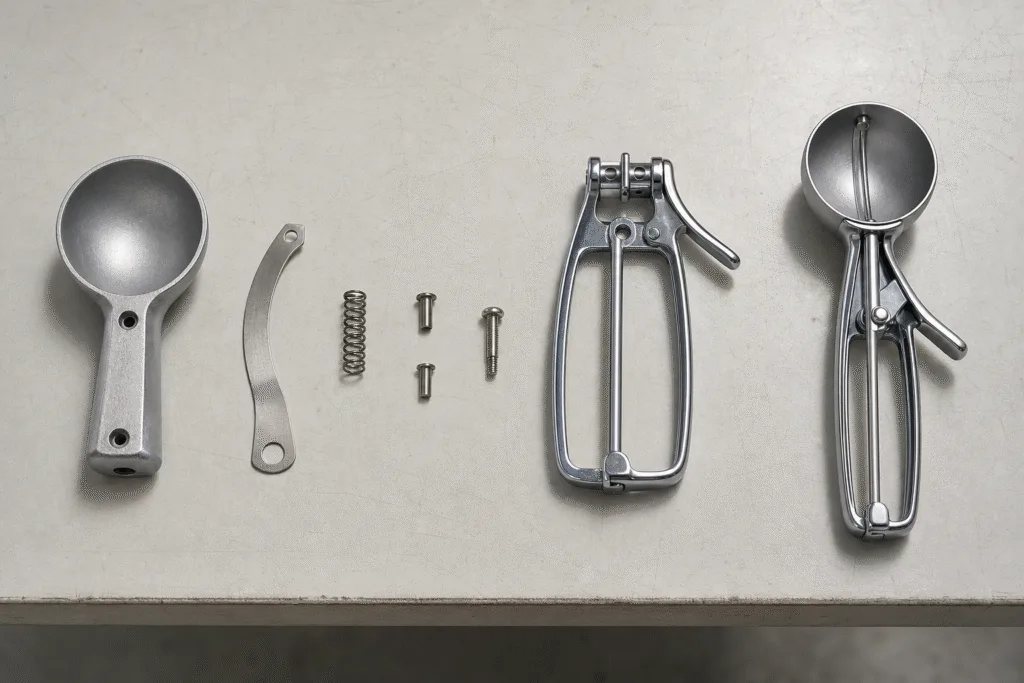
A direct ice cream scoop manufacturer can customize almost every element of the product. The most common OEM options are:
- Logo — Laser-engraved, embossed, or printed branding on the bowl, handle, or hang tag.
- Color — Anodized or coated finishes matched to your brand palette.
- Size — Custom scoop diameters and portion sizes beyond the standard range.
- Handle — Custom handle shapes, grip textures, and thumb-rest designs for ergonomics and brand identity.
- Surface finish — Polished, brushed, matte, anodized, plated, or color-coated.
- Packaging — Custom color boxes, blister cards, hang tags, barcodes, and multi-language labeling.
- Product design — Full ODM, where the factory designs and engineers a new scoop to your brief.
- Mold — Dedicated molds for your exclusive product, giving you a unique SKU nobody else can buy.
Customization is where the manufacturer-versus-trading-company distinction matters most: a factory can modify the mold, adjust the finish line, and control quality through every change, while a trading company must broker every request through a third party.
Common Quality Problems in Ice Cream Scoops
Knowing what goes wrong in production helps you ask the right questions and set the right acceptance criteria. The most common defects are:
- Casting defects — Porosity, cold shuts, and air pockets that weaken the part or show up as surface pitting.
- Flash — Excess material along the parting line that was not trimmed cleanly, leaving sharp edges.
- Burrs — Rough or sharp remnants at edges and holes, a sign of skipped deburring.
- Surface scratches — Damage from poor handling or finishing that ruins a premium appearance.
- Dimensional variation — Parts that are out of tolerance, causing fit problems and inconsistent portion sizes.
- Loose components — Trigger arms, rivets, or sweep blades that wobble or come apart under use.
- Uneven finishing — Inconsistent plating, anodizing, or coating between units in the same batch.
- Functional problems — A trigger that sticks, a sweep blade that doesn’t travel fully, or a bowl that bends under load.
A professional factory prevents most of these through process control and catches the rest at inspection. When you receive samples, test specifically for these failure modes before you commit to a production order.
FAQ
What is the best material for an ice cream scoop?
It depends on the use case. Aluminum alloy is the best value for high-volume, cost-sensitive commercial use and is the easiest to customize. Stainless steel is the best choice for premium retail and visible food service where strength, corrosion resistance, and appearance are priorities. Zinc alloy is ideal for trigger handles and detailed components.
Are aluminum ice cream scoops durable?
Yes — when made from a proper die-casting alloy with a good surface finish. A well-cast aluminum scoop lasts for years in normal service. The key is the alloy grade and the finish; pure aluminum or a rough finish will degrade faster.
How are aluminum ice cream scoops manufactured?
They are produced by high-pressure die casting: molten aluminum alloy is injected into a steel mold, then trimmed, machined, finished, assembled, and inspected. See the full process above.
What is the MOQ for ice cream scoops?
MOQ varies by factory, but for this product type it commonly ranges from a few hundred to a few thousand pieces, depending on the material, finish, and whether a custom mold is involved. Custom OEM projects with dedicated molds typically require higher quantities to justify the tooling.
Can an ice cream scoop manufacturer provide OEM?
Yes. A direct manufacturer can customize the logo, color, size, handle, finish, packaging, and even the full product design. This is precisely what separates a manufacturer from a trading company.