Sourcing a reliable nutcracker supplier for a wholesale nutcracker range aimed at kitchenware retailers involves more than comparing product photos and unit prices. For kitchenware wholesalers, importers, retailers, and private-label brands, the right supplier must offer suitable product designs, consistent quality, competitive pricing, and dependable production.
A nutcracker may be a relatively small kitchen tool, but its performance depends on several factors, including material selection, leverage, structural strength, handle design, and manufacturing precision. These details can affect customer satisfaction, product returns, and the long-term reputation of a kitchenware brand.
For wholesale buyers, the challenge is finding a supplier that can meet today’s order requirements while supporting future product development and repeat purchases.
This article explains how to evaluate nutcracker suppliers, compare manufacturing capabilities, assess samples, and make better sourcing decisions for wholesale and private-label projects.
Start With the Right Nutcracker Product Range
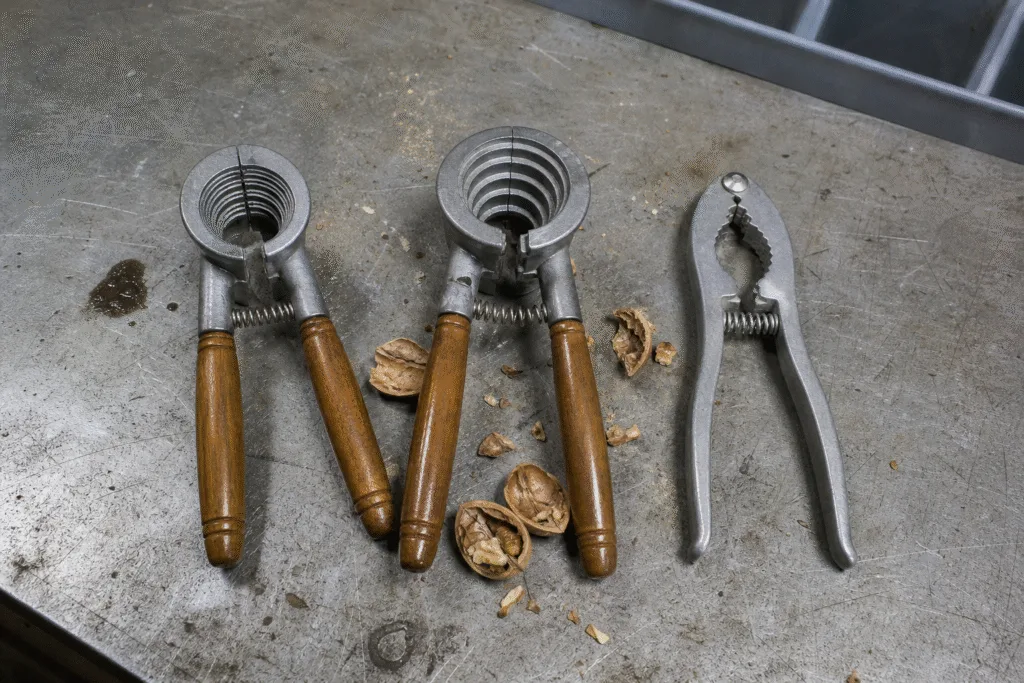
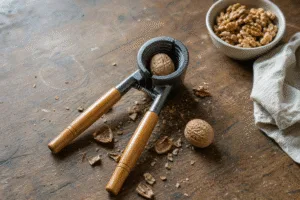
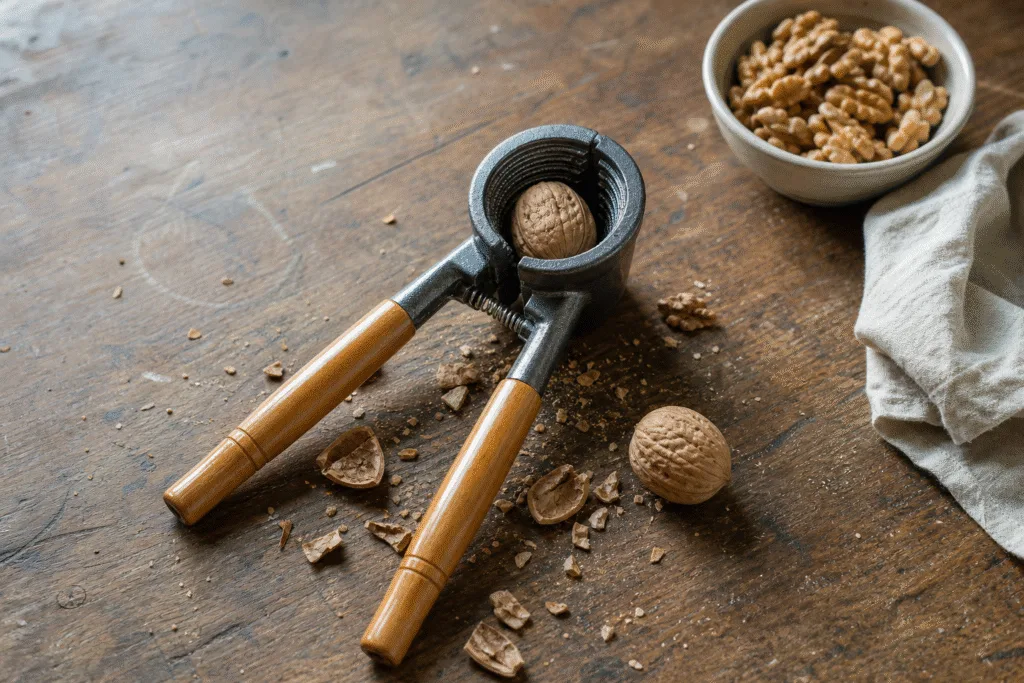
Before contacting suppliers, buyers should identify which types of nutcracker fit their target market — the classic round jaw model, the stepped multi-size version, or the spring plier — because a round jaw nutcracker wholesale programme is judged on opening diameter and jaw ribbing, not on finish.Different designs serve different customers, and selecting the right product range can help avoid unnecessary costs or unsuitable inventory.
Lever-Style Nutcrackers
Lever-style nutcrackers use mechanical leverage to apply pressure to a nut. Their performance depends on the relationship between the handle length, pivot position, contact surfaces, and overall structure.
Buyers should evaluate how comfortably the handles operate, whether the nut can be positioned securely, and whether the design accommodates the types of nuts intended for sale.
Pliers-Style Nutcrackers
Pliers-style designs use two handles connected by a pivot. They are commonly recognized by their compact construction and straightforward operating mechanism.
For wholesale buyers, important considerations include grip comfort, pivot stability, opening range, and the consistency of the cracking surfaces.
Multi-Size Nutcrackers
Some products incorporate different gripping positions or openings to accommodate nuts of different sizes.
These designs can offer greater versatility, but buyers should check whether each opening functions effectively and whether the product remains easy to control.
Aluminum Nutcrackers
Aluminum alloy can be used to produce nutcrackers with shaped handles and integrated structural features. Depending on the design, die casting may support repeatable production and relatively complex geometries.
However, not every aluminum nutcracker is suitable for every application. Buyers should evaluate the specific alloy, component dimensions, structural design, and intended workload rather than choosing a product based on material alone.
Evaluate Materials and Construction Before Comparing Prices
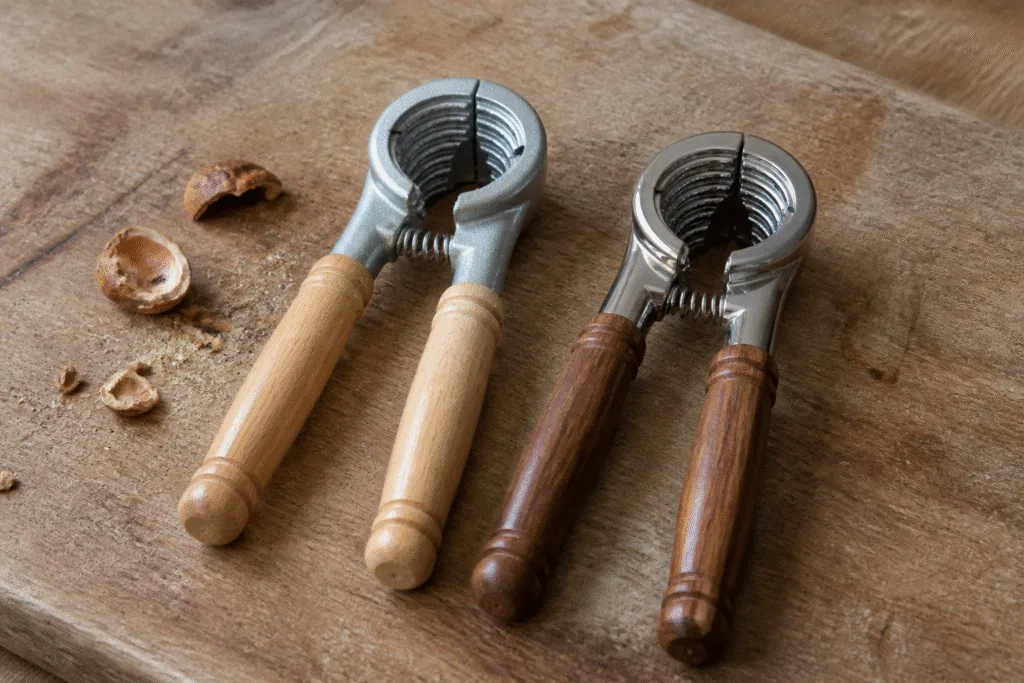
The material and construction of a nutcracker influence its weight, appearance, manufacturing process, and potential durability.
A reliable supplier should be able to explain what a product is made from and how its construction supports the intended use.
Aluminum Alloy
Aluminum alloy offers a relatively lightweight metal construction and can be suitable for products manufactured through die casting.
For wholesale buyers, the key questions concern alloy specifications, casting quality, wall thickness, finishing, and the design of load-bearing areas.
Ask an aluminum nutcracker manufacturer for the alloy designation, wall thickness and the design of load-bearing areas, and confirm the stainless steel nutcracker grade rather than accepting “stainless steel” as a description — a lower unit price is not attractive if the structural sections are weak.
Stainless Steel
Stainless steel may be suitable for designs where corrosion resistance and a particular metal finish are important selling points.
However, the grade, thickness, construction, and finishing method all affect the final product. Buyers should confirm the actual specification instead of relying on a general material description.
Other Metal and Mixed-Material Designs
Some nutcrackers use other metal alloys or combine metal components with different handle materials.
These products should be evaluated according to their intended application, connection strength, maintenance requirements, and relevant food-contact considerations.
When comparing options, buyers should request clear material specifications and confirm whether any coatings or surface treatments are used.
Check the Manufacturing Capabilities Behind the Product
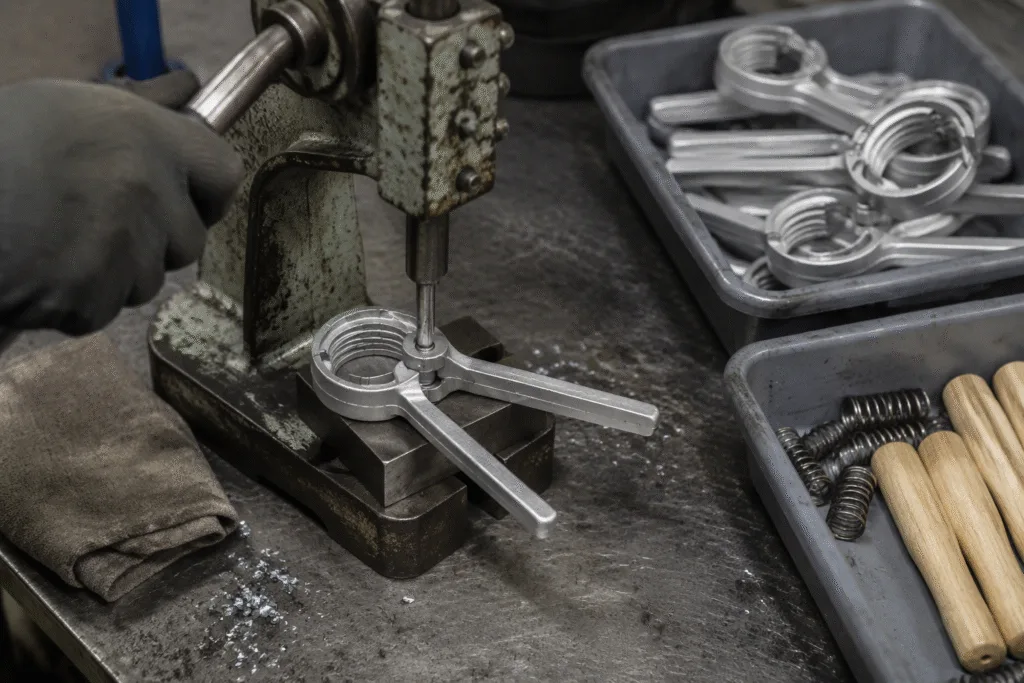
A supplier’s production capabilities matter when the order involves large quantities, customized designs, or repeat production.
A trading company may be able to coordinate an order through a manufacturing partner. A direct manufacturer may offer more direct communication about tooling, production processes, and technical adjustments. Neither arrangement guarantees quality on its own, so buyers should verify the capabilities relevant to their project.
Mold Development and Product Engineering
For die-cast aluminum nutcrackers, mold design affects product geometry, material flow, dimensional consistency, and production efficiency.
Ask whether the supplier develops molds in-house or outsources this work. If a new design is required, clarify who owns the tooling, how design changes are handled, and whether mold costs are quoted separately.
Casting and Post-Processing
Casting is only one part of metal product manufacturing.
Depending on the design, additional steps may include trimming, deburring, machining, polishing, surface treatment, and assembly.
Buyers should ask how the supplier controls defects at each stage and how components are checked before moving to the next operation.
Assembly and Final Inspection
The pivot, handles, contact surfaces, and other structural components should function as intended.
During nutcracker pivot assembly, the two cast arms and the spring are joined on a bench press — this is the step where die cast aluminum nutcracker production either holds its tolerance or does not, so ask how alignment, movement and connection stability are checked before the part moves on.The inspection process should be documented clearly enough for both parties to understand what constitutes an acceptable product.
Test Samples Before Committing to a Bulk Order
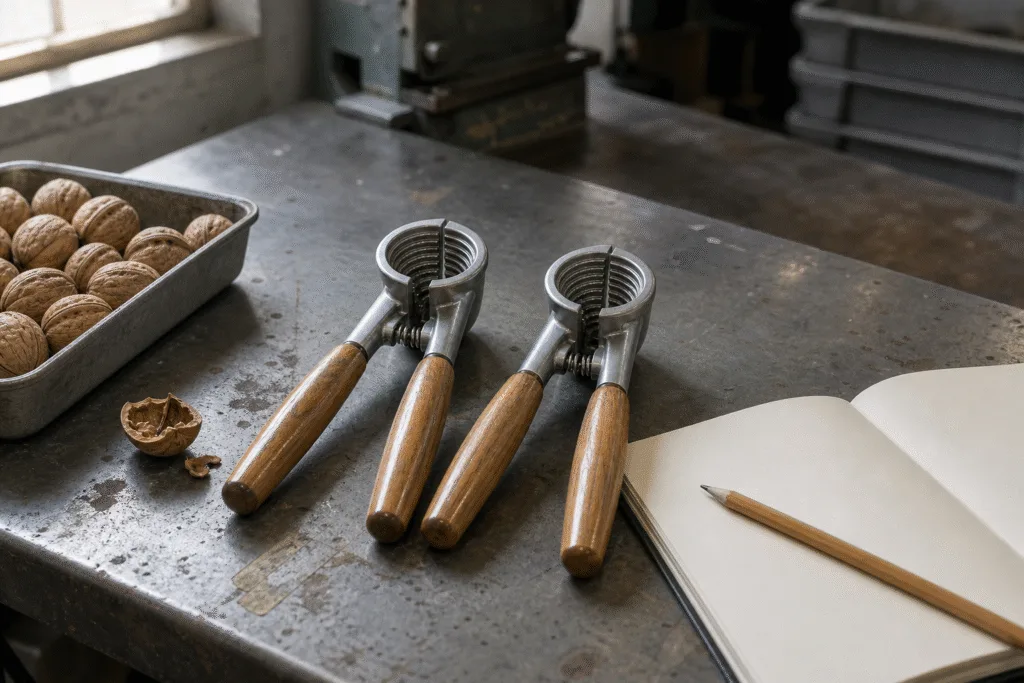
A product sample provides an opportunity to evaluate performance before investing in a larger order. Buyers should test samples against the intended use and the agreed product specifications.
A practical evaluation should cover the following areas.
Operating performance: Check whether the handles move smoothly and whether the product provides suitable leverage for the intended nut sizes.
Structural stability: Inspect the pivot, joints, and load-bearing sections. Check for excessive movement or signs of weakness during normal-use testing.
Grip and ergonomics: Evaluate whether the handles are comfortable to hold and provide adequate control.
Surface quality: Look for visible cracks, rough edges, scratches, uneven finishing, and excessive casting marks.
Dimensional consistency: Compare the sample with drawings, measurements, or approved specifications.
Cleaning and maintenance: Review whether the design is practical to clean and whether the supplier provides appropriate care instructions.
Packaging: Confirm that the product is protected during transport and that retail packaging matches the agreed requirements.
For a more objective nutcracker sample approval, document the sample’s key dimensions, material, weight, finish and functional requirements — that record is also what makes batch consistency provable on kitchen tools rather than a matter of opinion. Keep a record of the approved sample and use it as a reference for mass production.
A single successful sample does not prove that an entire production batch will be consistent. Buyers should also understand the supplier’s process for inspecting finished orders.
Understand Wholesale Pricing, MOQ, and Lead Time
The lowest quoted unit price does not always represent the lowest total sourcing cost.
When evaluating a nutcracker supplier, buyers should compare quotations using the same product specifications, order quantities, packaging requirements, and delivery terms.
Several factors can influence the final quotation.
- Material: Alloy type, material usage, and product weight affect costs.
- Product design: Complex shapes or multi-component structures may require additional processing.
- Tooling: New molds can involve upfront development costs.
- Surface finishing: Polishing, coating, or other treatments affect processing requirements.
- Order quantity: Larger orders may distribute certain fixed costs across more units.
- Packaging: Customized boxes, inserts, labels, and artwork can add costs.
- Quality requirements: Additional testing, inspection, or documentation may affect the quotation.
- Shipping and delivery terms: Freight, packaging dimensions, and agreed trade terms influence the total landed cost.
Minimum order quantities and lead times vary between suppliers and products. Standard catalog items may follow different requirements from newly developed designs.
Before placing an order, ask the supplier to confirm the minimum order quantity, sample lead time, production lead time, payment terms, packaging specifications, and process for approving changes.
For customized projects, request a breakdown of tooling, sampling, unit pricing, and other applicable charges.
Look for OEM and Private-Label Support
For kitchenware brands and distributors, private-label production can create opportunities to differentiate a product line from competing catalog offerings.
Depending on the supplier’s capabilities, customization may include:
- Product dimensions and design
- Handle shape and surface finish
- Product color or coating
- Brand logo
- Retail packaging
- Gift boxes and product inserts
- Customized product combinations
Not every change requires a new mold. Some requests may involve only packaging or branding, while changes to the product’s structure can require engineering work and new tooling.
Before starting an OEM project, provide a clear product brief covering the intended market, preferred materials, design references, target price, expected order quantity, and packaging requirements.
The supplier should then clarify technical feasibility, development costs, sample approval, production timing, and ownership of any custom tooling.
Buyers should also establish how changes will be approved after the initial sample. Uncontrolled changes to materials, dimensions, or finishing can create differences between the approved sample and the final order.
Verify the Supplier’s Quality Control Process
Quality control should be more than a final visual check.
A capable supplier should be able to explain which characteristics are inspected, when inspections take place, how defects are recorded, and what happens when a product fails to meet specifications.
For nutcrackers, the inspection plan may include:
- Material and component verification
- Critical dimensions and weight
- Surface defects and sharp edges
- Pivot alignment and handle movement
- Functional performance
- Assembly stability
- Packaging and labeling
- Batch consistency
The inspection criteria should reflect the product design and the buyer’s requirements. Where functional or durability tests are necessary, the method and acceptance criteria should be agreed before mass production.
Buyers sourcing for regulated markets should also confirm applicable product-safety and food-contact requirements. Compliance depends on the product’s materials, coatings, intended use, and destination market; it should not be assumed from the product category alone.
For repeat orders, ask how the supplier maintains consistency between batches and how any production changes are communicated.
Common Warning Signs When Choosing a Nutcracker Supplier
Several warning signs deserve attention during supplier evaluation.
Unclear material specifications: If a supplier cannot identify the material or explain the product construction, it becomes difficult to assess suitability.
Inconsistent quotations: Large price differences between quotations may reflect different materials, finishes, packaging, or inspection standards. Clarify the specifications before making a decision.
No clear sample approval process: Without documented specifications, disagreements can arise over what the finished product should look like or how it should perform.
Limited information about production: A supplier should be able to explain which manufacturing stages it controls directly and which are outsourced.
Unclear defect handling: Buyers should understand how nonconforming products are reported, investigated, and resolved.
Unrealistic promises: Production capacity, lead time, customization, and compliance claims should be supported by clear information rather than verbal assurances alone.
A supplier does not need to manufacture every component in-house to be suitable. What matters is transparency, effective coordination, and the ability to meet the agreed specifications.
Building a Long-Term Relationship With the Right Supplier
For wholesale buyers, a successful first order is only the beginning. Reliable repeat orders depend on clear communication, documented specifications, stable production processes, and a shared understanding of quality expectations.
Before confirming a long-term arrangement, consider whether the supplier can support future product variations, repeat production, packaging changes, and reasonable demand fluctuations.
At LeeYuen Kitchenware, manufacturing capabilities include aluminum alloy kitchen tools, mold development, production processing, assembly, quality inspection, and OEM/ODM support. Buyers interested in aluminum nutcracker projects should confirm the available models, material specifications, customization options, and order requirements directly with the team.
When evaluating any supplier, focus on verified capabilities and the requirements of your particular project rather than relying on broad claims about manufacturing experience.
What should wholesale buyers look for in a nutcracker supplier?
Evaluate product range, material specifications, manufacturing capabilities, sample quality, inspection procedures, pricing, minimum order quantities, lead times, and communication. For private-label projects, also confirm customization options and tooling arrangements.
Is an aluminum nutcracker a good choice for wholesale?
An aluminum nutcracker may suit buyers looking for a relatively lightweight metal product with flexible design options. Its suitability depends on the specific alloy, construction, intended workload, and target market.
What is the difference between a nutcracker supplier and a manufacturer?
A manufacturer produces the product directly, while a supplier may manufacture products itself or source them through other factories. Buyers should verify the actual production arrangement and determine who is responsible for quality, customization, and delivery.
Can nutcrackers be customized for private-label brands?
Depending on the supplier’s capabilities, customization may include product design, dimensions, finish, logo, and packaging. Structural changes may require additional engineering or new tooling.
How can buyers reduce quality risks in bulk nutcracker orders?
Approve a representative sample, document the specifications, agree on inspection criteria, and clarify how defects and production changes will be handled. For larger orders, consider an appropriate pre-shipment inspection process.