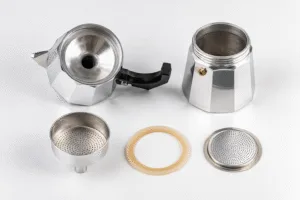
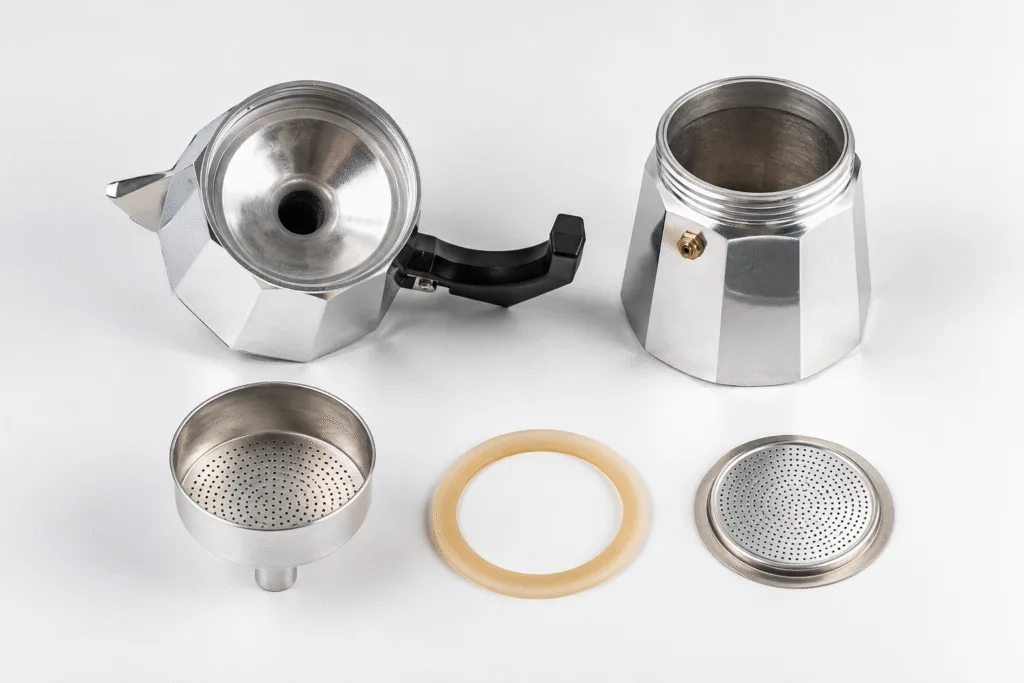
A moka pot may look like a simple stovetop coffee maker, but its performance depends on how well several components work together. The boiler, filter funnel, gasket, upper chamber, threads, and safety valve all influence brewing consistency, ease of use, and product reliability.
For kitchenware importers, coffee equipment distributors, and private label brands, these details matter well beyond the first product sample. A moka pot that looks attractive in a catalog may still create problems if its components fit poorly, its finish varies between batches, or replacement parts are difficult to obtain.
Choosing a suitable moka pot manufacturer therefore requires a more detailed evaluation than comparing prices and exterior designs.
This article examines the construction, material quality, safety-related components, manufacturing controls, and customization requirements that wholesale buyers should consider before committing to production.
Why Moka Pot Quality Matters in Wholesale Sourcing
Moka pots are widely recognized as traditional stovetop coffee makers. They use heat-generated pressure to move hot water from a lower chamber through ground coffee and into an upper collection chamber.
Unlike a simple serving utensil, a moka pot operates with heated water and internal pressure. Component fit, sealing performance, and safety-related design are therefore particularly important.
For wholesale buyers, product reliability affects several commercial outcomes:
- Customer satisfaction and product reviews
- Warranty claims and replacement requests
- Retailer confidence in repeat orders
- Consistency across private label product ranges
- Compliance with destination-market requirements
An attractive appearance can help a product stand out, but consistent construction and documented quality controls are essential to building a dependable product line.
A reliable sourcing strategy should evaluate the complete coffee maker rather than individual components in isolation.
Aluminum Construction and Material Quality
Aluminum is a common material for traditional moka pots. Its relatively low weight and good thermal conductivity make it practical for stovetop coffee maker construction.
However, buyers should not assume that every aluminum moka pot has identical properties.
Material Selection and Product Design
The alloy specification, component geometry, manufacturing method, and finishing process can all influence the finished product.
When evaluating a manufacturer, ask for clear information about the materials used in the boiler, upper chamber, filter funnel, and other components.
Important considerations include:
- Material specifications for food-contact components
- Consistency of component dimensions
- Surface quality and visible defects
- Suitability of the material for the intended heating conditions
- Compatibility with the specified gaskets, filters, and other parts
Aluminum components may be produced through different manufacturing methods depending on their design. Buyers should confirm the actual process used for the model they intend to purchase.
A supplier’s general experience in aluminum die casting is useful background, but it does not automatically establish that every moka pot component is die-cast or that the finished product has passed appropriate performance testing.
Surface Finish and Product Appearance
The exterior finish is an important part of retail presentation, particularly for private label coffee brands.
Buyers should inspect the sample for scratches, casting defects where applicable, uneven finishing, discoloration, sharp edges, and other visible inconsistencies.
The interior surfaces also deserve attention. Areas that contact water or coffee should be suitable for their intended use, and any applied coatings or treatments should be supported by relevant documentation.
A decorative finish should never be treated as a substitute for verified material suitability or product safety.
Key Components That Determine Moka Pot Reliability
A moka pot is a system of interacting components. Small differences in their dimensions or assembly can affect the overall product.
The following areas deserve particular attention during supplier evaluation.
Gaskets and Sealing Performance
The gasket helps form a seal between the upper and lower sections of the moka pot.
Poorly fitted or unsuitable gaskets may lead to leakage, inconsistent operation, or premature replacement.
Wholesale buyers should ask about the gasket material, intended temperature range, dimensional consistency, and availability of replacement parts.
Where relevant, request supporting documentation for food-contact suitability and applicable market requirements.
The gasket should also be easy to identify and replace according to the product’s maintenance instructions.
Safety Valve Design and Verification
The safety valve is a critical component of a traditional moka pot. It is intended to provide pressure relief under specified conditions.
Buyers should not assess this component by appearance alone.
Ask the manufacturer how the valve is specified, sourced or manufactured, assembled, and verified. The manufacturer should be able to explain the applicable safety requirements and provide appropriate test evidence for the complete product.
A safety valve should never be modified, blocked, or treated as a decorative component.
For procurement teams, documented verification is more meaningful than an unsupported statement that a moka pot is “100% safe.”
Thread Precision and Assembly Fit
The upper and lower chambers must connect correctly.
Poor thread quality can make assembly difficult, damage mating components, or interfere with proper sealing.
During sample inspection, check whether the two sections connect smoothly and consistently without unusual resistance or looseness.
The assembly should meet the manufacturer’s approved design specifications. Thread dimensions, surface condition, and repeatability should be controlled during production.
Filter Funnel and Filter Plate
The filter funnel and filter plate influence how water passes through the coffee grounds.
Buyers should inspect the fit, dimensions, hole consistency, surface condition, and ease of cleaning of these components.
Ask whether replacement filters are available and whether their dimensions will remain consistent across future orders.
For distributors planning a long-term product range, replacement-part compatibility can become an important customer service consideration.
Handles and Lid Components
Handles and lid components affect usability and perceived product quality.
Inspect the attachment points, stability, fit, and finish. Confirm that the handle material and design are suitable for the product’s intended heating conditions.
Do not assume that a particular handle will remain cool during operation. Product instructions should clearly explain safe handling and any necessary precautions.
How to Evaluate Moka Pot Samples Before Bulk Ordering
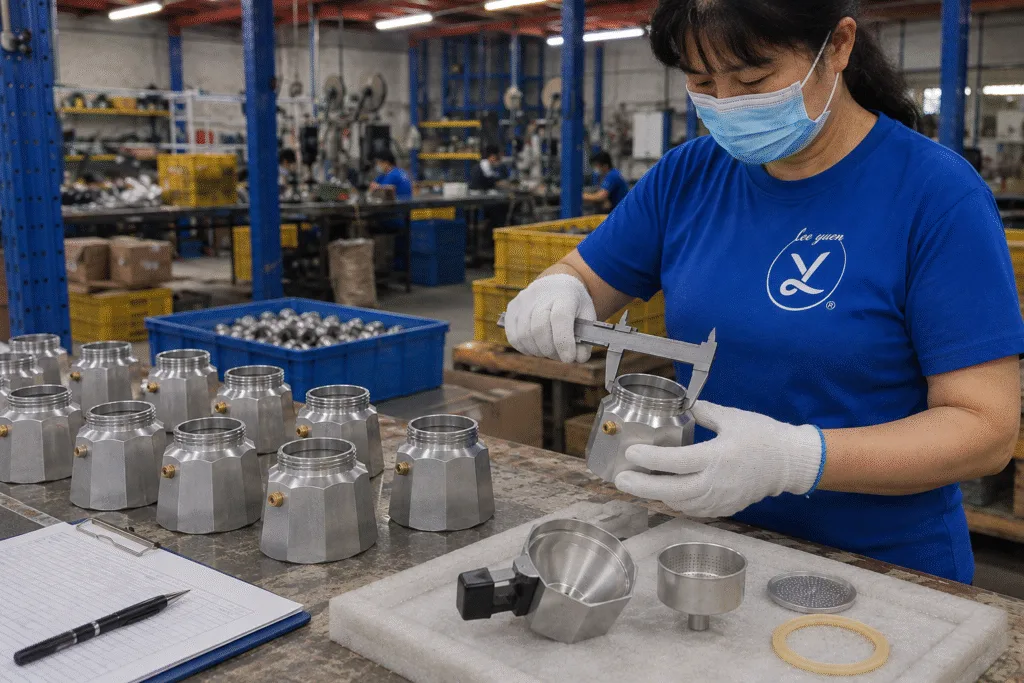
Sample testing should be a structured part of the procurement process, not merely a visual inspection.
A buyer should begin with an approved specification and evaluate the sample against it.
| Inspection area | What buyers should verify |
|---|---|
| Material | Documented material specifications and applicable food-contact requirements |
| Dimensions | Capacity, chamber fit, overall measurements, and tolerances |
| Surface quality | Finish consistency, absence of unacceptable defects, and properly finished edges |
| Sealing | Correct gasket fit and manufacturer-defined leak-test criteria |
| Safety components | Valve specifications, verification records, and assembly controls |
| Functional performance | Operation under the manufacturer’s approved test procedure |
| Packaging | Product protection, instructions, labeling, and carton specifications |
Start with a Specification Review
Confirm the product’s stated capacity, material, dimensions, intended heat-source compatibility, component list, and packaging configuration.
Different moka pot designs may have different operating and compatibility requirements. For example, not every traditional aluminum moka pot is suitable for an induction cooktop.
Any compatibility claim should be verified for the exact model.
Review Functional Test Evidence
Because a moka pot operates with heat and pressure, functional verification should follow an appropriate manufacturer-defined procedure and applicable requirements.
Ask for documented evidence covering the relevant sealing, pressure-related safety, and functional characteristics.
Buyers should not improvise pressure tests, obstruct safety valves, or alter the product to simulate abnormal operating conditions.
If the buyer needs independent verification, a qualified testing laboratory can help establish an appropriate testing program.
Approve a Reference Sample
After reviewing the sample, document the accepted material, dimensions, finish, components, packaging, and performance requirements.
Retain an approved reference sample for comparison with production units.
If the manufacturer proposes changes to a gasket, valve, filter, handle, material, or manufacturing process, the change should be assessed before production continues.
What to Expect from a Moka Pot Manufacturer
Product quality depends not only on the initial design but also on the manufacturer’s ability to reproduce that design consistently.
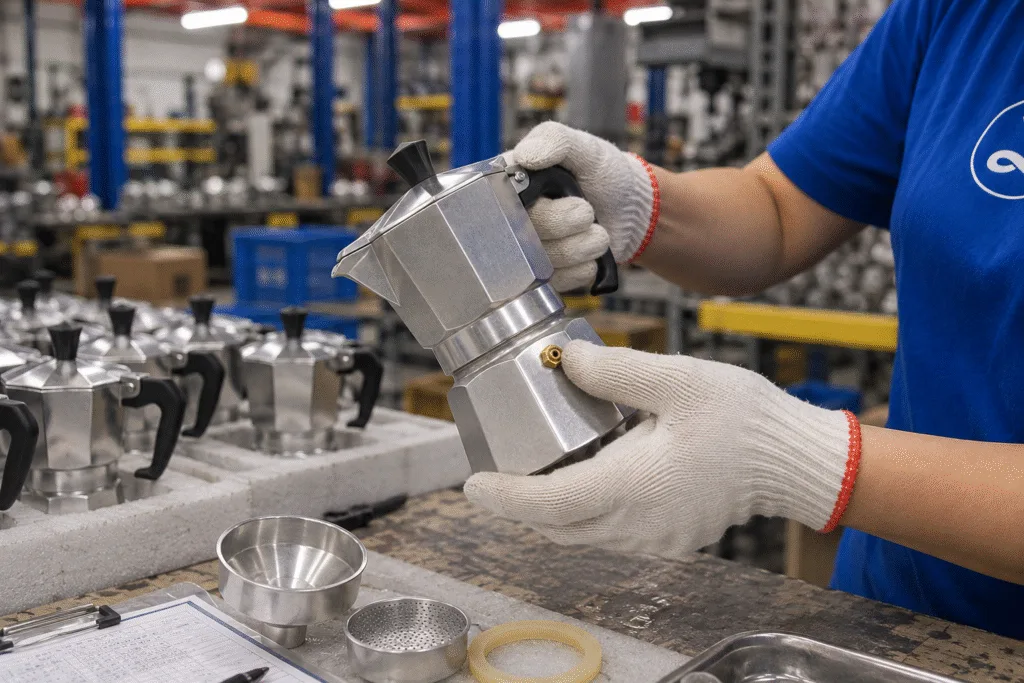
A capable supplier should be able to explain how it manages production specifications, component sourcing, assembly, and final inspection.
Manufacturing and Component Control
Ask which manufacturing operations are performed in-house and which are outsourced.
Depending on the supplier and product design, production may involve metal forming or casting, machining, surface finishing, component assembly, and packaging.
The manufacturer should have appropriate controls for the operations it performs and for externally sourced components.
This is particularly important for parts such as gaskets, valves, and filters, where a change in supplier or specification may affect product performance.
Quality Control During Production
A practical quality-control plan should identify critical product characteristics and the methods used to verify them.
Relevant controls may include incoming material checks, dimensional inspection, surface inspection, component verification, assembly checks, and final product testing.
Ask how nonconforming units are identified and handled.
For repeat orders, request confirmation that the same approved specifications and quality criteria will continue to apply.
Production Capacity and Lead Time
Before placing a wholesale order, clarify the minimum order quantity, production capacity, sample lead time, and expected delivery schedule.
Ask whether the quoted lead time includes customized components, packaging approval, and any required testing.
A manufacturer should communicate production constraints clearly rather than promising an unrealistic delivery date.
For brands planning seasonal launches or coordinated retail promotions, accurate production scheduling is particularly valuable.
OEM and Private Label Moka Pot Customization
Private label moka pots can help distributors and coffee brands develop a recognizable product range.
However, customization should be evaluated from both a commercial and technical perspective.
Product Appearance and Branding
Depending on the manufacturer’s capabilities, customization may include exterior colors, surface finishes, logo application, packaging design, or selected product details.
Buyers should confirm which modifications are available for an existing model and which require additional development.
Branding methods should be compatible with the materials, finishes, and intended operating conditions.
Custom Packaging and Retail Presentation
Packaging can influence shelf appeal, shipping protection, and customer experience.
Private label buyers may require branded cartons, printed instructions, barcodes, product identification, or multilingual labeling.
Before approving packaging, verify that all required product information, safety instructions, and market-specific labeling are included.
Protective packaging should also be tested or evaluated for the expected distribution conditions.
Design Changes and Tooling Requirements
Some design changes may affect component fit, sealing performance, manufacturing tolerances, or safety-related characteristics.
For that reason, OEM development should follow a controlled approval process.
Buyers should confirm:
- Whether new tooling or modifications are required
- Who owns the tooling and technical drawings
- What development and sampling costs apply
- How design changes will be tested and approved
- Whether replacement components will remain available
Customization should improve product differentiation without compromising verified product performance.
Food-Contact Compliance and International Market Requirements
International wholesale buyers need to consider the requirements of their destination markets.
For moka pots, these may include food-contact material rules, applicable product safety requirements, labeling obligations, and documentation related to specific materials or components.
For the European Union, buyers should assess relevant food-contact legislation, including Framework Regulation (EC) No 1935/2004 and applicable measures for the materials used. The precise requirements depend on the product and its components.
For the United States, material suitability and applicable FDA food-contact requirements should be reviewed based on the substances and intended conditions of use.
A general statement such as “FDA approved” or “EU certified” is not sufficient evidence on its own.
Instead, request relevant material declarations, test reports, supplier documentation, and other records appropriate to the product and destination market.
Requirements can vary by jurisdiction and product configuration. Importers should confirm current obligations with qualified compliance professionals or accredited testing providers where necessary.
Common Mistakes Wholesale Buyers Should Avoid
Even experienced sourcing teams can overlook important details when comparing moka pot suppliers.
Focusing Only on Exterior Design
A polished finish and attractive packaging do not establish that the product’s sealing, assembly, or safety-related components meet the required specifications.
Review the complete construction.
Accepting Unsupported Safety Claims
Claims about safety, food-contact suitability, or heat-source compatibility should be supported by relevant documentation and testing.
Avoid relying solely on catalog descriptions.
Ignoring Replacement Parts
Gaskets, filters, and other replaceable components can affect long-term customer satisfaction.
Confirm whether replacement parts can be supplied and whether their specifications will remain consistent.
Changing Components Without Reapproval
Switching a gasket material, valve design, or component supplier may require additional evaluation.
Agree on a change-control process before placing repeat orders.
Comparing Incomplete Quotations
A quotation should specify the exact model, materials, components, finish, packaging, order quantity, lead time, payment terms, and shipping terms.
Compare equivalent specifications rather than unit price alone.
FAQ
What should buyers look for in a moka pot manufacturer?
Buyers should evaluate material specifications, manufacturing and assembly capabilities, quality-control procedures, safety-related verification, sample consistency, and communication. A suitable manufacturer should be able to document the product requirements and explain how they are maintained during bulk production.
Are aluminum moka pots suitable for wholesale and private label brands?
Aluminum moka pots can be suitable for wholesale distribution and private label product ranges when their construction, materials, performance, documentation, and packaging meet the requirements of the intended market. Buyers should evaluate the exact model rather than assuming all aluminum moka pots have identical characteristics.
Can moka pots be customized with a private label logo?
Many suppliers offer some form of branding or packaging customization, but available options depend on the product design and manufacturer. Buyers should confirm logo methods, minimum order quantities, setup costs, artwork approval, and whether any customization affects the product’s technical requirements.
How can importers verify moka pot safety and quality?
Importers should review product specifications, applicable test reports, material documentation, and the manufacturer’s quality-control procedures. Safety-related components, including valves and seals, require appropriate verification. Independent laboratory testing may be useful when required by the destination market or the buyer’s risk assessment.