For kitchenware wholesalers, foodservice distributors, and private-label brands, a meat tenderizer may seem like a straightforward product. However, differences in material, head design, handle construction, and finishing can significantly affect its performance and service life.
When sourcing a meat tenderizer tool in bulk, buyers need to look beyond appearance and unit price. A product that feels solid in a sample may still have inconsistent dimensions, weak connections, rough edges, or poor finishing across a large production batch.
For manufacturers, these details are equally important. Product design and manufacturing controls determine whether a meat tenderizer can meet the expectations of retailers, restaurants, and other professional buyers.
This article explains the key quality factors to evaluate when selecting meat tenderizer tools, from material and construction to factory inspection and bulk sourcing.
What Makes a Meat Tenderizer Suitable for Professional Use?
A meat tenderizer is commonly used to break down muscle fibers or flatten cuts of meat before cooking. In professional kitchens, the tool may be used repeatedly throughout food preparation, making reliability and ease of handling important considerations.
A suitable product should offer several practical qualities:
- Consistent performance: The striking surface should work as intended without unstable movement.
- Reliable construction: The head, handle, and connecting structure should withstand normal use.
- Comfortable handling: The handle should provide adequate grip and leverage.
- Practical cleaning: The product should be designed with accessible surfaces and suitable cleaning instructions.
- Consistent production quality: Dimensions, finish, and assembly should remain within agreed specifications.
The best design depends on the intended market. A lightweight household model may prioritize comfortable handling, while a foodservice product may require a different balance of weight, durability, and operating efficiency.
Commercial suitability should therefore be evaluated against the product’s intended use rather than assumed from its appearance alone.
Common Types of Meat Tenderizer Tools
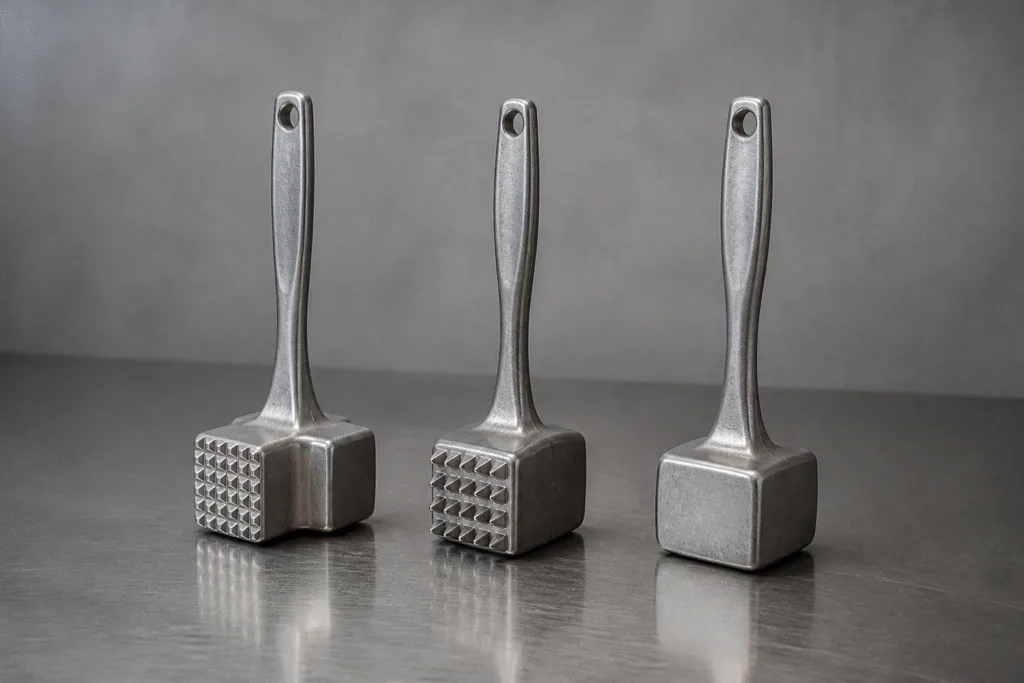
Before placing a wholesale order, buyers should identify which design best matches their customers’ needs.
Two-Sided Meat Tenderizer Mallets
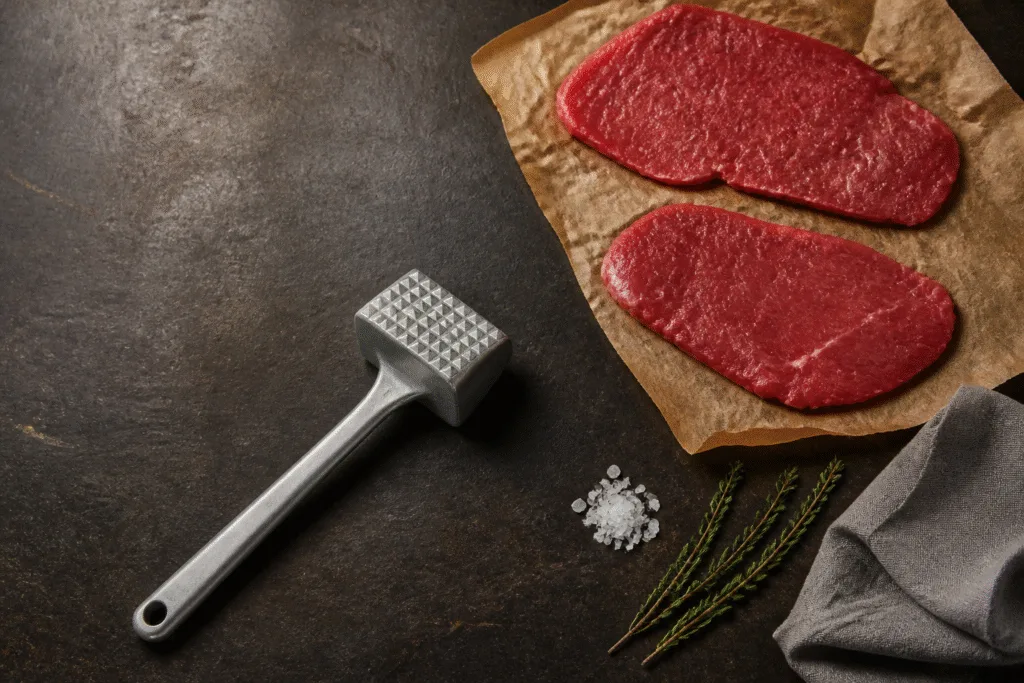
A two-sided meat tenderizer typically has a textured surface for tenderizing and a flat surface for pounding or flattening meat.
This design offers two functions in one tool and can be attractive to retailers, restaurants, and kitchenware distributors looking for versatile products.
Buyers should check that both surfaces are properly formed and that the head is comfortable to control during use.
Textured Meat Tenderizers
Textured or toothed heads are designed to apply force across the meat surface. Different patterns can produce different contact areas and levels of penetration.
For sourcing purposes, the important factors include the consistency of the texture, the finish of the edges, and whether the design can be cleaned effectively.
Flat Meat Pounders
Flat-faced models are primarily used to flatten cuts to a more uniform thickness. They can be useful in kitchens that prepare cutlets, steaks, and similar dishes.
Head size and weight influence handling and coverage. Buyers should evaluate these characteristics using samples and actual use tests.
Aluminum and Multi-Material Designs
Some meat tenderizers use aluminum alloy for the head and handle, while others combine a metal head with a wood or molded grip.
Each construction has different requirements for manufacturing, assembly, cleaning, and inspection. Buyers should select a design based on their market and product specifications.
How Material and Construction Affect Product Quality
Material selection influences weight, appearance, manufacturing options, and maintenance requirements. It should be considered together with product geometry and construction.
Aluminum Alloy
Aluminum alloy is used in many meat tenderizer mallets because it can be formed into functional shapes and offers a relatively lightweight metal construction.
For manufacturers, die casting can support repeatable production of complex head and handle shapes. Depending on the design, additional trimming, machining, and finishing may be required.
Buyers should not assume that every aluminum alloy has the same properties. The alloy specification, casting quality, wall thickness, and finishing process all influence the finished product.
Stainless Steel
Stainless steel is another option for meat tenderizer products. It may be appropriate for buyers prioritizing corrosion resistance and a particular premium or professional product position.
However, stainless steel products vary in grade, thickness, construction, and manufacturing quality. The material name alone does not establish performance.
Zinc Alloy
Zinc alloy can be used for certain cast kitchen tools where shape, surface appearance, and production requirements support the choice.
Buyers should verify the intended application, material specifications, and relevant food-contact requirements before approving a product.
Material Comparison
| Material | Potential advantages | Points to evaluate |
|---|---|---|
| Aluminum alloy | Lightweight metal construction and flexible casting design | Alloy specification, casting quality, surface finish |
| Stainless steel | Corrosion resistance and a solid metal feel | Steel grade, weight, construction, finishing |
| Zinc alloy | Good casting flexibility for suitable designs | Intended use, coating, material compliance |
| Mixed materials | Can combine a metal head with a different grip material | Joint strength, cleaning, wear, assembly consistency |
There is no single material that is best for every application. The correct choice depends on target pricing, design, expected use, and buyer requirements.
Key Quality Checks Before Bulk Ordering
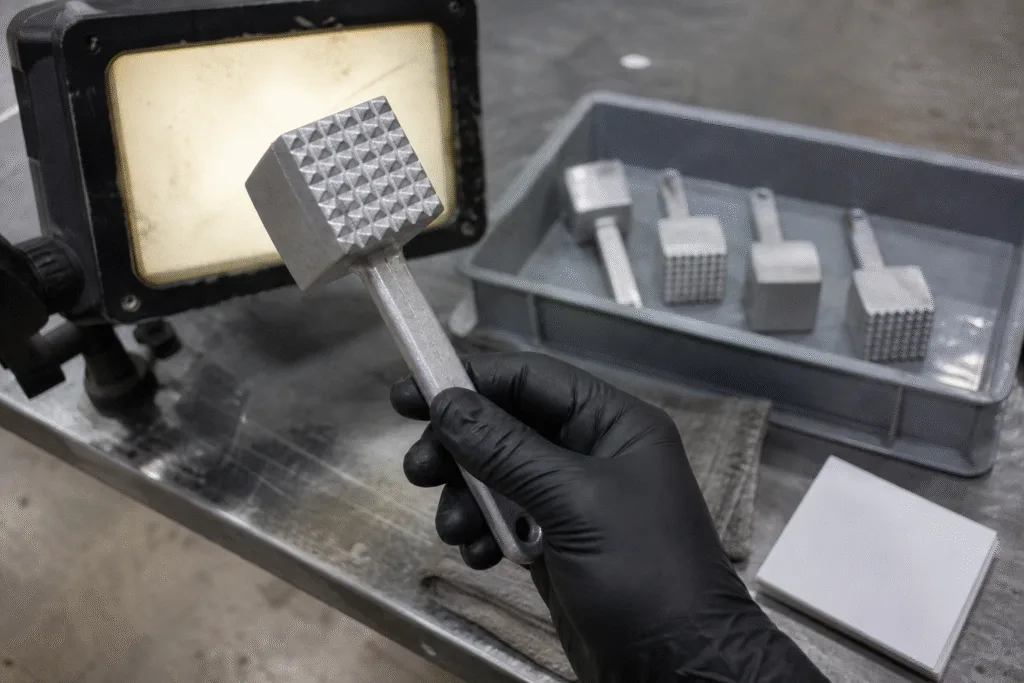
A product sample should be evaluated systematically before a purchase order is confirmed. The following checks can help buyers identify potential issues early.
1. Check the Head and Striking Surface
Inspect the flat and textured surfaces for visible defects, irregular shapes, and rough edges.
For textured models, the pattern should be consistent with the approved sample or drawing. For flat-faced models, check whether the surface is sufficiently even for its intended purpose.
If the product is die cast, examine accessible surfaces for visible porosity, cracks, excessive flash, or other casting defects.
2. Test Handle Strength and Grip
The handle should be comfortable to hold and provide adequate control.
Check for sharp edges, awkward contours, loose components, and excessive movement. If the design uses a separate handle or grip, inspect the connection and verify that it remains stable during normal-use testing.
An attractive handle is not enough if it compromises control or durability.
3. Inspect Structural Stability
The head-to-handle connection is an important inspection point on products with separate components.
For integrated designs, inspect the main body for visible defects and verify that the shape and dimensions match the approved specification.
Any strength or durability testing should follow a defined method appropriate to the product. Informal demonstrations should not be treated as proof of long-term performance.
4. Review Surface Finishing
Surface finishing influences both appearance and maintenance.
Check for:
- Uneven polishing or coating
- Scratches and dents
- Rough casting marks
- Burrs and sharp edges
- Inconsistent color or gloss
- Visible defects around joints and corners
For private-label products, finishing standards should be agreed before mass production so that both parties have a clear reference for acceptance.
5. Confirm Cleaning and Food-Contact Requirements
Buyers should confirm the cleaning instructions and relevant food-contact requirements for the target market.
The appropriate documentation depends on the material, coatings, product design, and destination market. Do not assume that a metal product is automatically compliant simply because it is made from aluminum or stainless steel.
If a coating or additional surface treatment is used, ask the supplier for the relevant material and compliance documentation.
6. Compare Samples With Production Specifications
A sample approval process should document the important product characteristics, including dimensions, weight, material, finish, packaging, and assembly.
For larger orders, the manufacturer should use agreed inspection criteria to check whether production units remain consistent with the approved sample.
This reduces the risk of disputes caused by unclear expectations.
How Manufacturers Control Meat Tenderizer Quality
Quality starts before the first production run. A reliable process considers design, tooling, manufacturing, finishing, assembly, and final inspection.
Product Design and Mold Development
For cast products, the design needs to account for the intended load, shape, wall thickness, material flow, and manufacturing limitations.
Mold development is particularly important when the product includes complex contours or integrated handle features. A well-developed mold helps support repeatability, but it does not replace inspection of the finished product.
Casting and Post-Processing
During aluminum die casting, process conditions and mold condition can affect the quality of the finished component.
After casting, trimming and deburring remove excess material. Additional machining or surface finishing may be required depending on the product specification.
Manufacturers should identify potential defects at the relevant production stage rather than waiting until packaging.
Assembly and Final Inspection
For multi-component models, assembly checks should confirm that connections are secure and that the product functions as intended.
Final inspection may cover appearance, dimensions, weight, movement, assembly, and packaging. The exact inspection plan should reflect the product design and buyer’s requirements.
For wholesale orders, consistent quality across the batch is more useful than a small number of carefully selected samples.
Choosing the Right Meat Tenderizer for Your Customers
Different buyers have different priorities. Understanding the sales channel can help determine which specifications deserve the most attention.
| Buyer type | Main considerations |
|---|---|
| Kitchenware wholesalers | Competitive landed cost, dependable supply, packaging, consistent quality |
| Retail and private-label brands | Appearance, product differentiation, branding, packaging, customer expectations |
| Restaurant supply distributors | Practical handling, reliable construction, cleaning requirements |
| Hospitality suppliers | Product standardization, supply continuity, documentation |
| Importers sourcing multiple models | Minimum order quantities, sample approval, production lead times, supplier coordination |
Before selecting a model, define its intended market and target price range. This helps avoid paying for features that customers do not value—or choosing a low-cost product that fails to meet their expectations.
What Affects the Cost of Meat Tenderizer Tools?
The price of a meat tenderizer depends on more than its material.
Important cost factors include:
- Material and weight: The alloy, amount of material, and product dimensions affect material costs.
- Product design: Complex shapes or multi-component structures may require additional processing.
- Mold investment: New designs may require dedicated tooling and development.
- Surface finishing: Polishing, coating, and other finishes affect production cost.
- Assembly requirements: Separate grips or components add assembly and inspection steps.
- Packaging: Retail boxes, gift packaging, and customized artwork influence the final cost.
- Order quantity: Larger orders may distribute certain fixed costs across more units, depending on the project.
- Quality requirements: Additional testing, inspection, and documentation may affect the overall quotation.
When comparing suppliers, request quotations based on the same specifications. Otherwise, a lower unit price may reflect differences in material, finish, packaging, or inspection requirements rather than a more efficient manufacturing process.
For customized products, ask the supplier to separate tooling charges, sample costs, unit pricing, and any other applicable fees.
Questions to Ask a Meat Tenderizer Supplier
Before confirming a bulk order, buyers should discuss the following points with the supplier:
What material and construction are used?
Request the material specification and clarify whether the product is one-piece or assembled.
Can you provide samples for testing?
Evaluate the sample for handling, finish, dimensions, and normal-use performance before approving production.
How do you control quality during production?
Ask about casting inspection, deburring, assembly checks, final inspection, and defect handling.
Can the product be customized?
Confirm whether the supplier supports changes to dimensions, shape, finish, logo, or packaging.
What are the minimum order quantity and lead time?
These may vary depending on whether the product is a standard model or requires new tooling.
What documentation can you provide?
Clarify which material, food-contact, and other compliance documents are available and whether they meet the destination market’s requirements.
How are production changes approved?
Agree on a sample approval process and how any changes to materials, dimensions, finish, or packaging will be communicated.
Clear answers to these questions can help buyers assess whether a supplier is equipped to support a repeatable B2B order.
Working With a Manufacturer on Custom Meat Tenderizers
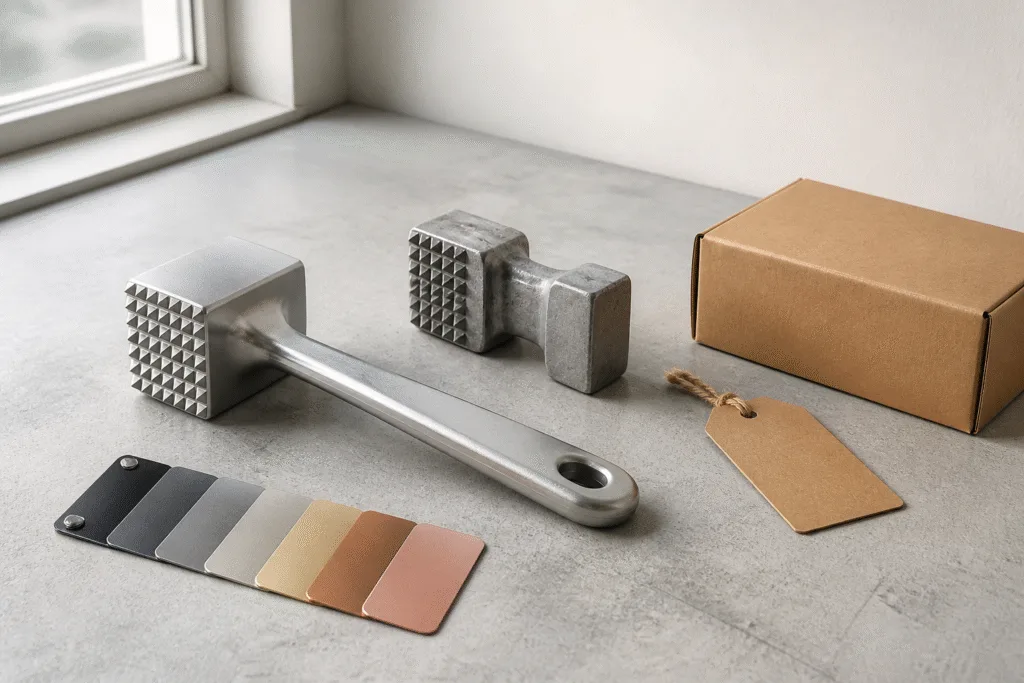
For private-label brands and distributors, customization can help distinguish a product line from standard catalog offerings.
Depending on the manufacturer’s capabilities, a project may include changes to the head shape, handle design, dimensions, surface finish, logo, or packaging.
A practical development process usually starts with a product brief that defines the target market, intended use, key dimensions, material preferences, target cost, and packaging requirements.
The manufacturer can then assess feasibility, provide a sample or prototype, and agree on the specifications before mass production.
At LeeYuen Kitchenware, the meat tenderizer range includes aluminum models and different designs for varied product requirements. The company’s manufacturing offering includes OEM and ODM support for bulk buyers. Buyers considering a custom project should confirm the exact model, material, tooling needs, minimum order quantity, and available documentation with the team.
What should I look for when buying a meat tenderizer in bulk?
Evaluate material specifications, head design, handle comfort, structural stability, surface finish, cleaning requirements, packaging, and batch consistency. Test a representative sample before approving a large order.
Is an aluminum meat tenderizer suitable for commercial kitchens?
An aluminum meat tenderizer may be suitable for professional food preparation when its design, material, and construction meet the intended requirements. Buyers should evaluate the specific model rather than assuming every aluminum product is suitable for heavy-duty use.
What is the difference between a flat and textured meat tenderizer?
A flat face is generally used to pound or flatten meat, while a textured face is designed to tenderize it through a patterned contact surface. Two-sided models combine these functions in one tool.
Can meat tenderizers be customized for private-label brands?
Depending on the manufacturer, customization may include product dimensions, shape, finish, logo, and packaging. Buyers should confirm tooling requirements, minimum order quantities, and sample approval procedures before starting production.