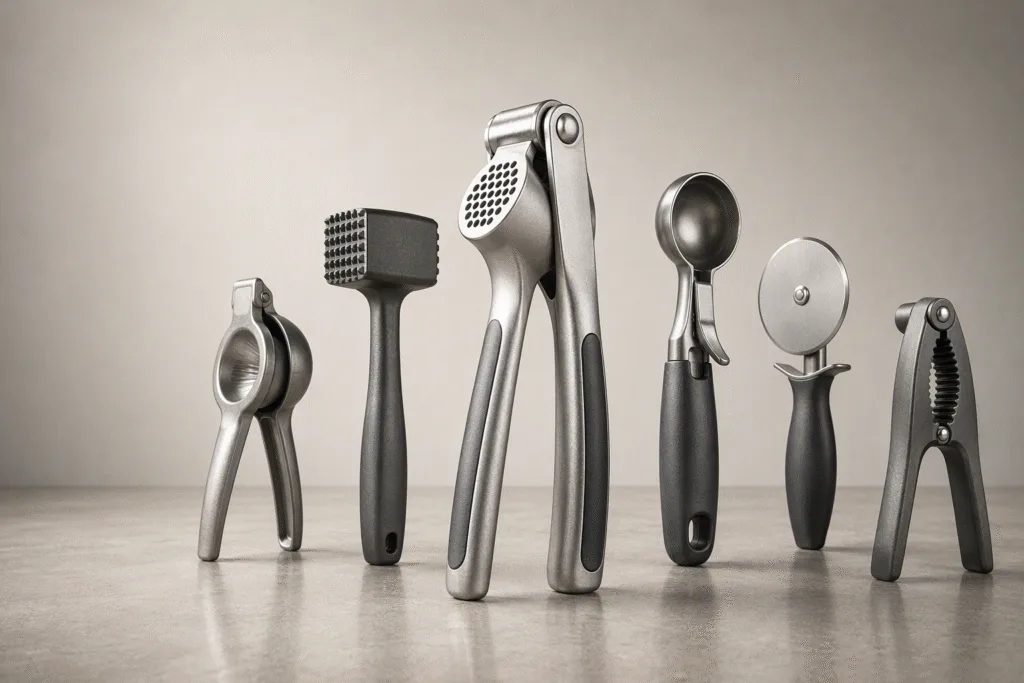
For B2B buyers, custom kitchen tools can be an effective way to create product differentiation without developing an entirely new product from scratch. However, not every customization has the same cost, lead time, or tooling requirements.
Changing a logo or surface finish may be relatively simple, while modifying the dimensions, mechanism, or overall structure of a kitchen tool can require new molds and engineering work.
Understanding what can actually be customized helps importers, wholesalers, retailers, and private-label brands control development costs and avoid unnecessary tooling.
What Are Custom Kitchen Tools?
Custom kitchen tools are products that are modified to meet a buyer’s specific requirements.
Customization can range from simple branding changes to significant product modifications. Depending on the project, buyers may customize:
- Product dimensions
- Material
- Shape and structure
- Handle design
- Surface finish
- Color
- Logo placement
- Packaging
- Product components
- Functionality
The important distinction is between product customization and new product development.
If a buyer modifies an existing kitchen tool, the manufacturer may be able to use existing tooling. If the buyer requires a completely different structure, new molds and engineering development may be necessary.
What Can B2B Buyers Customize?
Material and Product Construction
Material selection affects product weight, durability, appearance, manufacturing cost, and application.
For metal kitchen tools, common options include aluminum alloy, zinc alloy, and stainless steel components.
Aluminum alloy is particularly suitable for products that require a combination of low weight, strength, corrosion resistance, and die-casting efficiency.
For example, an existing aluminum kitchen tool may be customized with different component combinations or material specifications while maintaining the basic product structure.
Buyers should confirm the required material grade and food-contact requirements before production rather than treating material selection as a simple cost decision.
Product Size and Dimensions
Dimensions can be customized for different markets or applications.
Possible changes include:
- Overall product length
- Handle thickness
- Product width
- Working-head dimensions
- Capacity
- Product weight
- Hole or opening dimensions
However, dimensional changes can affect tooling and production processes.
For example, changing the handle appearance may require only a relatively small modification, while changing the entire geometry of a die-cast component may require a new mold.
Shape and Design
The external shape of a kitchen tool is another common customization area.
A buyer may want to modify:
- Handle shape
- Grip structure
- Product proportions
- Decorative details
- Ergonomic features
- Working-head geometry
For products such as garlic presses, lemon squeezers, and meat tenderizers, structural design can directly affect performance.
A manufacturer should therefore evaluate the proposed design from both a visual and manufacturing perspective before confirming the final specifications.
Surface Finish and Color
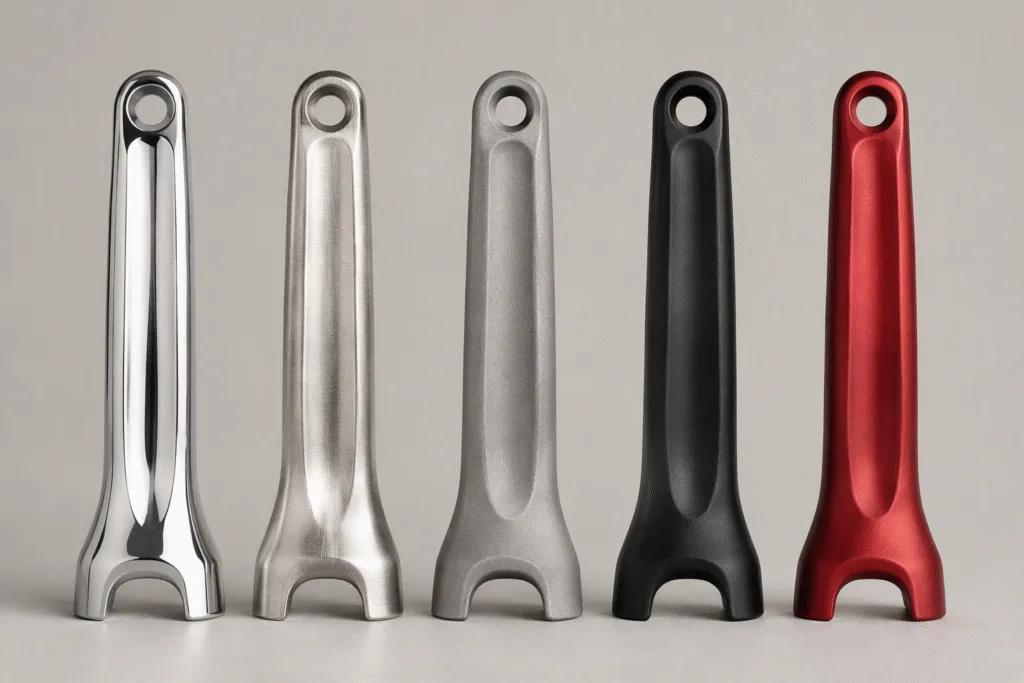
Surface treatment can significantly change the appearance of an aluminum kitchen tool without changing its basic structure.
Depending on the material and manufacturing process, options may include:
- Polished finish
- Brushed finish
- Matte finish
- Painted or coated surfaces
- Anodized finishes
- Custom colors
The final choice should consider durability, cleaning requirements, food-contact considerations, and the target market.
For retail brands, surface finish is often one of the easiest ways to create a more distinctive product appearance without completely redesigning the tool.
Logo and Branding
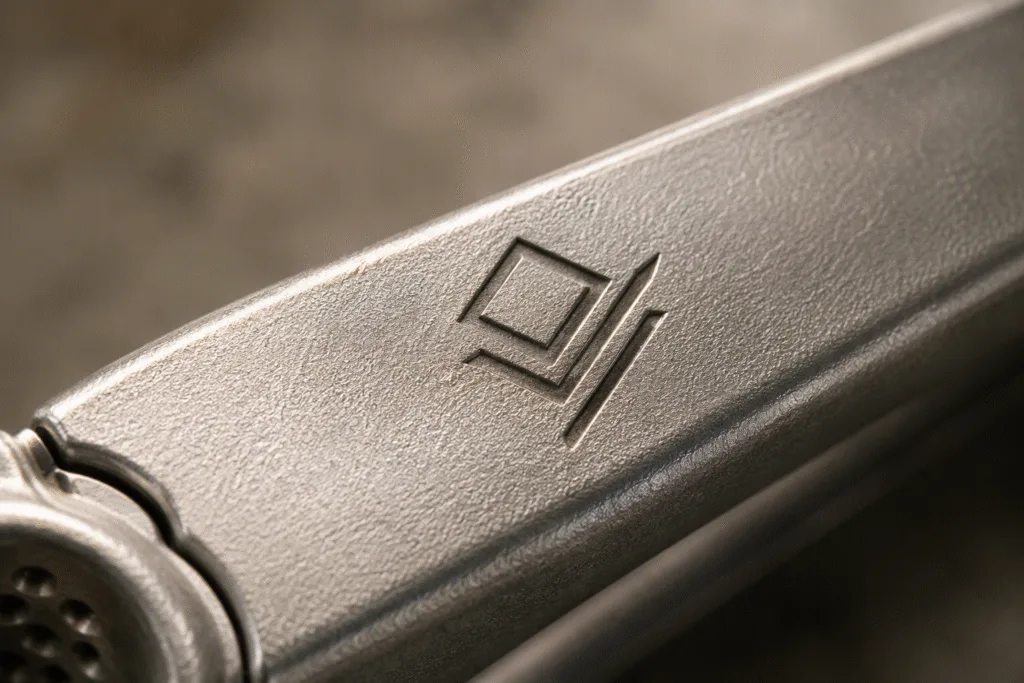
Branding customization is usually more straightforward than structural customization.
Common methods include:
- Laser engraving
- Embossed logos
- Printed logos
- Molded branding
- Logo placement on handles or product surfaces
The best method depends on the material, surface geometry, order quantity, and required appearance.
For example, a buyer may use an existing garlic press design while adding a brand logo and custom packaging. This creates a branded product without requiring the manufacturer to develop an entirely new product.
Packaging
Packaging can often be customized independently from the product itself.
B2B buyers may request:
- Custom color boxes
- Kraft packaging
- Gift boxes
- Hang cards
- Printed inserts
- Barcode labels
- Retail-ready packaging
- Bulk export packaging
For private-label kitchen tools, packaging is particularly important because it connects the physical product with the buyer’s brand identity.
Packaging customization may also require minimum order quantities because printed materials and packaging components are generally produced in batches.
Which Customizations Require a New Mold?
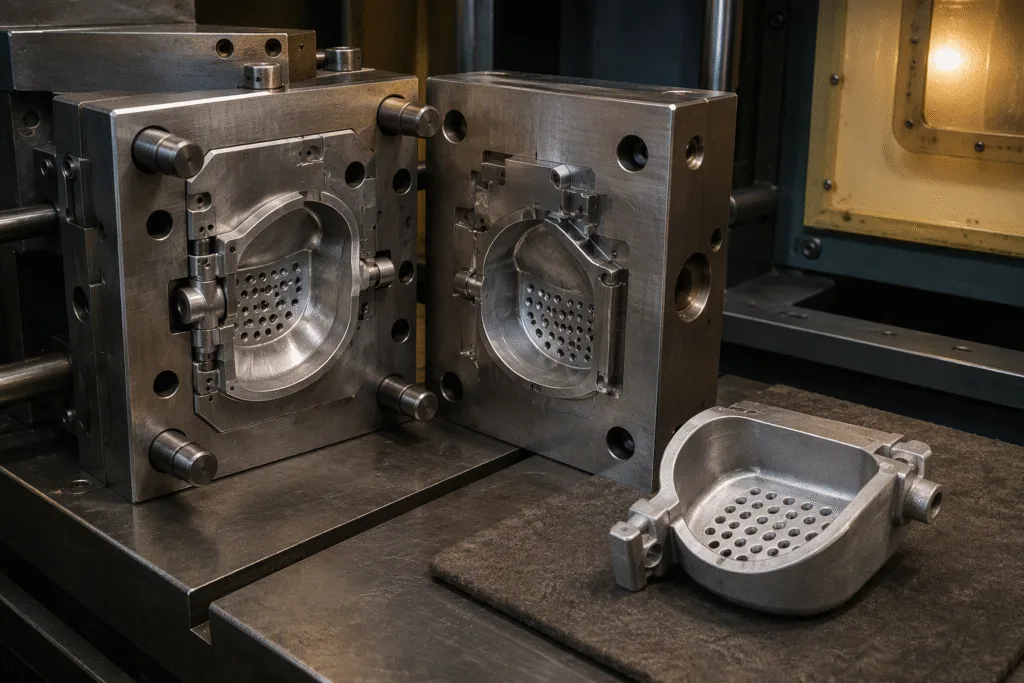
One of the most important questions for B2B buyers is whether customization requires new tooling.
| Customization | New Mold Usually Required? | Typical Cost Impact |
|---|---|---|
| Logo engraving | No | Low |
| Logo printing | No | Low |
| Color | No | Low |
| Surface finish | Usually No | Low–Medium |
| Packaging | No | Low–Medium |
| Handle modification | Sometimes | Medium |
| Product dimensions | Often | Medium–High |
| Structural modification | Usually | High |
| Completely new product design | Yes | High |
These are general guidelines rather than fixed rules. The actual tooling requirement depends on the product structure and manufacturing process.
For die-cast aluminum kitchen tools, even a seemingly small structural modification can affect the mold design, draft angles, wall thickness, ejection system, and production stability.
This is why buyers should confirm tooling requirements before approving a quotation.
Custom Kitchen Tools vs Private Label vs OEM
These terms are often used interchangeably, but they describe different levels of customization.
| Option | Existing Product | Product Modification | Custom Logo | Custom Packaging | New Mold |
|---|---|---|---|---|---|
| Standard Wholesale | Yes | No | Limited | Usually No | No |
| Private Label | Yes | Limited | Yes | Yes | Usually No |
| Custom Product | Usually | Yes | Yes | Yes | Sometimes |
| OEM | Not necessarily | Extensive | Yes | Yes | Often |
Private label is generally suitable when a buyer wants to sell an existing product under its own brand.
Custom manufacturing is more suitable when the buyer wants to modify the product itself.
OEM projects usually involve a higher degree of product development and may require new tooling, engineering work, and extensive sampling.
Choosing the right approach can prevent buyers from paying for unnecessary development.
How Much Does Customization Cost?
There is no single price for custom kitchen tools because the cost depends on the type and depth of customization.
A quotation may include:
- Existing product cost
- Material cost
- Tooling or mold cost
- Engineering cost
- Surface finishing
- Logo application
- Packaging
- Sample development
- Testing or inspection
- Shipping and packaging requirements
For simple projects, the main additional cost may come from branding and packaging.
For structural customization, tooling can become a major part of the initial investment.
B2B buyers should therefore compare the total development cost, not only the final unit price.
What Is the MOQ for Custom Kitchen Tools?
MOQ depends on the product, customization method, and manufacturing process.
A standard product with a simple logo may have a lower MOQ than a completely customized die-cast product.
Custom packaging can also increase MOQ because printed packaging materials normally need to be produced in batches.
A practical approach is to separate customization into three levels:
Level 1 — Branding
Existing product + logo + packaging.
This is generally the simplest option.
Level 2 — Product Modification
Existing product + changes to dimensions, shape, finish, or components.
This may require engineering evaluation and new tooling.
Level 3 — New Product Development
New design + new mold + samples + testing + mass production.
This requires the greatest investment and development time.
Customization Examples for Popular Kitchen Tools
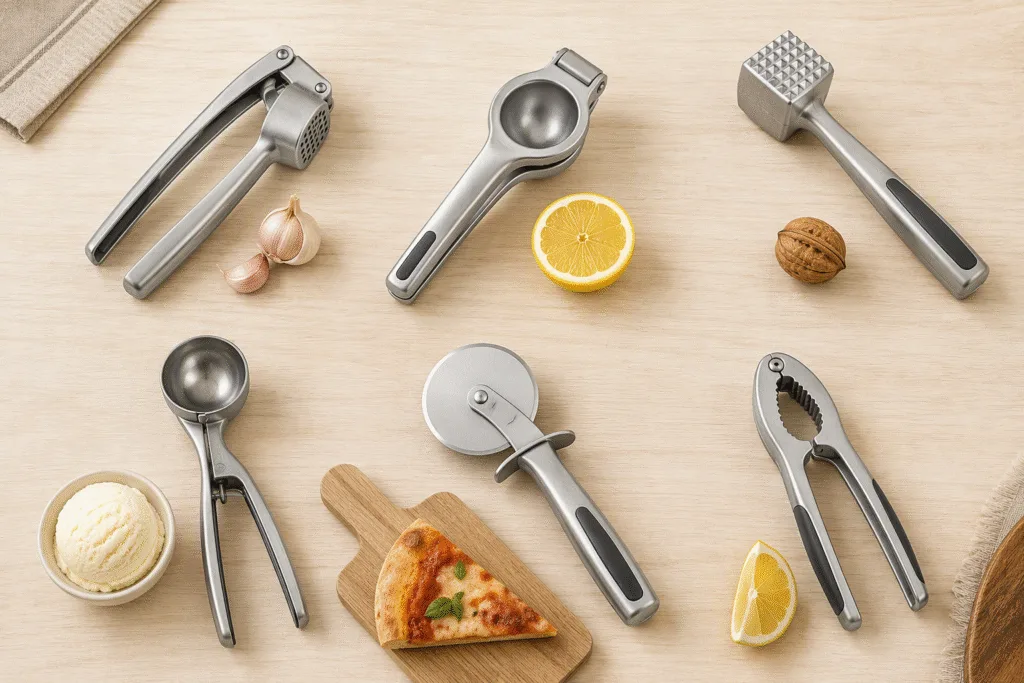
Custom Garlic Press
A garlic press can often be customized through handle design, surface finish, logo placement, and packaging.
More substantial changes to the pressing chamber or mechanical structure may require new tooling.
Custom Lemon Squeezer
For an aluminum lemon squeezer, buyers may customize color, surface treatment, handle shape, logo, and packaging.
Changes to the squeezing chamber or overall dimensions may require a mold modification or new mold.
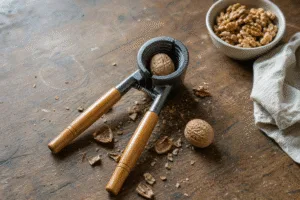
Custom Walnut Cracker
A walnut cracker can be customized through handle geometry, surface finish, branding, and packaging.
Because the cracking mechanism must withstand repeated force, structural changes should be evaluated carefully before production.
Custom Ice Cream Scoop
For an ice cream scoop, customization may include scoop size, handle design, surface finish, color, logo, and packaging.
For foodservice customers, dimensions and durability may be more important than decorative customization.
Custom Meat Tenderizer
A meat tenderizer can be customized through head geometry, handle design, surface finish, logo, and packaging.
The weight and balance of the tool should also be considered because they influence usability.
Custom Pizza Cutter
A pizza cutter may be customized through wheel size, handle design, surface treatment, branding, and packaging.
If the buyer changes the cutting mechanism or major structural components, additional engineering work may be required.
How the Custom Kitchen Tools Development Process Works
A reliable customization project should follow a structured development process.
Step 1: Define Product Requirements
Start with the target market, application, dimensions, material, expected quantity, and retail requirements.
Step 2: Review Existing Products
Determine whether an existing product can meet most of the buyer’s requirements.
Using an existing platform can reduce development time and tooling costs.
Step 3: Confirm Customization Requirements
Separate the requested changes into branding, appearance, packaging, and structural modifications.
This makes it easier to identify which changes affect manufacturing.
Step 4: Evaluate Tooling Requirements
The manufacturer should determine whether existing molds can be used or whether new tooling is required.
Step 5: Develop Samples
Samples allow buyers to evaluate dimensions, appearance, functionality, surface finish, and packaging before mass production.
Step 6: Approve the Final Sample
The approved sample should become the reference standard for mass production.
Any important specifications should be documented at this stage.
Step 7: Confirm Packaging
Packaging specifications, artwork, barcode information, carton dimensions, and labeling requirements should be finalized before production.
Step 8: Start Mass Production
After specifications and samples are approved, production can begin according to the agreed schedule.
Step 9: Quality Control
Quality checks should cover appearance, dimensions, functionality, assembly, surface finish, packaging, and other agreed requirements.
Step 10: Final Packaging and Shipment
Finished products are packed according to the buyer’s requirements and prepared for export.
How to Choose a Custom Kitchen Tools Manufacturer
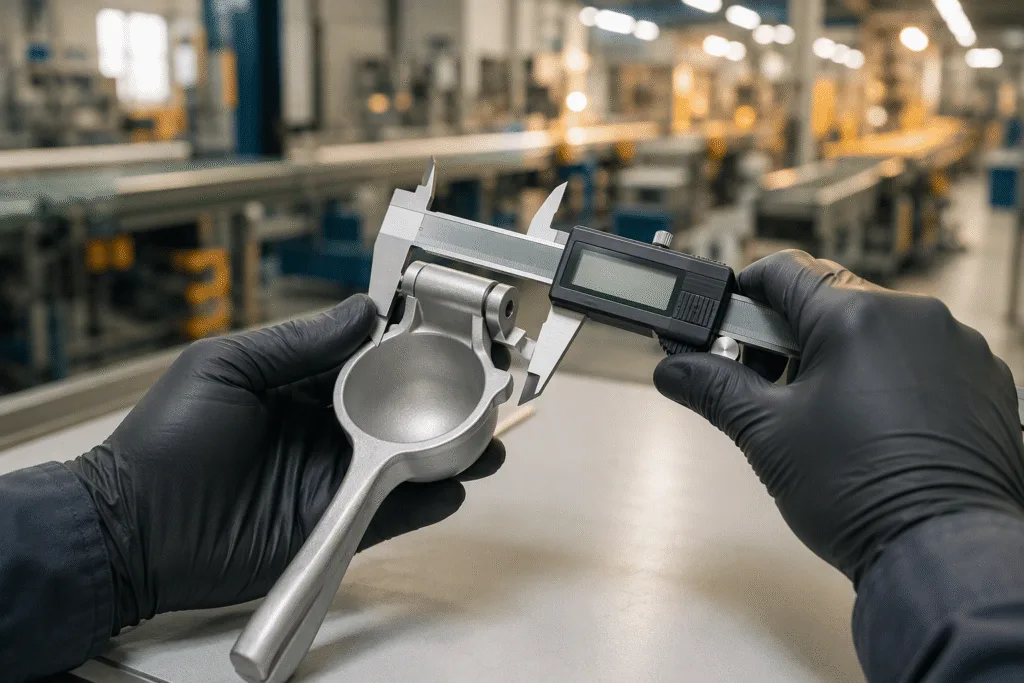
A supplier’s customization capability depends heavily on its manufacturing infrastructure.
B2B buyers should evaluate:
In-House Mold Development
A manufacturer with internal mold development capability can generally communicate design changes more efficiently than a supplier that depends entirely on external tooling companies.
Die-Casting Capability
For aluminum kitchen tools, die-casting equipment and process experience directly influence product consistency and production efficiency.
Engineering Support
A capable engineering team should be able to identify manufacturing problems before tooling begins.
Sampling Capability
The supplier should have a clear process for producing and revising samples before mass production.
Quality Control
Quality control should cover raw materials, casting, machining, finishing, assembly, packaging, and final inspection.
OEM and ODM Experience
Experience with OEM and ODM projects can be valuable when customization involves more than branding.
Production and Packaging Support
A supplier that can manage production, assembly, quality control, and packaging under one system can simplify the supply chain for international buyers.
Common Mistakes When Ordering Custom Kitchen Tools
Focusing Only on Unit Price
A lower unit price does not necessarily mean a lower total project cost.
Tooling, samples, packaging, and development costs should also be considered.
Customizing Too Many Features at Once
Adding unnecessary changes can increase development time and make quality control more complicated.
It is often better to customize the features that provide the greatest commercial value.
Ignoring Tooling Costs
Buyers should confirm whether a new mold is required before accepting a quotation.
Skipping the Sample Approval Stage
A sample provides an opportunity to identify problems before committing to mass production.
Changing Specifications After Approval
Late changes can increase costs and delay production.
Specifications should therefore be carefully reviewed before sample approval.
Choosing a Supplier Without Manufacturing Capability
A trading company may offer a competitive price, but buyers looking for extensive customization should evaluate whether the supplier has direct access to engineering, tooling, production, and quality-control resources.
FAQ
Can kitchen tools be customized with a logo?
Yes. Depending on the product material and surface, logos can often be added through laser engraving, printing, embossing, or other branding methods.
Do custom kitchen tools always require a new mold?
No. Logo, packaging, color, and some surface-finishing changes usually do not require a new mold. Structural changes may require modified or completely new tooling.
What is the MOQ for custom kitchen tools?
MOQ varies by product and customization level. Existing products with simple branding generally require less production volume than products involving new tooling and structural modifications.
How long does custom kitchen tool development take?
Development time depends on whether existing molds can be used. Simple branding projects can move relatively quickly, while new-product projects require additional engineering, tooling, sampling, and approval stages.
What is the difference between custom and private label kitchen tools?
Private label generally means selling an existing product under a buyer’s brand. Custom kitchen tools involve modifying the product itself to meet specific requirements.
Can aluminum kitchen tools be customized?
Yes. Aluminum kitchen tools can be customized in areas such as dimensions, shape, surface finish, color, logo, handle design, and packaging. More substantial structural changes may require new die-casting tooling.