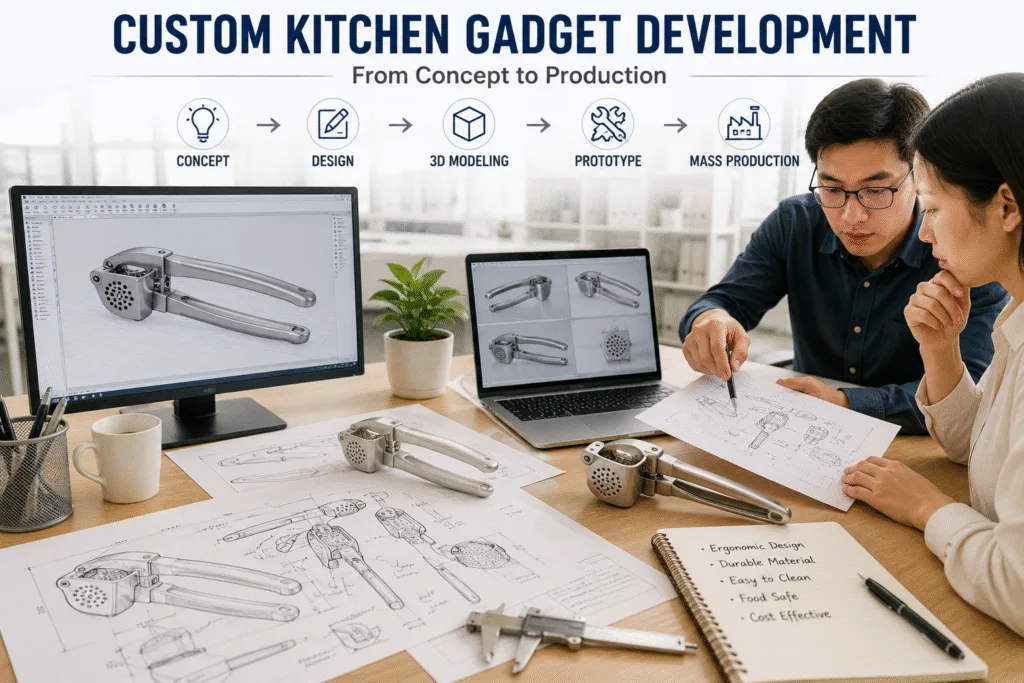
Why Custom Kitchen Gadgets Are Becoming More Popular
The global kitchenware market continues to evolve as brands seek innovative products that stand out from competitors. Instead of selling generic products, many importers and retailers now invest in custom kitchen gadgets.That reflect their brand identity and customer preferences.
Many of today’s best-selling kitchen gadgets can also be customized for OEM projects, including:
- Garlic Presses
- Lemon Squeezers
- Pizza Cutters
- Ice Cream Scoops
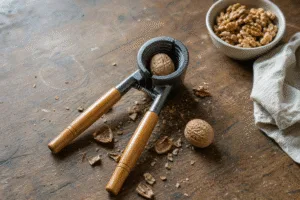
- Nutcrackers
- Ice Scoops
For brands, custom product development offers greater differentiation, stronger customer loyalty, and higher profit margins.
Step 1: Define Your Product Concept
Every successful product starts with a clear idea.
Before contacting a manufacturer, define:
- Product purpose
- Target customer
- Material requirements
- Expected retail price
- Competitive advantages
A detailed product brief helps manufacturers understand your requirements and provide more accurate recommendations.
Example Product Brief
| Item | Example |
|---|---|
| Product | Lemon Squeezer |
| Material | Aluminum Alloy |
| Finish | Powder Coating |
| Logo | Laser Engraving |
| Packaging | Custom Gift Box |
Step 2: Create Product Designs and Technical Drawings
Once the concept is finalized, the next step is creating technical drawings or 3D models.
Professional drawings help manufacturers evaluate:
- Dimensions
- Product structure
- Material thickness
- Functional features
- Manufacturing feasibility
At this stage, communication between the buyer and manufacturer is critical to avoid costly design mistakes later.
Step 3: Prototype Development and Testing
Before mass production begins, manufacturers typically create prototypes.
Prototypes allow buyers to verify:
- Appearance
- Ergonomics
- Functionality
- Product strength
- User experience
Testing samples early reduces development risks and shortens the overall product launch timeline.
Step 4: Tooling and Mold Development
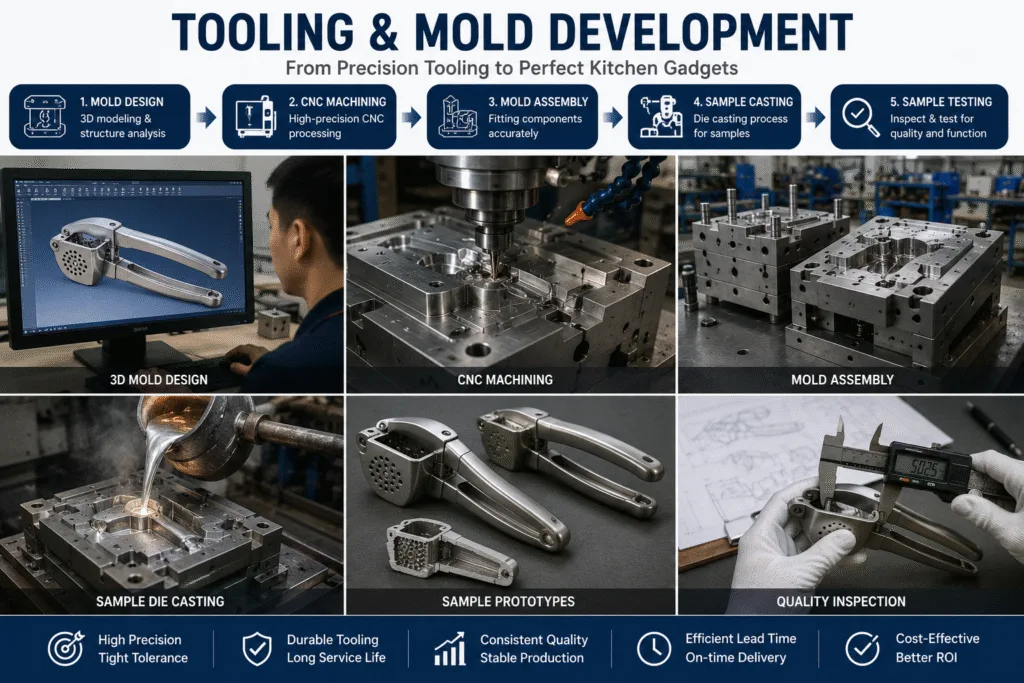
For many aluminum kitchen gadgets, the aluminum die casting process requires dedicated tooling before production can begin.
Tooling determines:
- Product consistency
- Surface quality
- Manufacturing efficiency
- Long-term production costs
Although mold development requires an initial investment, it significantly improves production stability for large-volume orders.
Why Tooling Matters
A high-quality mold helps ensure:
- Precise dimensions
- Better product durability
- Consistent appearance
- Lower defect rates
Step 5: Material Selection
Material choice directly impacts product quality and customer satisfaction.
Common materials used in kitchen gadget manufacturing include:
| Material | Benefits |
|---|---|
| Aluminum Alloy | Lightweight and durable |
| Stainless Steel | Corrosion resistant |
| Zinc Alloy | Premium appearance |
| Food-Grade Plastic | Cost-effective and versatile |
When selecting materials, buyers should prioritize durability, safety, and intended market positioning.
Step 6: OEM Branding and Packaging
Custom branding transforms a standard product into a recognizable brand asset.
OEM options often include:
- Laser logos
- Embossed branding
- Color customization
- Custom packaging
- Instruction manuals
- Barcode labels
Well-designed packaging improves product presentation and retail appeal.
Step 7: Mass Production
After prototype approval, manufacturers move into mass production.
Key considerations include:
- Production scheduling
- Capacity planning
- Material procurement
- Process control
- Delivery timelines
Reliable manufacturers maintain strict production procedures to ensure consistency across every batch.
Step 8: Quality Control and Inspection
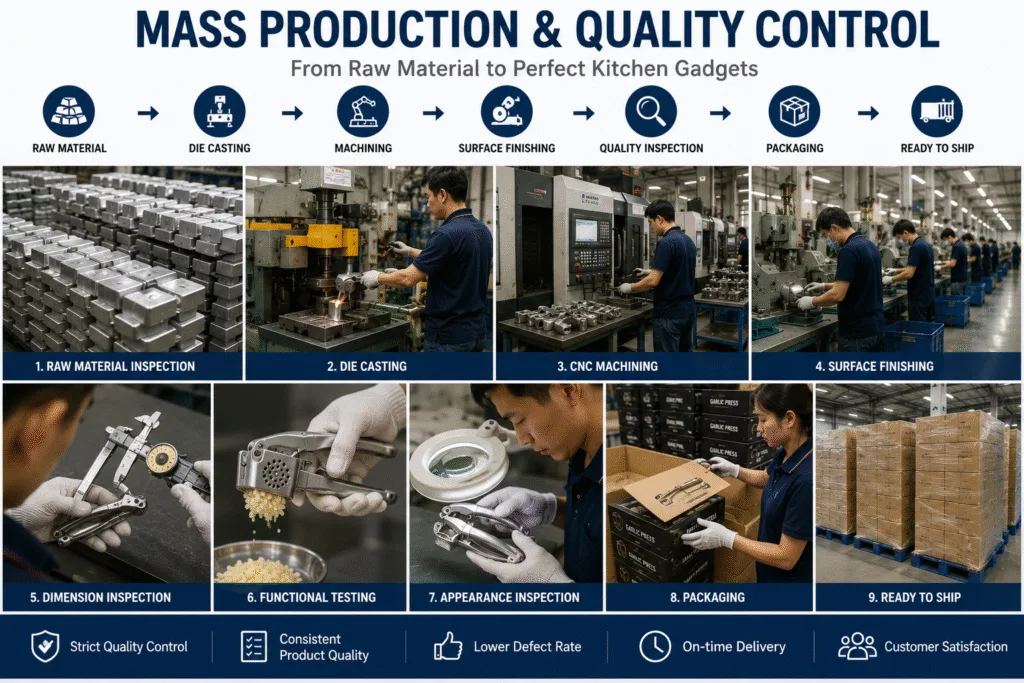
Quality control is one of the most important stages of custom product development.
Typical inspections include:
Incoming Material Inspection
Verifies raw material quality.
In-Process Inspection
Monitors production consistency.
Final Product Inspection
Checks appearance, dimensions, and functionality.
Packaging Inspection
Ensures products are ready for export.
A strong quality management system significantly reduces customer complaints and product returns.
Common Challenges in Custom Kitchen Gadget Development
Many new buyers encounter similar challenges.
Unclear Product Specifications
Incomplete requirements often cause delays.
Choosing Suppliers Based Only on Price
The lowest quotation does not always provide the best value.
Insufficient Product Testing
Skipping sample evaluation can lead to quality problems after launch.
Weak Quality Control
Without proper inspections, defect rates may increase significantly.
How to Choose the Right OEM Kitchen Gadget Manufacturer
When evaluating potential suppliers, consider:
- Manufacturing experience
- Tooling capabilities
- Quality control systems
- OEM experience
- Export history
- Communication efficiency
A reliable kitchenware manufacturer should support every stage of product development.
FAQ
What is a custom kitchen gadget?
A custom kitchen gadget is a product developed according to a buyer’s specifications, including design, branding, materials, and packaging.
How long does product development take?
Depending on complexity, development may take several weeks to several months, including prototyping and tooling.
Do I need a mold for custom kitchen gadgets?
Many aluminum and metal products require custom tooling to achieve consistent quality and efficient production.
Can manufacturers provide OEM branding?
Yes. Most experienced kitchen gadget manufacturers offer logo customization, packaging design, and private label solutions.
Why is quality control important?
Quality control helps ensure product consistency, safety, and customer satisfaction throughout the production process.