China remains the world’s largest manufacturing hub for kitchenware products, supplying supermarkets, wholesalers, eCommerce brands, hospitality suppliers, and private label companies across global markets. However, choosing the right kitchenware manufacturer in China is not simply about finding the lowest price. A reliable supplier directly impacts product quality, delivery stability, brand reputation, and long-term profitability.
For international buyers, understanding how to evaluate a kitchenware factory is essential before placing OEM or wholesale orders.
This guide explains the most important factors global buyers should consider when selecting a professional kitchenware manufacturer in China.
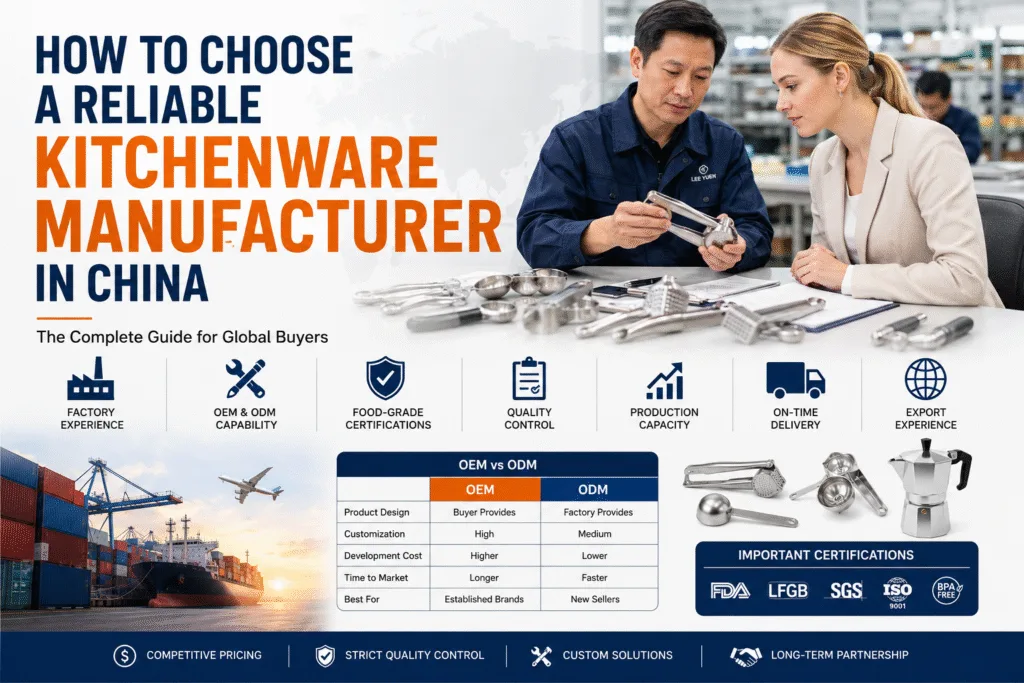
What Is a Kitchenware Manufacturer?
A kitchenware manufacturer is a company that designs, develops, and produces kitchen tools, cookware, and food preparation products for wholesalers, retailers, distributors, supermarkets, Amazon sellers, and private label brands.
Professional kitchenware manufacturers typically provide:
- OEM manufacturing
- ODM product development
- Mold customization
- Private label services
- Packaging solutions
- Bulk production
- Export support
Manufacturers may specialize in different production methods such as:
| Manufacturing Type | Common Products | Advantages |
|---|---|---|
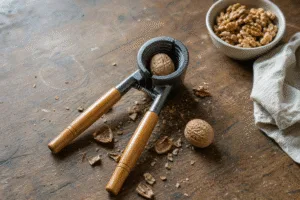
| Aluminum Die Casting | Garlic presses, nutcrackers, lemon squeezers | Durable and cost-effective |
| Stainless Steel Fabrication | Kitchen utensils, baking tools | Corrosion resistance |
| Plastic Injection Molding | Measuring cups, gadgets | Lightweight and scalable |
| CNC Machining | Premium kitchen tools | Precision manufacturing |
Why Global Buyers Source Kitchenware from China
China has developed one of the world’s most complete kitchenware supply chains. From raw materials to packaging production, nearly every stage of manufacturing can be completed within highly integrated industrial clusters.
Key advantages include:
| Advantage | Explanation |
|---|---|
| Mature Supply Chain | Fast sourcing of components and materials |
| Competitive Production Costs | Lower labor and tooling costs |
| OEM & ODM Capability | Flexible customization options |
| Large-Scale Production | Supports mass wholesale orders |
| Export Experience | Familiar with global compliance standards |
| Fast Product Development | Efficient mold-making systems |
7 Factors to Evaluate Before Choosing a Kitchenware Supplier
Selecting the wrong supplier can lead to delayed shipments, inconsistent quality, and costly product failures. Professional buyers usually evaluate factories using multiple criteria.
1. Manufacturing Experience
Manufacturing experience is one of the most important indicators of supplier reliability.
Experienced factories usually have:
- Stable production systems
- Better defect control
- Mature QC procedures
- Skilled engineering teams
- Faster problem-solving capability
When evaluating a kitchenware manufacturer, buyers should ask:
- How many years has the factory operated?
- What products are their specialties?
- Which countries do they export to?
- Do they understand international compliance requirements?
Factories with long-term export experience generally provide more stable cooperation.
2. OEM & ODM Capability
OEM and ODM capabilities are critical for modern kitchenware brands.
OEM Manufacturing
OEM manufacturing allows buyers to customize:
- Logos
- Colors
- Packaging
- Materials
- Product dimensions
ODM Manufacturing
ODM manufacturing provides ready-made product designs that buyers can brand and modify.
| OEM vs ODM | OEM | ODM |
|---|---|---|
| Product Design | Buyer provides | Factory provides |
| Customization Level | High | Medium |
| Development Cost | Higher | Lower |
| Time to Market | Longer | Faster |
| Best For | Established brands | New sellers |
Professional manufacturers should support both OEM and ODM solutions.
3. Food-Grade Certifications
Kitchenware products must comply with food-contact safety regulations.
Reliable manufacturers should support certifications such as:
| Certification | Market | Purpose |
|---|---|---|
| FDA | USA | Food-contact compliance |
| LFGB | Europe | Food safety standards |
| SGS Testing | Global | Product inspection |
| BPA Free | Global | Material safety |
| ISO 9001 | Global | Quality management |
Factories without certification experience may create serious import risks for buyers.
4. Quality Control System
Quality control is one of the biggest differences between professional factories and low-cost suppliers.
Reliable kitchenware factories usually implement:
- Raw material inspections
- In-process inspections
- Finished product inspections
- Packaging inspections
- Drop tests
- Salt spray tests
- Durability testing
Example of Typical QC Workflow
| Production Stage | QC Inspection |
|---|---|
| Raw Materials | Material composition verification |
| Die Casting | Surface defect inspection |
| Polishing | Finish consistency check |
| Assembly | Functional testing |
| Packaging | Carton integrity inspection |
Strict quality control reduces defect rates and protects brand reputation.
5. Production Capacity
Production capacity determines whether a supplier can handle large wholesale orders during peak seasons.
Buyers should evaluate:
- Number of production lines
- Factory size
- Worker quantity
- Lead time stability
- Monthly production volume
For example, a professional aluminum kitchenware manufacturer may produce:
| Product | Monthly Capacity |
|---|---|
| Garlic Press | 100,000+ pcs |
| Lemon Squeezer | 80,000+ pcs |
| Nutcracker | 60,000+ pcs |
| Pizza Cutter | 120,000+ pcs |
Stable production capacity helps prevent delayed deliveries.
6. Lead Time Stability
Delayed shipments can severely impact retailers and distributors.
Professional manufacturers usually provide:
- Stable material procurement
- Production scheduling systems
- Inventory planning
- Export logistics coordination
Typical lead times for kitchenware products:
| Order Type | Lead Time |
|---|---|
| Standard Products | 15–25 days |
| OEM Orders | 25–40 days |
| New Mold Development | 35–60 days |
Factories with unstable lead times may struggle during high-demand seasons.
7. Export Experience
Export experience is especially important for international buyers.
Experienced exporters understand:
- Packaging standards
- Barcode requirements
- Carton drop testing
- Amazon FBA requirements
- Customs documentation
- International shipping processes
Factories with strong export backgrounds usually communicate more efficiently and reduce sourcing risks.
Red Flags When Working with Kitchenware Factories
Some suppliers appear competitive initially but create serious long-term problems.
Buyers should avoid factories with these warning signs:
| Red Flag | Potential Risk |
|---|---|
| Extremely low pricing | Poor material quality |
| No certifications | Import compliance issues |
| Slow communication | Project delays |
| No factory photos/videos | Trading company risks |
| No QC explanation | High defect rates |
| Unrealistic lead times | Delivery instability |
| No product testing | Durability issues |
Choosing suppliers based only on price often increases overall procurement costs.
OEM vs ODM Kitchenware Manufacturing
Many buyers misunderstand the differences between OEM and ODM manufacturing.
Understanding both models helps buyers select the right business strategy.
| Comparison | OEM | ODM |
|---|---|---|
| Product Ownership | Buyer-owned | Factory-owned |
| Branding | Fully customized | Semi-customized |
| Mold Development | Required | Usually unnecessary |
| Development Time | Longer | Faster |
| Initial Investment | Higher | Lower |
| Product Uniqueness | High | Medium |
| Best For | Established brands | Startup sellers |
OEM manufacturing is ideal for companies building long-term brand differentiation.
ODM manufacturing is more suitable for rapid market entry.
Why Aluminum Kitchenware Is Popular Worldwide
Aluminum remains one of the most widely used materials in kitchen tool manufacturing.
Common aluminum kitchenware products include:
Benefits of Aluminum Kitchen Tools
| Benefit | Explanation |
|---|---|
| Lightweight | Easy daily use |
| Durable | Strong structural performance |
| Cost-Effective | Efficient for mass production |
| Corrosion Resistance | Long-term durability |
| Surface Finish Flexibility | Supports polishing and coating |
Aluminum die-casting technology also enables complex product designs with consistent dimensions.
How to Verify a Kitchenware Manufacturer Before Ordering
Before placing bulk orders, buyers should conduct supplier verification.
Recommended verification methods include:
| Verification Method | Purpose |
|---|---|
| Video Factory Tour | Verify production capability |
| Product Samples | Evaluate product quality |
| Certification Review | Confirm compliance |
| Third-Party Inspection | Reduce sourcing risk |
| Customer References | Verify export experience |
Professional suppliers are usually willing to provide transparent factory information.
Best Practices for Long-Term Supplier Cooperation
Long-term supplier relationships often create better pricing, faster development, and more stable production.
Recommended practices include:
- Maintain clear product specifications
- Confirm packaging standards early
- Use detailed QC standards
- Build rolling forecasts
- Conduct regular supplier evaluations
Stable cooperation reduces procurement uncertainty over time.
Future Trends in Kitchenware Manufacturing
The kitchenware industry continues evolving toward:
| Trend | Market Direction |
|---|---|
| Sustainable Materials | Eco-friendly production |
| Smart Kitchen Gadgets | Technology integration |
| Premium Finishes | Higher-end retail demand |
| Multifunctional Tools | Space-saving solutions |
| Private Label Growth | Brand customization |
Manufacturers with strong R&D capability are better positioned for future market changes.
Why Professional Buyers Choose Experienced Kitchenware Manufacturers
Professional kitchenware manufacturers provide more than product production.
They also help buyers improve:
- Supply chain stability
- Product consistency
- Market competitiveness
- Brand image
- Delivery reliability
For wholesalers, retailers, and private label brands, choosing a reliable kitchenware manufacturer is one of the most important long-term sourcing decisions.
Frequently Asked Questions
What is the MOQ for OEM kitchenware orders?
MOQ typically ranges from 500–1000 pieces depending on product type and customization level.
Can kitchenware manufacturers customize packaging?
Yes. Most professional factories support custom packaging, barcode labels, and retail-ready solutions.
Which certification is most important for European markets?
LFGB certification is one of the most important food-contact compliance standards for Europe.
What materials are commonly used in kitchen tools?
Common materials include aluminum alloy, stainless steel, zinc alloy, silicone, and BPA-free plastics.
How long does OEM production usually take?
OEM production typically requires 25–40 days depending on customization complexity.
Can suppliers develop products based on drawings?
Yes. Professional manufacturers can produce products according to CAD drawings, 3D files, or physical samples.
What is die casting in kitchenware manufacturing?
Die casting is a process where molten aluminum or zinc alloy is injected into precision molds to create durable kitchen tools.
Why do buyers prefer direct factory cooperation?
Direct factory cooperation usually improves pricing, communication efficiency, and customization flexibility.
What should buyers inspect during factory audits?
Buyers should inspect production lines, QC systems, certifications, warehouse management, and packaging operations.
How do manufacturers reduce product defects?
Manufacturers reduce defects through standardized QC procedures, material inspections, and production testing.