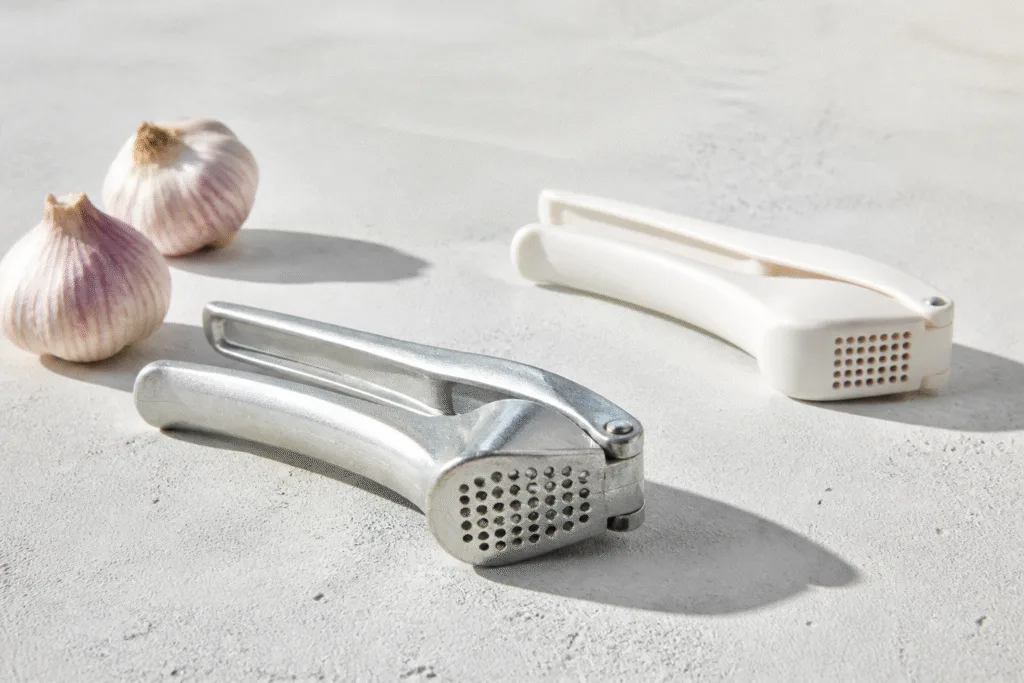
For wholesalers, kitchenware brands, and foodservice suppliers, a garlic press may look like a simple kitchen tool. But once you start sourcing it in bulk, the differences between products become much more important.
Material, casting quality, handle design, surface finish, pressing force, durability, and consistency between production batches can all affect the final product.
This is why aluminum garlic presses are attracting more attention from buyers looking for a durable metal alternative to low-cost plastic models.
For manufacturers and private-label brands, aluminum also provides opportunities for custom designs, different surface finishes, branding, and OEM production.
Why Buyers Are Looking Beyond Plastic Garlic Presses
Plastic garlic presses can be inexpensive and lightweight, but they may not always provide the durability expected from a long-term kitchen tool.
A metal garlic press offers a different value proposition.
For everyday users, the main benefit is a stronger structure. For commercial buyers, the more important consideration is whether the product can maintain its performance through repeated use.
A well-designed aluminum garlic press can provide:
- A rigid metal body
- Good resistance to repeated pressing
- A solid hand feel
- A durable surface
- More opportunities for custom designs
- Better positioning for mid-range and premium kitchenware
This makes aluminum particularly interesting for brands that do not want their products to compete purely on the lowest price.
What Makes Aluminum Suitable for a Garlic Press?
The material used in a garlic press has a direct influence on its weight, strength, appearance, and manufacturing possibilities.
Aluminum alloy is particularly useful because it can be formed into relatively complex shapes through die casting.
This allows manufacturers to produce integrated bodies and ergonomic shapes while maintaining consistent dimensions across large production runs.
For buyers, the important point is not simply that a product is made from aluminum.
The alloy, casting quality, wall thickness, machining, finishing, and inspection process all influence the final product.
A poorly manufactured aluminum garlic press can still have problems such as rough edges, inconsistent surfaces, weak connections, or difficult operation.
Material alone does not guarantee product quality.
How an Aluminum Garlic Press Is Made
The manufacturing process usually involves several stages, and each stage can affect the finished product.
Product Design and Engineering
Production starts with the product design.
Manufacturers need to consider:
- Overall dimensions
- Handle shape
- Pressing chamber size
- Hinge structure
- Load-bearing areas
- Ergonomics
- Cleaning requirements
- Assembly method
For OEM projects, the buyer may provide an existing design, drawing, sample, or initial concept.
The manufacturer then develops the design for actual production.
Mold Development
For die-cast aluminum garlic presses, the mold is one of the most important production investments.
The mold needs to accommodate:
- Material flow
- Product geometry
- Wall thickness
- Ejection
- Cooling
- Dimensional stability
Poor mold design can create defects that become expensive to correct after mass production begins.
This is why buyers evaluating an aluminum garlic press manufacturer should look beyond the finished product and ask whether the supplier has in-house mold development capabilities.
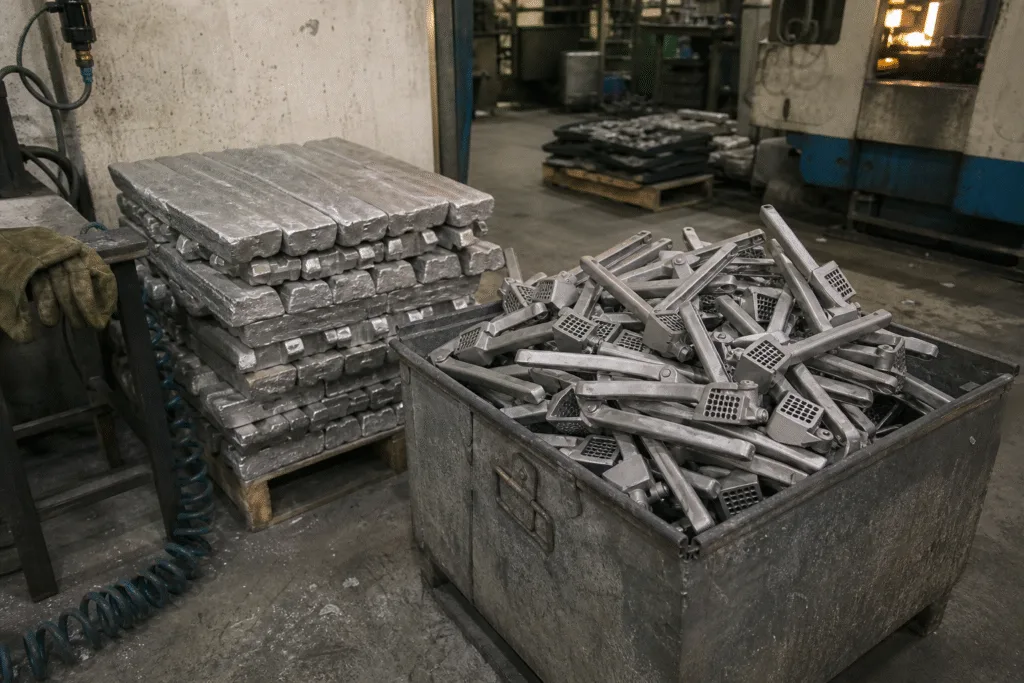
Aluminum Die Casting
Molten aluminum alloy is injected into the mold under pressure.
The process allows manufacturers to produce repeatable metal components at scale.
For garlic presses, die casting can be particularly useful for creating ergonomic handles and complex structural shapes without relying entirely on machining from solid material.
After casting, the components still require additional processing.
Trimming and Deburring
Excess material from the casting process needs to be removed.
Edges are trimmed and deburred to improve safety, appearance, and assembly.
This stage is particularly important for handheld kitchen tools because rough edges can negatively affect both user experience and perceived quality.
Machining and Surface Finishing
Depending on the product design, certain areas may require additional machining.
Surface treatment can then be applied to improve appearance and protect the product.
Possible finishing options include different polished, brushed, coated, or anodized effects depending on the design and material requirements.
For private-label brands, surface finishing is also an important part of visual differentiation.
Assembly and Quality Inspection
The individual components are assembled and inspected before packaging.
A garlic press may be checked for:
- Handle alignment
- Hinge movement
- Pressing performance
- Surface defects
- Sharp edges
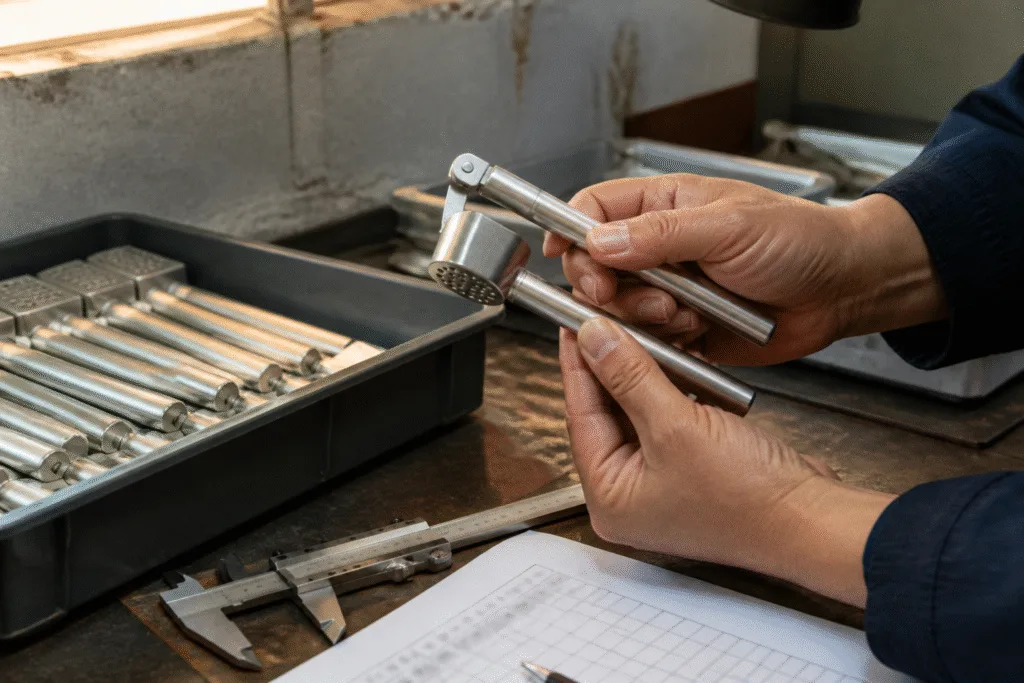
- Dimensional consistency
- Assembly strength
- Appearance
For large B2B orders, consistent quality across the entire production batch is more important than simply having a few good samples.
What Should Buyers Check Before Ordering Aluminum Garlic Presses?
A sample should be evaluated from several different perspectives.
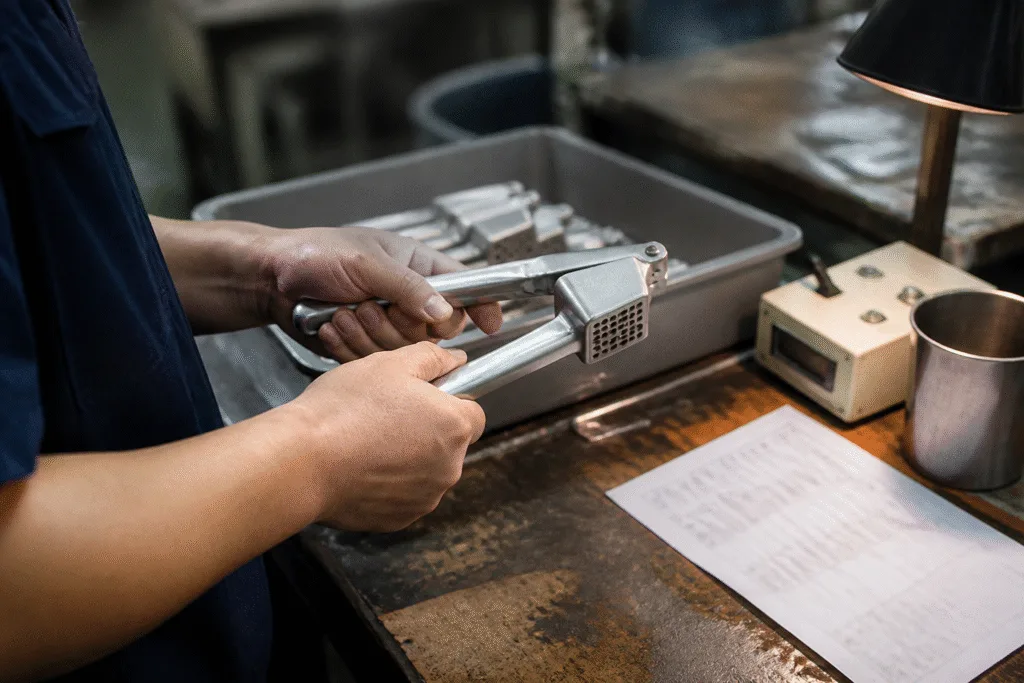
1. Pressing Performance
The press should operate smoothly without excessive force or unstable movement.
The handle should also feel comfortable during repeated use.
2. Structural Strength
Pay attention to the hinge, handle connection, pressing chamber, and other areas exposed to repeated force.
These are potential weak points if the design or manufacturing quality is poor.
3. Surface Quality
Inspect the casting surface for:
- Visible porosity
- Cracks
- Deep scratches
- Uneven finishing
- Excessive casting marks
- Rough edges
A premium kitchenware product needs a finish that matches its target market.
4. Dimensional Consistency
If the buyer is ordering thousands of units, dimensions need to remain consistent between batches.
This becomes especially important when multiple components must fit together.
5. Cleaning and Food Contact
The product should be designed with practical cleaning requirements in mind.
For brands selling in different international markets, buyers should also confirm the applicable food-contact requirements and documentation before placing a large order.
Aluminum Garlic Press vs Other Materials
Aluminum is not automatically the best material for every garlic press.
Different materials offer different advantages.
| Material | Main Advantage | Typical Positioning |
|---|---|---|
| Aluminum alloy | Lightweight metal structure and casting flexibility | Mid-range to premium |
| Stainless steel | High corrosion resistance and strong metal construction | Premium/commercial |
| Zinc alloy | Good casting performance and solid feel | Mid-range |
| Plastic | Low cost and lightweight | Entry-level |
For buyers, the right material depends on the intended market, target retail price, product design, and expected usage.
An importer supplying discount retailers may prioritize cost.
A private-label kitchenware brand may place greater emphasis on appearance, durability, packaging, and differentiation.
A foodservice supplier may prioritize repeated-use performance.
When Does Customization Make Sense?
A standard garlic press may be sufficient for buyers who simply want to add another kitchen tool to an existing catalog.
Customization becomes more valuable when the product is part of a private-label strategy.
Possible customization options include:
- Handle shape
- Product dimensions
- Surface finish
- Color
- Logo
- Packaging
- Gift box
- Retail packaging
- Product combination
- Customized mold
For larger orders, a manufacturer can develop the product around the buyer’s requirements rather than simply supplying an existing catalog model.
This is where working directly with an aluminum garlic press manufacturer can provide an advantage over buying through multiple trading layers.
What Makes a Reliable Garlic Press Supplier?
Price is only one part of supplier evaluation.
Before selecting a supplier, buyers should look at the manufacturer’s production capabilities.
A reliable supplier should be able to clearly explain:
Where is the product manufactured?
A genuine factory should be able to provide information about its production facility and manufacturing process.
Can the supplier develop molds?
For customized aluminum products, mold development capability can significantly affect development speed and communication efficiency.
What happens after casting?
Ask about trimming, machining, polishing, surface treatment, assembly, and inspection.
How is quality controlled?
The supplier should have a defined inspection process rather than relying only on visual inspection at the end.
Can the supplier handle OEM projects?
For private-label buyers, product development, logo application, packaging, and production coordination are all important.
Why Direct Factory Production Matters
For B2B buyers, working directly with a manufacturer can provide more visibility into the production process.
At LeeYuen Kitchenware, aluminum kitchen tools can be developed through an integrated manufacturing process covering mold development, die casting, processing, assembly, quality inspection, and packaging.
This is particularly relevant for buyers who need more than a standard catalog product.
For an OEM project, having manufacturing capabilities under one production system can make communication easier from initial design through mass production.
It can also make it easier to identify where a quality problem occurs if adjustments are required.
Common Problems With Low-Quality Garlic Presses
Buyers should be cautious about products that appear attractive in a sample but perform poorly during repeated use.
Common problems include:
- Weak hinges
- Excessive handle movement
- Rough casting edges
- Uneven surface treatment
- Poor component alignment
- Inconsistent dimensions
- Difficult pressing action
- Surface defects
- Loose assembly
Some problems may not become obvious until the product has been used repeatedly.
Therefore, B2B buyers should not evaluate a garlic press only by its appearance.
Functional testing and production consistency are equally important.
Is Aluminum a Good Choice for Your Garlic Press Line?
For brands positioned around affordable metal kitchenware, aluminum can be an attractive material.
It provides manufacturers with flexibility in product design while giving buyers a stronger alternative to basic plastic models.
The decision ultimately depends on the target market.
If your customers value lightweight metal construction, ergonomic design, attractive finishing, and reasonable production costs, an aluminum garlic press may fit well within your product range.
For higher-end commercial applications, stainless steel may still be preferable depending on the required durability and operating environment.
The best choice is therefore not simply about choosing the strongest material.
It is about matching material, design, manufacturing process, target price, and end use.
Can aluminum garlic presses be customized?
Yes. Depending on the project, manufacturers can customize product dimensions, handle designs, surface finishes, branding, and packaging. More extensive customization may require a new mold.
Are aluminum garlic presses suitable for commercial use?
They can be suitable for commercial and foodservice applications when the product is properly designed and manufactured for repeated use. Buyers should evaluate structural strength and applicable food-contact requirements.
Can aluminum garlic presses be manufactured with OEM branding?
Yes. OEM projects can include customized products, logos, packaging, and other specifications depending on the manufacturer’s production capabilities and order requirements.
What should I ask an aluminum garlic press supplier?
Ask about material specifications, mold development, production process, quality inspection, customization, packaging, minimum order quantity, lead time, and relevant compliance documentation.
Is die casting suitable for garlic press production?
Yes. Aluminum die casting is suitable for producing repeatable metal components with complex shapes and consistent dimensions at production scale.