Introduction
Launching a kitchen products brand does not always require developing completely new products from scratch.
For many wholesalers, retailers, importers, e-commerce brands, and distributors, private label kitchen gadgets provide a practical way to enter the market with proven products while building a recognizable brand.
Instead of investing heavily in product development from the beginning, a business can select existing kitchen gadgets, customize branding and packaging, and sell them under its own brand.
However, private label does not simply mean adding a logo to an existing product.
The most successful private label programs consider the entire product presentation, including product selection, materials, finish, branding, packaging, quality control, MOQ, and long-term supply.
For kitchen gadget businesses, this model can work particularly well for practical products such as garlic presses, lemon squeezers, walnut crackers, ice cream scoops, meat tenderizers, and pizza cutters.
This guide explains how B2B buyers can build a private label kitchen gadget product line, what can be customized, how to choose products, and how to select the right manufacturing partner.
What Are Private Label Kitchen Gadgets?
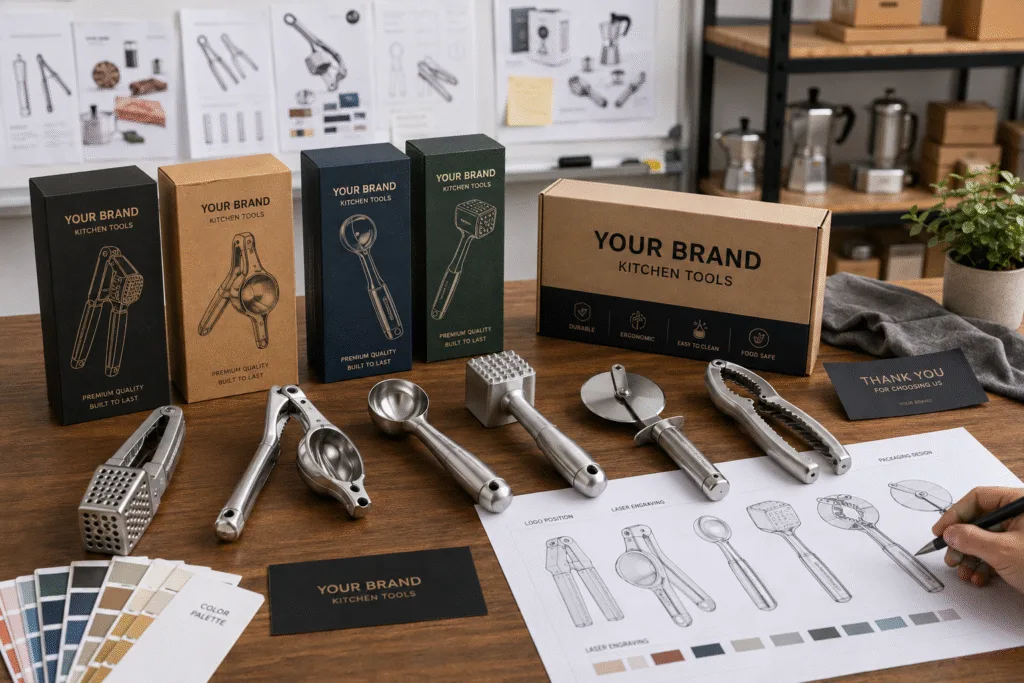
Private label kitchen gadgets are kitchen tools manufactured by a supplier and sold under the buyer’s own brand.
The manufacturer may already have established products, while the buyer controls the branding and market presentation.
Depending on the supplier, private label customization can include:
- Brand logo
- Product color
- Surface finish
- Packaging
- Labels
- Product combinations
- Minor product modifications
- Retail presentation
For example, a supplier may already manufacture an aluminum garlic press.
A private label customer could potentially purchase that product with:
Existing Product + Custom Logo + Brand Packaging + Retail Label
The final product is then marketed under the customer’s brand.
This approach can significantly reduce the product development requirements compared with creating an entirely new kitchen gadget.
Private Label vs OEM vs ODM Kitchen Gadgets
One of the first decisions a B2B buyer needs to make is whether private label, OEM, or ODM manufacturing is the right model.
| Factor | Private Label | OEM | ODM |
|---|---|---|---|
| Product starting point | Existing product | Buyer’s design/specification | Manufacturer-assisted design |
| Development cost | Lower | Higher | Medium to high |
| Product customization | Low to medium | High | High |
| Launch speed | Fast | Slower | Medium |
| Product differentiation | Medium | High | High |
| Custom mold | Usually not required | May be required | May be required |
| Best for | Market testing and branding | Unique products | Product development |
| Initial risk | Lower | Higher | Medium |
Private Label
Best when the buyer wants to launch quickly and does not need a completely unique product.
OEM
Better when the buyer already has specific product drawings, dimensions, materials, or technical requirements.
ODM
Useful when the buyer wants the manufacturer to participate in product development.
For many new brands, private label can be the starting point, while successful products can later move into OEM or ODM development.
Why Choose Private Label Kitchen Gadgets?
Faster Market Entry
Using an existing product can significantly shorten the development process.
Instead of starting with product design and mold development, buyers can begin by evaluating available products and selecting suitable models.
This can be particularly useful when testing a new market.
Lower Initial Development Investment
Developing a completely new kitchen gadget may require:
- Product design
- Engineering
- Prototyping
- Mold development
- Testing
- Tooling
Private label products can reduce some of these initial requirements.
This allows brands to allocate more resources toward:
- Branding
- Packaging
- Marketing
- Distribution
- Inventory
Lower Product Development Risk
Existing kitchen gadgets have already gone through a manufacturing process.
The buyer can inspect samples before making a large investment.
This provides an opportunity to evaluate:
- Product functionality
- Material
- Dimensions
- Surface finish
- Assembly
- User experience
before committing to large-scale production.
Easier Product Line Expansion
Private label also makes it easier to build a broader product line.
For example, a brand could start with:
- Garlic press
- Lemon squeezer
- Walnut cracker
and later add:
- Ice cream scoop
- Meat tenderizer
- Pizza cutter
- Moka pot
This allows the brand to expand gradually rather than developing an entire catalog at once.
What Kitchen Gadgets Are Suitable for Private Label?
Not every product is equally suitable for private labeling.
The ideal products are usually:
- Easy to understand
- Practical
- Suitable for repeated use
- Relatively easy to package
- Easy to demonstrate
- Suitable for retail or e-commerce
- Available in multiple variations
Garlic Press
Garlic presses are highly practical kitchen tools and can be suitable for private label programs.
Possible customization may include:
- Logo
- Finish
- Handle design
- Packaging
- Color
Lemon Squeezer
A lemon squeezer is another straightforward product for branded kitchen tool collections.
Brands can position it around:
- Home cooking
- Baking
- Cocktail preparation
- Food preparation
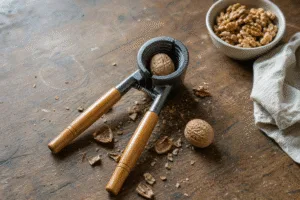
Walnut Cracker
A walnut cracker can be positioned as a seasonal or everyday kitchen accessory.
For private label brands, packaging and surface finish can have a strong impact on product presentation.
Ice Cream Scoop
Ice cream scoops can serve both household and foodservice markets.
They may be suitable for brands targeting:
- Home kitchens
- Dessert shops
- Restaurants
- Foodservice distributors
Meat Tenderizer
Meat tenderizers can be positioned as practical cooking tools for home chefs and professional kitchens.
Material, weight, grip, surface finish, and packaging should be carefully evaluated.
Pizza Cutter
Pizza cutters are simple products but can fit well into broader kitchen tool collections.
A brand can combine several related products to create a coordinated kitchen gadget range.
What Can You Customize in Private Label Kitchen Gadgets?
Private label customization goes beyond putting a logo on the product.
1. Brand Logo
Depending on the material and product design, branding methods may include:
- Laser engraving
- Embossing
- Printing
- Other suitable marking methods
The branding method should be selected according to the material, surface, quantity, and desired appearance.
2. Product Color
Color can help create a consistent visual identity across a product line.
For example, a brand may use a consistent color theme across:
- Garlic presses
- Lemon squeezers
- Ice cream scoops
- Meat tenderizers
Color consistency can make products easier to recognize on retail shelves and online stores.
3. Surface Finish
For metal kitchen gadgets, surface finish can significantly influence perceived product quality.
Possible finishes may include:
- Polished
- Matte
- Brushed
- Coated
The selected finish should also be appropriate for the intended product application.
4. Packaging
Packaging is one of the most important private label elements.
It can include:
- Custom boxes
- Color boxes
- Sleeves
- Insert cards
- Instruction cards
- Brand labels
- Barcodes
- Retail packaging
A product with professional packaging can create a very different retail experience from the same product sold in generic packaging.
Private Label Kitchen Gadgets Are More Than a Logo
A common mistake is to think:
Private Label = Add Logo
In reality:
Private Label = Product + Branding + Packaging + Quality + Market Positioning
A successful private label product should feel like part of a complete brand.
The product, packaging, colors, photography, product descriptions, and retail presentation should communicate a consistent message.
This is particularly important for online brands because customers often evaluate product quality before they physically touch the product.
How Much Do Private Label Kitchen Gadgets Cost?
There is no single price for private label kitchen gadgets.
The total cost depends on several factors.
Product
Different kitchen gadgets have different manufacturing costs.
Material
Aluminum alloy, stainless steel, zinc alloy, and other materials can have different costs.
Quantity
Larger production quantities may provide better unit economics.
Branding
The cost of applying a logo depends on the method and order quantity.
Packaging
Custom retail packaging can add design, material, printing, and assembly costs.
Tooling
Existing products may not require new tooling, while customized products may require mold modifications or new molds.
Shipping
International freight and packaging dimensions can affect the final landed cost.
For this reason, buyers should compare total sourcing cost, rather than looking only at the factory unit price.
What MOQ Should You Expect?
MOQ means Minimum Order Quantity.
Private label MOQ can vary depending on:
- Product
- Material
- Logo method
- Packaging
- Color
- Customization
- Production process
For example, applying a simple logo to an existing product may have different requirements from developing a completely new product and packaging system.
Before placing an order, buyers should ask suppliers for a project-specific MOQ.
It is also useful to compare:
MOQ + Unit Price + Packaging Cost + Tooling Cost
rather than considering MOQ alone.
How to Choose Products for a Private Label Kitchen Gadget Line
One of the biggest challenges for new brands is deciding which products to launch first.
A common mistake is trying to introduce too many products at once.
A better approach is to start with a small group of complementary products.
Start With 3–5 Core Products
For example:
Core Product Group
- Garlic press
- Lemon squeezer
- Walnut cracker
Then expand into:
Additional Products
- Ice cream scoop
- Meat tenderizer
- Pizza cutter
This approach allows the brand to test customer response before committing significant inventory to a large product catalog.
Build Products Around a Clear Customer
Your product selection should match your target customer.
For example:
Home Cooking Brand
Focus on:
- Garlic press
- Lemon squeezer
- Meat tenderizer
- Pizza cutter
Baking and Dessert Brand
Focus on:
- Ice cream scoop
- Pastry-related tools
- Measuring and preparation tools
Professional Foodservice Brand
Focus on:
- Durable metal tools
- High-use kitchen accessories
- Commercial-oriented products
A private label kitchen gadget line should have a clear purpose rather than simply containing as many products as possible.
How to Build a Private Label Kitchen Gadget Product Line
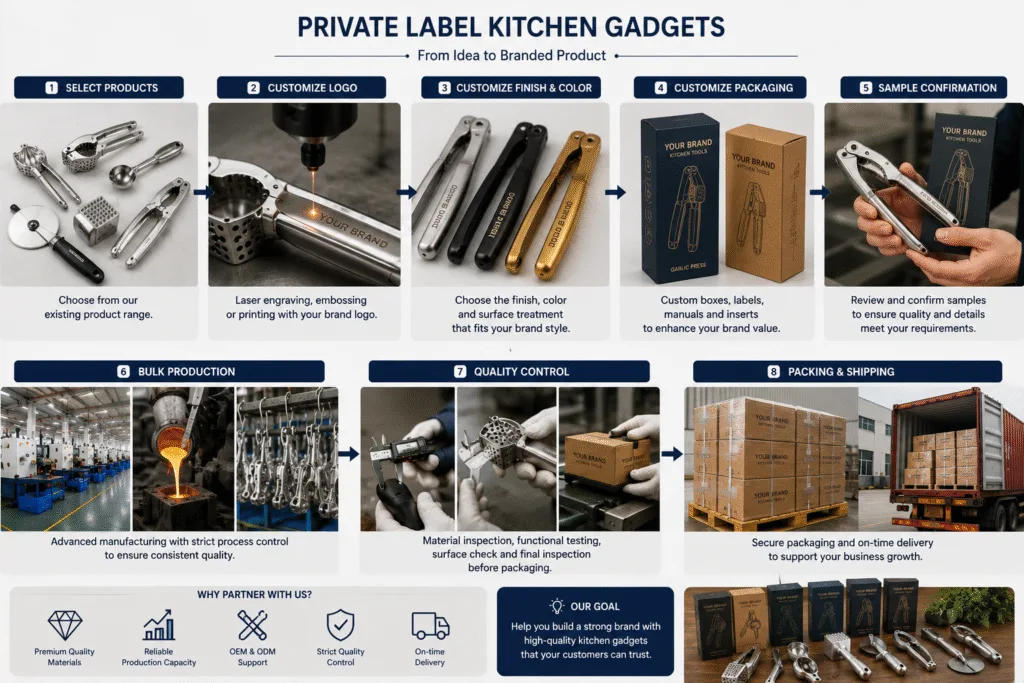
Step 1: Define Your Target Market
Determine whether you are targeting:
- Retail consumers
- E-commerce customers
- Wholesale distributors
- Restaurants
- Foodservice
- Supermarkets
- Specialty kitchen stores
Step 2: Select Your Initial Products
Choose products that fit your target customer and brand positioning.
Focus on practical products with clear consumer benefits.
Step 3: Evaluate Existing Products
Request samples from potential suppliers.
Check:
- Material
- Weight
- Dimensions
- Function
- Surface finish
- Assembly
- Durability
Step 4: Decide What to Customize
Not every element needs to be customized.
For an initial launch, consider prioritizing:
Logo + Packaging + Product Selection
More extensive customization can be introduced after the product has been validated.
Step 5: Develop Your Packaging
Create packaging that matches your brand identity.
Consider:
- Brand colors
- Logo placement
- Product photography
- Product information
- Barcode
- Instructions
- Retail requirements
Step 6: Approve Samples
Before mass production, approve the final product and packaging samples.
The approved sample should become the reference for production.
Step 7: Start Mass Production
Once specifications and samples are confirmed, production can begin.
Clear communication at this stage is essential.
Step 8: Monitor Quality
Quality should be monitored before products leave the factory.
Important inspection areas include:
- Dimensions
- Appearance
- Function
- Assembly
- Packaging
Step 9: Evaluate Market Performance
After launch, monitor:
- Sales
- Customer feedback
- Returns
- Reviews
- Repeat purchases
Use this information to decide which products should receive more investment.
How to Choose a Private Label Kitchen Gadgets Supplier
Choosing the right supplier is one of the most important parts of a private label project.
Do not evaluate a supplier only by its product catalog or quotation.
Look at:
Product Experience
Does the supplier have experience manufacturing the products you want?
Customization
Can the supplier provide logo, finish, color, and packaging customization?
Manufacturing Capability
Does the supplier have relevant production capabilities?
Quality Control
Does the supplier have clear inspection procedures?
Production Capacity
Can the supplier support both initial and repeat orders?
Communication
Can the supplier clearly understand product specifications and provide timely feedback?
Long-Term Support
Can the supplier help you expand your product line in the future?
Why Manufacturing Capability Matters for Private Label Brands
Private label customers may start with existing products, but manufacturing capability still matters.
For example, a supplier with aluminum die-casting capabilities may be able to provide greater control over aluminum kitchen gadgets.
A production system may include:
Mold Development → Aluminum Die Casting → CNC Machining → Surface Finishing → Assembly → Quality Control → Packaging
This can be particularly valuable when a brand eventually wants to move from basic private labeling toward more customized products.
A supplier that already understands the manufacturing process can potentially support that transition more efficiently.
Private Label to OEM: A Natural Growth Path
Private label does not have to be the final stage of a brand’s product development.
It can be the first stage.
A practical growth strategy may look like:
Stage 1 — Private Label
Use proven products with your branding.
↓
Stage 2 — Market Testing
Evaluate sales and customer feedback.
↓
Stage 3 — Product Optimization
Modify selected products based on market requirements.
↓
Stage 4 — OEM Development
Develop products with more unique specifications.
↓
Stage 5 — Proprietary Product Line
Invest in products that provide stronger differentiation.
This approach allows brands to increase product development investment as market confidence grows.
Private Label Kitchen Gadgets and Quality Control
Private label products carry your brand name.
That means manufacturing quality directly affects your reputation.
A suitable quality control system may include:
Material Inspection
Verify incoming materials before production.
Dimensional Inspection
Check important product dimensions.
Surface Inspection
Look for scratches, dents, uneven finishing, and other appearance problems.
Functional Testing
Verify that the product performs its intended function.
Assembly Inspection
Check component fit and assembly quality.
Final Inspection
Inspect finished products before packaging and shipment.
For private label brands, establishing clear quality requirements before production is especially important.
Private Label Kitchen Gadget Packaging
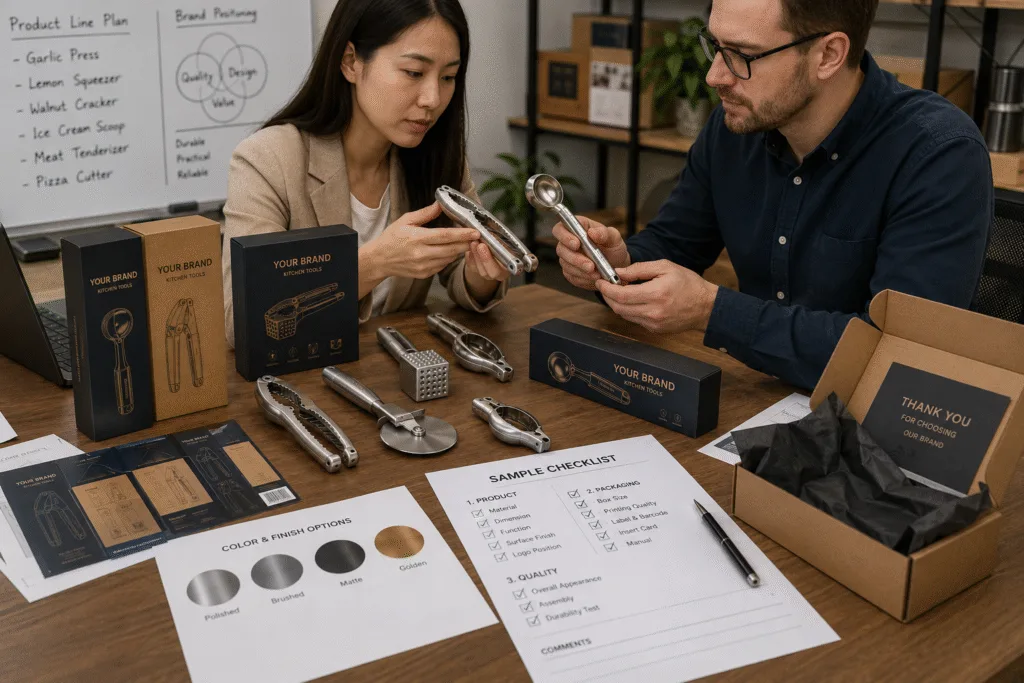
Packaging deserves special attention because it is often the first physical interaction between a customer and your brand.
A strong packaging system can communicate:
- Brand identity
- Product benefits
- Product specifications
- Instructions
- Safety information
- Retail information
For online brands, packaging can also contribute to the unboxing experience.
A consistent packaging design across multiple kitchen gadgets can make separate products look like part of one professional product family.
Common Private Label Kitchen Gadget Mistakes
Launching Too Many Products
A large product catalog can create unnecessary inventory risk.
Start with a focused product selection.
Choosing Only by Price
The cheapest supplier may not provide the best quality or long-term value.
Ignoring Samples
Always evaluate physical samples before large-scale production.
Treating Branding as an Afterthought
A private label product should be designed as part of a brand system.
Over-Customizing Too Early
New brands do not always need completely unique products from the beginning.
Test the market first when appropriate.
Ignoring Repeat Orders
A supplier should be capable of maintaining consistent quality across multiple production batches.
Not Defining Quality Standards
Clear specifications and approved samples can reduce production misunderstandings.
A Practical Private Label Strategy for New Kitchen Gadget Brands
For a new brand, a relatively low-risk approach is:
Phase 1: Product Testing
Select 3–5 practical kitchen gadgets.
Phase 2: Brand Development
Apply consistent branding and packaging.
Phase 3: Market Launch
Test sales through your selected channels.
Phase 4: Performance Analysis
Identify your best-selling products.
Phase 5: Product Expansion
Add related kitchen tools.
Phase 6: Custom Development
Develop OEM or ODM products after identifying proven market demand.
This approach can help a brand avoid committing too much capital before understanding its market.
FAQ
What are private label kitchen gadgets?
Private label kitchen gadgets are kitchen tools produced by a supplier and sold under a buyer’s own brand. Products can often be customized with logos, packaging, colors, finishes, and other specifications.
What is the difference between private label and OEM kitchen gadgets?
Private label usually starts with an existing product, while OEM manufacturing is generally based on the buyer’s own specifications or design and allows greater customization.
Can I put my logo on kitchen gadgets?
Yes. Depending on the product and material, suppliers may offer laser engraving, printing, embossing, or other suitable branding methods.
Can I customize private label kitchen gadget packaging?
Yes. Custom boxes, sleeves, labels, insert cards, instruction cards, and retail packaging can be part of a private label project.
What is the MOQ for private label kitchen gadgets?
MOQ varies according to the product, material, logo method, packaging, customization, and production requirements. Buyers should request a project-specific MOQ.
Are aluminum kitchen gadgets suitable for private labeling?
Yes. Aluminum kitchen gadgets such as garlic presses, lemon squeezers, ice cream scoops, and meat tenderizers can be suitable for private label programs, depending on the product and target market.
How many products should a new private label brand launch?
There is no universal number, but starting with approximately 3–5 complementary products can make market testing and inventory management easier.
Can private label products later become OEM products?
Yes. A brand can start with existing products and gradually develop more customized or proprietary products after validating market demand.
How do I find a private label kitchen gadgets supplier?
Look for suppliers with relevant product experience, manufacturing capabilities, customization services, quality control, production capacity, and experience supporting international B2B customers.