Introduction
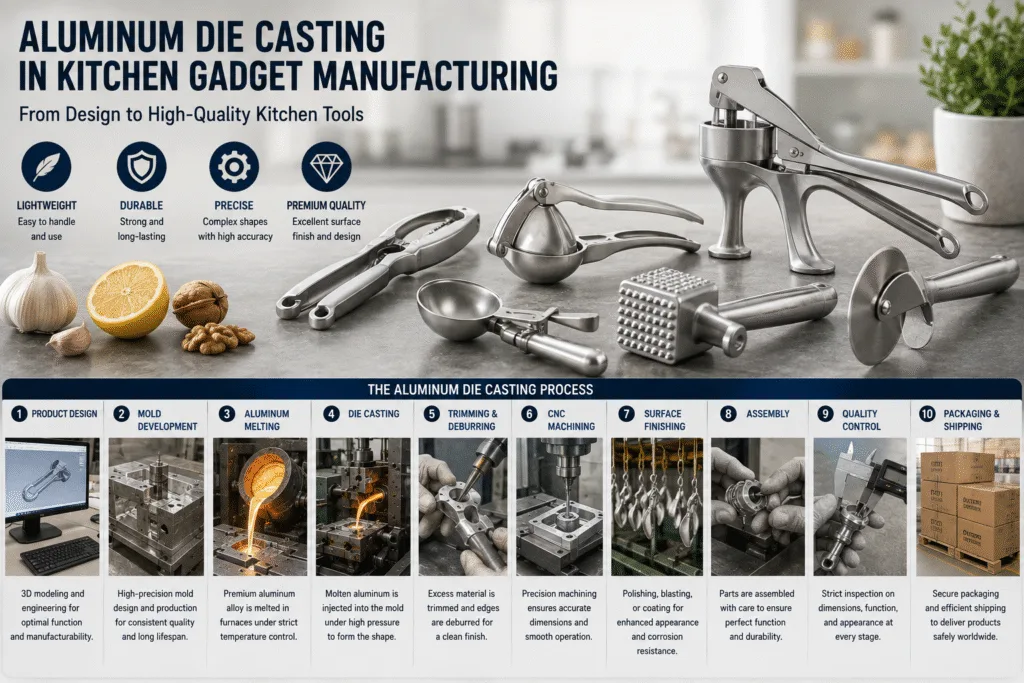
Aluminum die casting has become an important manufacturing process for producing durable, lightweight, and precisely shaped kitchen gadgets. From garlic presses and lemon squeezers to nutcrackers, meat tenderizers, and ice cream scoops, die-cast aluminum allows manufacturers to create functional metal tools with consistent quality and attractive designs.
For kitchenware brands, wholesalers, importers, and private label companies, understanding the aluminum die casting process can make it easier to evaluate manufacturers, compare production methods, and develop better products.
Unlike simple sheet-metal forming or plastic injection molding, aluminum die casting can produce complex metal components at high production volumes while maintaining consistent dimensions and surface quality.
This guide explains how aluminum die casting is used in kitchen gadget manufacturing, from mold development and casting to machining, surface finishing, assembly, and final quality inspection.
What Is Aluminum Die Casting?
Aluminum die casting is a manufacturing process in which molten aluminum alloy is injected into a specially designed metal mold under high pressure.
Once the molten aluminum enters the mold cavity, it rapidly fills the designed shape and begins to solidify. After cooling, the cast component is removed from the mold and goes through additional processes such as trimming, machining, polishing, surface finishing, and assembly.
The basic process can be summarized as:
Product Design → Mold Development → Aluminum Melting → High-Pressure Die Casting → Trimming → Machining → Surface Finishing → Assembly → Quality Inspection
The process is particularly suitable for kitchen gadgets because it can produce strong metal components with relatively complex geometries while supporting efficient mass production.
Why Aluminum Is Suitable for Kitchen Gadgets
Material selection has a major impact on the performance, appearance, and manufacturing cost of a kitchen gadget.
Aluminum alloy offers several advantages for kitchen tool manufacturing.
Lightweight Construction
Aluminum is significantly lighter than many other metals while still providing good mechanical strength.
This is particularly useful for handheld kitchen gadgets such as garlic presses, lemon squeezers, and ice cream scoops, where excessive weight can make products uncomfortable to use.
Good Strength-to-Weight Ratio
Die-cast aluminum can provide a useful balance between weight and structural strength.
For products exposed to repeated hand pressure, such as nutcrackers and garlic presses, appropriate aluminum alloy selection and product design can provide reliable performance.
Complex Product Shapes
Die casting allows manufacturers to create shapes that would be difficult or expensive to produce using conventional machining alone.
Design features such as:
- Curved handles
- Integrated ribs
- Reinforced structures
- Ergonomic contours
- Internal cavities
- Decorative details
can be incorporated into the mold design.
Efficient Mass Production
Once the die casting mold has been developed and qualified, manufacturers can produce large quantities of consistent components.
This makes aluminum die casting particularly attractive for OEM kitchen gadget projects and wholesale orders.
Surface Finishing Flexibility
Die-cast aluminum can be processed using various finishing techniques, including polishing, blasting, painting, powder coating, and other suitable surface treatments.
This gives brands more flexibility when developing different product appearances.
The Aluminum Die Casting Process
A professional aluminum die casting project involves multiple manufacturing stages.
Step 1: Product Design
The process begins with the product concept and engineering design.
Designers and engineers consider:
- Product dimensions
- Functional requirements
- Wall thickness
- Structural strength
- Ergonomics
- Draft angles
- Assembly requirements
- Surface finishing
- Manufacturing feasibility
A good product design should not only look attractive but also be suitable for efficient die casting.
For OEM projects, manufacturers may review customer drawings or develop the product design based on samples, specifications, and functional requirements.
Step 2: Mold Development
The die casting mold is one of the most important components of the production process.
Engineers transform the approved product design into a mold structure that can withstand repeated high-pressure casting cycles.
Important mold considerations include:
- Mold cavity design
- Parting line
- Draft angles
- Gate design
- Runner system
- Overflow design
- Cooling system
- Ejection system
High-quality mold development helps improve dimensional consistency, casting quality, production efficiency, and mold service life.
For custom kitchen gadgets, professional mold engineering is especially important because product appearance and ergonomics often involve complex shapes.
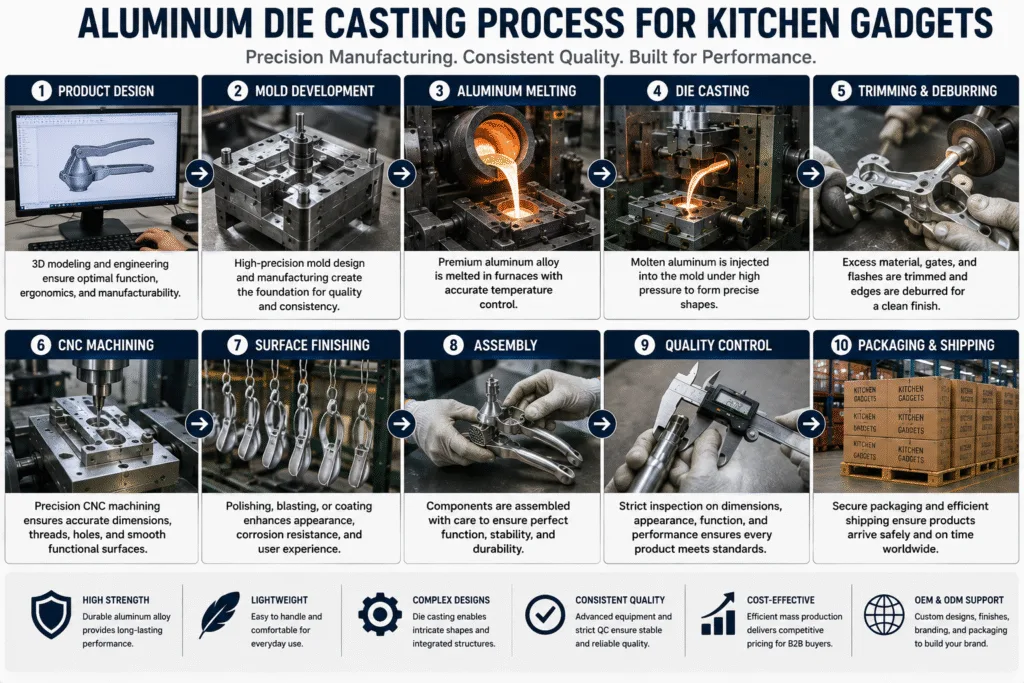
Step 3: Aluminum Alloy Preparation
Before casting, aluminum alloy is heated until it reaches the appropriate molten state.
The alloy selection depends on the product’s required characteristics, including:
- Strength
- Fluidity
- Castability
- Surface quality
- Corrosion resistance
- Machining requirements
Raw material quality also needs to be controlled carefully.
Consistent alloy composition helps manufacturers maintain stable production performance across different batches.
Step 4: High-Pressure Die Casting
After the aluminum alloy has been prepared, molten metal is injected into the mold cavity under high pressure.
The metal rapidly fills the cavity and takes the shape of the mold.
After solidification, the casting is removed from the mold.
The casting cycle must be carefully controlled because factors such as injection speed, pressure, temperature, and cooling can affect the final product.
Professional process control helps minimize potential casting problems such as:
- Porosity
- Incomplete filling
- Cold shuts
- Cracks
- Surface defects
- Dimensional variation
Step 5: Trimming and Deburring
Freshly cast components usually contain excess material around gates, runners, and parting areas.
These unwanted sections need to be removed.
Typical operations include:
- Trimming
- Deburring
- Grinding
- Edge treatment
The goal is to create a clean component that is ready for machining and finishing.
This stage is particularly important for kitchen gadgets because exposed sharp edges or unwanted casting material can negatively affect both product appearance and user experience.
Step 6: CNC Machining
Some die-cast components require additional precision machining after casting.
CNC machining may be used for:
- Precision holes
- Threads
- Mounting surfaces
- Connection points
- Dimensional correction
- Functional contact surfaces
Die casting provides the basic product geometry efficiently, while CNC machining can provide additional dimensional precision where required.
Combining these processes allows manufacturers to achieve a practical balance between production efficiency and precision.
Step 7: Surface Finishing
Surface finishing is an important part of kitchen gadget manufacturing because it affects both appearance and user perception.
Depending on the product design, manufacturers may use processes such as:
Polishing
Polishing creates a smoother and more refined surface and can enhance the appearance of aluminum components.
Sandblasting
Sandblasting can create a consistent matte or textured appearance while helping prepare the surface for subsequent finishing.
Powder Coating
Powder coating can provide a durable decorative surface in different colors and finishes when the product and application are suitable for the process.
Painting
Painting can be used to achieve specific colors and branding requirements.
The appropriate finishing process should be selected according to product design, intended use, appearance requirements, and applicable food-contact considerations.
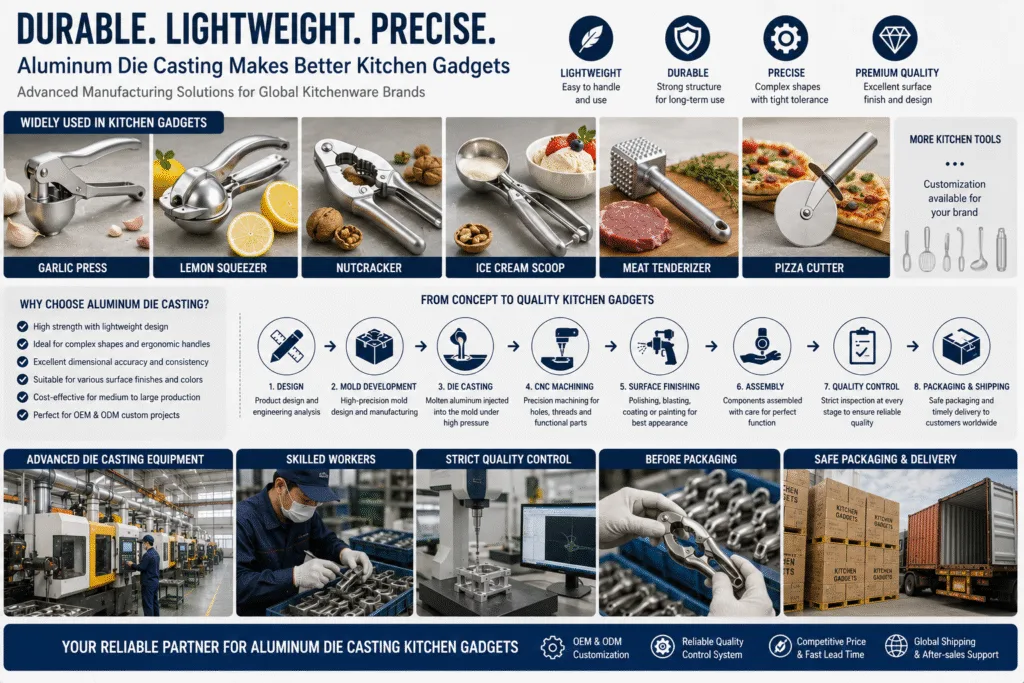
Common Kitchen Gadgets Made with Aluminum Die Casting
Aluminum die casting is suitable for a wide range of kitchen tools.
Garlic Presses
A garlic press needs a strong structure because users repeatedly apply hand pressure during operation.
Die-cast aluminum can provide a rigid body while keeping the product relatively lightweight.
Lemon Squeezers
Manual lemon squeezers require a durable lever structure and comfortable handles.
Aluminum die casting allows manufacturers to integrate structural reinforcement and ergonomic contours into the product design.
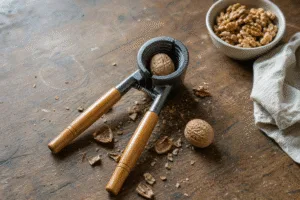
Nutcrackers
Nutcrackers need to withstand repeated mechanical loads.
A well-designed aluminum die-cast body can provide the required structural strength while maintaining manageable product weight.
Ice Cream Scoops
Ice cream scoops benefit from lightweight metal construction and smooth ergonomic shapes.
Die casting allows manufacturers to develop visually attractive and comfortable designs.
Meat Tenderizers
A meat tenderizer requires a strong head and handle structure capable of repeated impact.
Aluminum alloy can be used to create a robust one-piece or multi-component design depending on the product requirements.
Pizza Cutters
Aluminum die casting can be used for the handle or body of certain pizza cutter designs, while the cutting blade may use a different material according to functional requirements.
CNC Machining After Die Casting
Not every die-cast component needs extensive CNC machining.
However, certain areas require additional precision after casting.
For example, a kitchen gadget may need accurately machined:
- Screw holes
- Axle holes
- Threads
- Assembly interfaces
- Contact surfaces
The combination of die casting and CNC machining can reduce the amount of material that would otherwise need to be removed through machining.
This can improve production efficiency while maintaining the precision required for critical components.
Surface Finishing for Die-Cast Kitchen Gadgets
A high-quality kitchen gadget requires more than a functional casting.
Surface appearance can significantly influence how customers perceive the product.
Common finishing options include:
- Polishing
- Brushing
- Sandblasting
- Powder coating
- Painting
- Other suitable protective or decorative treatments
For B2B buyers, surface finishing should be evaluated together with the product’s intended application and destination-market requirements.
Manufacturers should also ensure that any coating or surface treatment used on relevant food-contact areas is appropriate for the intended application and complies with applicable regulations.
Quality Control in Aluminum Die Casting
Quality control should begin before mass production and continue throughout the entire manufacturing process.
Raw Material Inspection
Manufacturers should control incoming aluminum alloy materials and verify that they meet the required specifications.
Mold Inspection
The mold should be checked for:
- Dimensions
- Surface condition
- Alignment
- Wear
- Ejection performance
Casting Inspection
Finished castings should be inspected for visible defects and dimensional consistency.
CNC Inspection
Machined components should be checked against engineering drawings and required tolerances.
Surface Inspection
Manufacturers should examine:
- Scratches
- Dents
- Burrs
- Uneven finishes
- Coating defects
- Color variation
Functional Testing
Kitchen gadgets should also be tested according to their intended function.
For example, a garlic press may require repeated pressing tests, while a lemon squeezer may require operating-cycle testing.
Final Inspection
Before packaging and shipment, finished products should undergo final quality inspection to verify appearance, function, assembly, packaging, and quantity.
Advantages of Die-Cast Aluminum Kitchen Gadgets
For suitable applications, aluminum die casting offers several important advantages.
1. Lightweight
Aluminum provides a useful combination of low weight and mechanical performance.
2. Durable
Properly designed and manufactured die-cast components can withstand repeated everyday use.
3. Complex Designs
The process supports complex shapes and integrated structural features.
4. Consistent Production
Once the mold and production parameters have been properly established, manufacturers can produce large quantities of consistent components.
5. OEM Customization
Brands can customize product dimensions, shapes, colors, finishes, logos, packaging, and other specifications.
6. Efficient Mass Production
Die casting becomes increasingly cost-effective when production volumes justify the initial tooling investment.
Aluminum Die Casting vs Other Manufacturing Methods
Different kitchen gadgets require different manufacturing technologies.
| Manufacturing Method | Typical Applications | Main Advantage |
|---|---|---|
| Aluminum Die Casting | Metal kitchen gadgets with complex shapes | Efficient complex metal production |
| CNC Machining | Precision metal components | High dimensional precision |
| Stainless Steel Stamping | Thin sheet-metal tools | Efficient sheet-metal production |
| Plastic Injection Molding | Plastic kitchen accessories | High-volume lightweight production |
There is no single manufacturing method that is best for every kitchen gadget.
The appropriate process depends on product structure, material, production volume, performance requirements, and target cost.
How to Choose an Aluminum Die Casting Manufacturer
For international buyers, selecting the right manufacturer is just as important as selecting the right material.
Before placing an order, consider the following factors.
Die Casting Equipment
Ask whether the manufacturer has suitable die casting machines and sufficient production capacity.
Mold Development Capability
A manufacturer with in-house or closely controlled mold development capabilities can often respond more efficiently to design changes and tooling requirements.
Engineering Expertise
Experienced engineers can identify potential manufacturing problems before mass production begins.
CNC and Finishing Capabilities
Integrated machining and finishing capabilities can simplify the supply chain and improve process coordination.
Quality Control
Look for a manufacturer with structured quality control covering raw materials, production, machining, assembly, and final inspection.
OEM Experience
For customized products, experience with international OEM projects can help reduce communication and production risks.
Assembly and Packaging
A manufacturer capable of handling assembly and packaging can provide a more complete manufacturing solution.
Export Experience
Experience serving international markets can help manufacturers understand packaging, documentation, quality expectations, and shipping requirements.
What B2B Buyers Should Ask Before Ordering
Before starting a project, buyers should clarify:
- What aluminum alloy will be used?
- Is mold development included?
- What is the expected tooling lead time?
- What are the production tolerances?
- Which surface finishes are available?
- What quality inspections are performed?
- What is the MOQ?
- What is the production lead time?
- Can the manufacturer provide samples?
- Can the manufacturer handle assembly and packaging?
- What customization options are available?
Clear communication at the beginning of a project can prevent many problems later.
Frequently Asked Questions
What is aluminum die casting?
Aluminum die casting is a manufacturing process in which molten aluminum alloy is injected into a reusable metal mold under high pressure to create precise metal components.
Why is aluminum used for kitchen gadgets?
Aluminum is lightweight, strong, suitable for complex die-cast shapes, and compatible with a variety of surface finishing processes. These characteristics make it suitable for many handheld kitchen tools.
What kitchen gadgets can be made using aluminum die casting?
Common applications include garlic presses, lemon squeezers, nutcrackers, ice cream scoops, meat tenderizers, and certain pizza cutter components.
Is die-cast aluminum durable?
Properly designed and manufactured aluminum die-cast products can provide good durability for everyday kitchen applications. Product performance depends on alloy selection, product design, manufacturing quality, and intended use.
Can aluminum die-cast kitchen gadgets be customized?
Yes. OEM manufacturers can customize product geometry, dimensions, finishes, colors, branding, packaging, and other specifications according to the project requirements.
Does every die-cast aluminum product require CNC machining?
No. The need for CNC machining depends on the product design and dimensional requirements. Some components can be used after trimming and finishing, while others require precision machining for functional areas.
What affects the cost of aluminum die casting?
Major factors include mold complexity, tooling cost, aluminum alloy, product weight, production volume, machining requirements, surface finishing, packaging, and quality requirements.