Introduction
Behind every high-quality die-cast kitchen gadget is a carefully designed and manufactured mold.
For products such as garlic presses, lemon squeezers, nutcrackers, ice cream scoops, and meat tenderizers, mold quality directly affects product dimensions, surface appearance, structural strength, production efficiency, and manufacturing cost.
A well-designed mold allows manufacturers to produce consistent components at scale, while a poorly designed mold can lead to defects, production delays, excessive maintenance, and higher manufacturing costs.
For kitchenware brands, wholesalers, importers, and private label companies, understanding the kitchen gadget mold development process can help them make better decisions when developing customized products.
This guide explains how kitchen gadget molds are designed and manufactured, from the initial product concept and 3D modeling to CNC machining, EDM, trial casting, mold optimization, and mass production.
What Is a Kitchen Gadget Mold?
A kitchen gadget mold is a precision metal tool used to form the shape of a kitchen product or component during manufacturing.
In aluminum die casting, molten aluminum alloy is injected into the mold cavity under high pressure. The metal fills the cavity and solidifies into the desired product shape.
The mold essentially determines the geometry and many of the dimensional characteristics of the finished component.
A typical die casting mold may include:
- Mold cavity
- Mold core
- Parting line
- Runner system
- Gate system
- Cooling channels
- Ejection system
- Overflow areas
- Guide components
For customized kitchen gadgets, mold design must balance product appearance, functionality, manufacturability, and production efficiency.
Why Mold Design Matters in Kitchen Gadget Manufacturing
Mold design is one of the most important stages of the manufacturing process.
A good mold can help manufacturers achieve:
- Consistent product dimensions
- Stable production cycles
- Better surface quality
- Efficient material flow
- Reduced casting defects
- Easier part removal
- Longer mold service life
- Lower production costs
For kitchen gadgets, appearance and ergonomics can be particularly important.
A garlic press, for example, may contain curved handles, connection points, cavities, and textured surfaces. These features must all be considered during the mold design stage.
If the product design does not account for die casting requirements, problems may appear later during production.
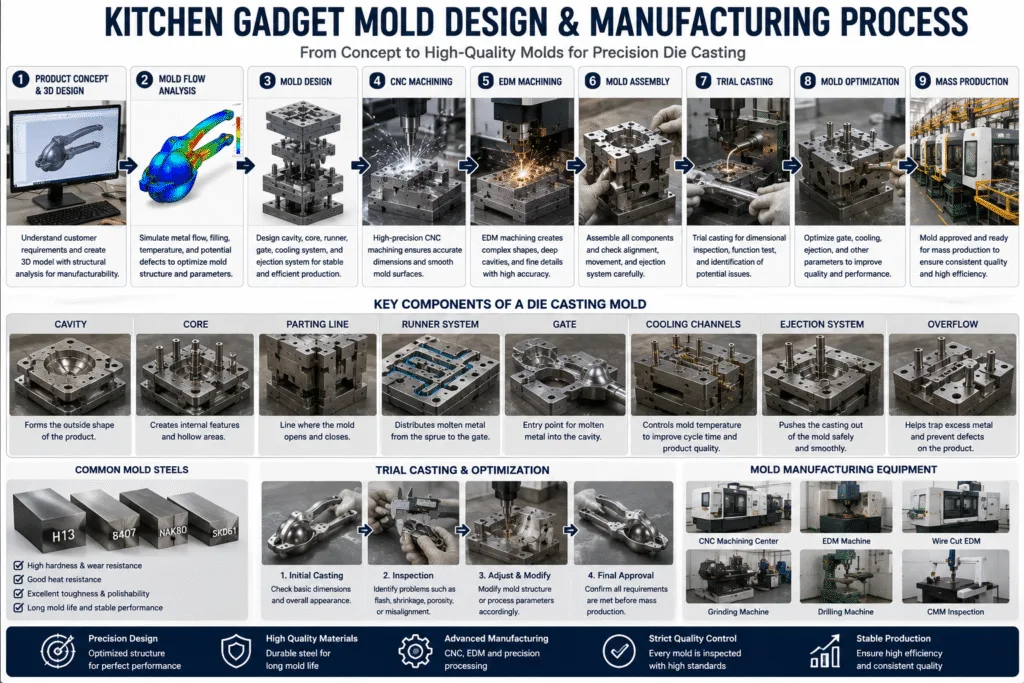
The Kitchen Gadget Mold Development Process
The complete mold development process can generally be divided into several stages:
Product Concept → 3D Modeling → Mold Flow Analysis → Mold Design → CNC Machining → EDM → Mold Assembly → Trial Casting → Mold Optimization → Mass Production
Each stage contributes to the final performance of the mold.
Step 1: Product Design and 3D Modeling
Mold development begins with the product itself.
Before engineers design the mold, they need a clear understanding of the product’s:
- Dimensions
- Function
- Material
- Structure
- Ergonomics
- Assembly method
- Surface finish
- Production quantity
The product is usually developed as a 3D CAD model.
During this stage, engineers also evaluate whether the proposed design is suitable for die casting.
For example, certain features may require modifications to:
- Wall thickness
- Draft angles
- Ribs
- Corners
- Holes
- Fillets
- Connection areas
Designing for manufacturability at this stage can prevent expensive mold modifications later.
Step 2: Mold Design
Once the product design has been approved, engineers develop the mold structure.
The mold must be designed so that molten aluminum can fill the cavity effectively and the finished part can be removed without damage.
Important design elements include the cavity, core, parting line, runner, gate, cooling system, and ejection mechanism.
Cavity and Core
The cavity and core create the external and internal geometry of the product.
Their dimensions must account for the required product dimensions and the characteristics of the casting material.
Parting Line
The parting line is where the mold separates to allow the casting to be removed.
Its position can affect:
- Product appearance
- Flash
- Mold complexity
- Ejection
- Machining requirements
Engineers generally aim to position the parting line where it has the least negative impact on the final product.
Gate and Runner System
The gate and runner system controls how molten aluminum enters the mold cavity.
An appropriate design helps distribute the metal effectively and reduce potential filling problems.
Cooling System
Cooling channels help control mold temperature during production.
Stable temperature management can improve:
- Cycle consistency
- Product quality
- Mold life
- Production efficiency
Ejection System
After the aluminum component has solidified, the finished casting must be removed from the mold.
The ejection system needs to apply force in a controlled way without damaging the product.
Step 3: Mold Flow Analysis
For more complex kitchen gadget designs, mold flow analysis can help engineers identify potential manufacturing problems before the mold is manufactured.
Simulation may help evaluate:
- Metal flow
- Filling behavior
- Temperature distribution
- Potential air entrapment
- Solidification
- Shrinkage
- Potential defect locations
This allows engineers to make adjustments before committing to final mold machining.
Early design optimization can reduce the need for costly modifications after the mold has been produced.
Step 4: CNC Machining
After the mold design has been finalized, the mold components are manufactured using precision machining equipment.
CNC machining is commonly used to create accurate mold cavities, cores, inserts, and other components.
Depending on the design, machining operations may include:
- Milling
- Drilling
- Boring
- Threading
- Precision contour machining
The accuracy of the machining process directly affects the dimensional consistency and surface quality of the final product.
Step 5: EDM Machining
Electrical Discharge Machining, commonly known as EDM, can be used for mold areas that are difficult to manufacture using conventional cutting tools.
EDM is particularly useful for creating:
- Deep cavities
- Fine details
- Narrow slots
- Complex internal features
- Sharp or difficult-to-machine geometries
For kitchen gadgets with decorative or functional details, EDM can complement CNC machining during mold manufacturing.
Step 6: Mold Assembly
After individual mold components have been machined, they are assembled into the complete mold system.
During assembly, engineers check:
- Component alignment
- Moving parts
- Ejection mechanism
- Guide systems
- Cooling channels
- Mold closing
- Parting surfaces
The mold must operate smoothly before trial production begins.
Precision assembly is especially important because even small alignment problems can affect casting quality.
Step 7: Trial Casting
A newly manufactured mold should normally undergo trial production before mass manufacturing.
The trial casting process allows engineers to evaluate how the mold performs under actual production conditions.
They may inspect:
- Product dimensions
- Surface quality
- Filling behavior
- Flash
- Ejection
- Cycle time
- Casting defects
If problems are identified, the mold can be modified before large-scale production begins.
Step 8: Mold Optimization
Trial casting often reveals opportunities for improvement.
Engineers may adjust:
- Gate locations
- Runner dimensions
- Cooling channels
- Ejection pins
- Mold surfaces
- Product dimensions
- Venting areas
The objective is to achieve stable production with consistent quality.
For OEM kitchen gadget projects, this optimization stage can be particularly important because customized products may have unique structural requirements.
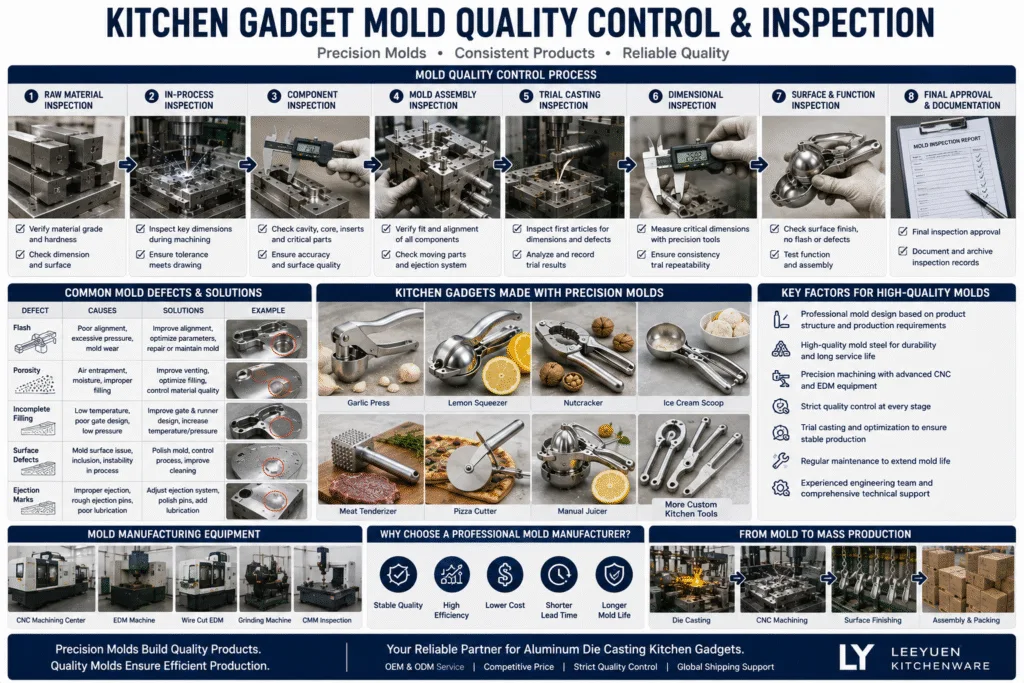
Common Mold Problems in Kitchen Gadget Manufacturing
Even well-designed molds can encounter problems if the design, machining, material, or production parameters are not properly controlled.
Flash
Flash occurs when molten metal enters unwanted gaps between mold components.
Possible causes include:
- Poor mold alignment
- Excessive injection pressure
- Mold wear
- Damaged parting surfaces
Regular mold inspection and maintenance can help reduce flash.
Porosity
Porosity refers to small internal voids or pores within a casting.
Potential causes include:
- Air entrapment
- Improper filling
- Material conditions
- Process parameters
Mold design and casting process optimization can help minimize these problems.
Incomplete Filling
Incomplete filling occurs when molten metal does not fully fill the mold cavity.
Possible causes include:
- Poor gate design
- Insufficient metal flow
- Incorrect temperature
- Complex product geometry
Engineers can evaluate the filling system and adjust the mold design accordingly.
Surface Defects
Casting surfaces may develop defects caused by:
- Poor metal flow
- Mold surface problems
- Temperature instability
- Improper process parameters
Since kitchen gadgets are often highly visible consumer products, surface appearance is particularly important.
Dimensional Variation
Dimensional inconsistencies can result from:
- Mold wear
- Incorrect machining
- Thermal changes
- Process instability
- Improper mold alignment
Regular inspection helps maintain production consistency.
How Manufacturers Improve Mold Life
A die casting mold represents an important investment, especially for customized kitchen gadgets.
Proper maintenance can help extend its useful production life.
Important practices include:
Regular Cleaning
Removing aluminum residue and contaminants helps maintain mold surfaces and moving components.
Mold Inspection
Manufacturers should regularly inspect:
- Parting surfaces
- Cavity surfaces
- Ejection components
- Cooling channels
- Guide systems
Preventive Maintenance
Replacing worn components before they fail can reduce unexpected production downtime.
Temperature Management
Stable mold temperature can help reduce thermal stress and improve production consistency.
Proper Lubrication
Appropriate lubrication of moving components can reduce friction and wear.
How Mold Design Affects Kitchen Gadget Cost
Mold cost is an important consideration for OEM and private label projects.
However, the cheapest mold is not necessarily the most economical solution over the entire product lifecycle.
Several factors affect mold cost.
Product Complexity
More complex products usually require more complicated mold structures.
Mold Size
Larger products may require larger molds and more material.
Mold Steel
The choice of mold material affects durability, machining cost, and expected production life.
Number of Cavities
Multi-cavity molds can increase production efficiency but may require greater initial investment.
CNC and EDM Requirements
Complex geometries can increase machining time and manufacturing costs.
Cooling Design
More sophisticated cooling systems may increase mold complexity while improving production stability.
Expected Production Volume
For large-volume projects, investing in a higher-quality mold may provide better long-term economics.
Therefore, buyers should evaluate tooling cost together with expected order volume, product quality, production efficiency, and mold life.
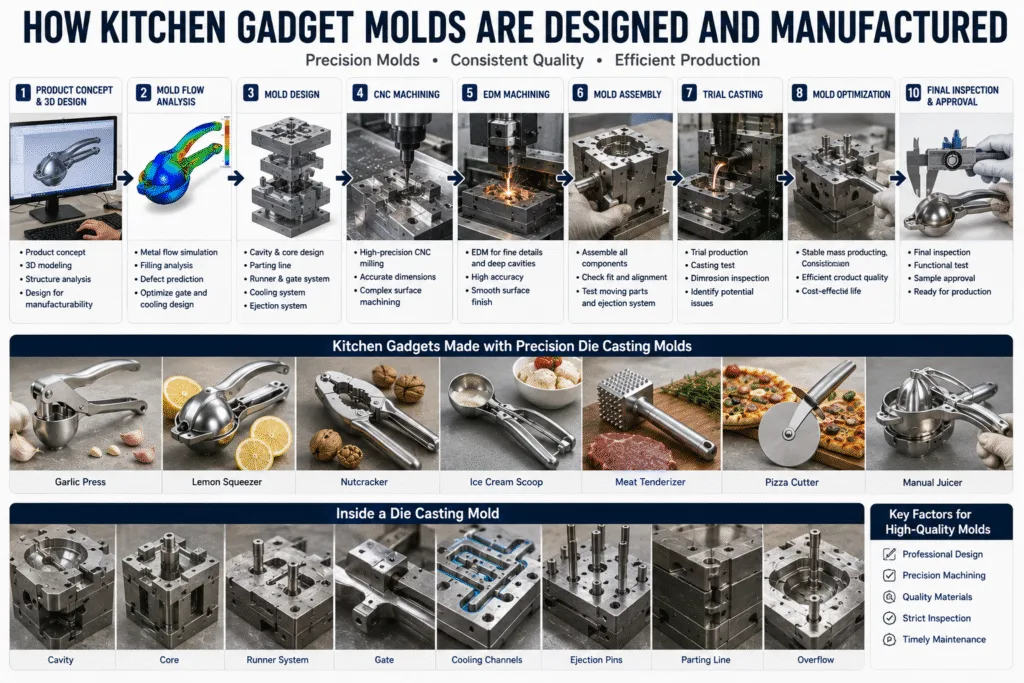
Kitchen Gadgets That Commonly Use Die Casting Molds
Many aluminum kitchen gadgets can benefit from die casting.
Garlic Presses
Garlic presses require strong structures and accurate connection points because users repeatedly apply pressure.
A well-designed mold can produce consistent handles and functional components.
Lemon Squeezers
Lemon squeezers often feature curved handles and integrated structural elements.
Die casting can help manufacturers create ergonomic shapes while maintaining production efficiency.
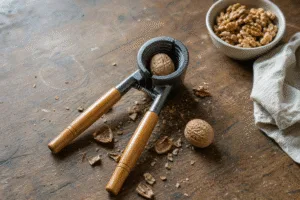
Nutcrackers
Nutcrackers must withstand repeated mechanical loads.
Proper mold design helps maintain consistent dimensions and structural strength across large production runs.
Ice Cream Scoops
Ice cream scoops benefit from lightweight construction, comfortable handles, and attractive surface finishes.
Die casting can support complex ergonomic designs.
Meat Tenderizers
Meat tenderizers require durable structures capable of repeated impact.
Mold design must take mechanical loads and product geometry into consideration.
Pizza Cutters
Die casting can be used for selected handles and structural components of pizza cutters, while the cutting blade may be manufactured separately using an appropriate material and process.
Kitchen Gadget Mold vs Standard Industrial Mold
Although many basic mold principles are similar across industries, kitchen gadget molds can have specific requirements.
| Factor | Kitchen Gadget Mold | General Industrial Mold |
|---|---|---|
| Product appearance | Often highly important | Depends on application |
| Ergonomics | Frequently important | Product dependent |
| Surface quality | Usually important | Application dependent |
| Product customization | Common | Varies |
| Consumer usability | Important | Depends on product |
| Production volume | Often medium to high | Varies significantly |
Kitchen gadget manufacturers need to balance manufacturing efficiency with consumer-facing design requirements.
How to Choose a Kitchen Gadget Mold Manufacturer
Choosing a mold manufacturer is an important decision for B2B buyers developing customized products.
Consider the following factors.
Mold Design Capability
The manufacturer should have engineers capable of converting product concepts into manufacturable mold designs.
CNC Machining Capability
Precision machining equipment is important for producing accurate mold components.
EDM Capability
EDM can be valuable when the product contains complex or difficult-to-machine details.
Die Casting Experience
A mold manufacturer with practical aluminum die casting experience can design molds with actual production conditions in mind.
Trial Production Capability
The ability to perform trial casting and make necessary adjustments can reduce development risks.
Quality Inspection
Precision measurement equipment and systematic inspection procedures help maintain mold and product quality.
Mold Maintenance
A manufacturer should be able to provide maintenance and repair support throughout the mold’s production life.
OEM/ODM Experience
For international brands, experience with customized kitchen gadget projects can simplify communication and development.
Questions B2B Buyers Should Ask
Before starting a kitchen gadget mold project, buyers should clarify:
- Can the manufacturer develop molds from 3D drawings?
- Does the factory have in-house mold engineers?
- What mold materials are available?
- What machining equipment is used?
- Is EDM available?
- Is trial casting included?
- How many modifications are included?
- What is the estimated mold lead time?
- What is the expected mold life?
- How is mold maintenance handled?
- Can the manufacturer provide production samples?
- Can the same manufacturer handle mass production?
Clear answers to these questions can help buyers compare suppliers more effectively.
Frequently Asked Questions
How long does it take to make a kitchen gadget mold?
The lead time depends on product complexity, mold size, machining requirements, material selection, and the number of trial modifications. Simple molds generally require less development time than complex customized molds.
How much does an aluminum die casting mold cost?
Mold cost varies significantly depending on product geometry, mold size, steel selection, cavity structure, machining requirements, and expected production volume. Buyers should request a project-specific quotation rather than relying on a general price.
How long can a die casting mold last?
Mold life depends on mold material, product design, casting conditions, maintenance, production volume, and operating parameters. Proper maintenance can help extend mold service life.
Can kitchen gadget molds be customized?
Yes. Kitchen gadget molds are normally developed according to the specific product design, dimensions, functions, and manufacturing requirements.
What materials are used to make die casting molds?
Specialized tool steels are commonly used because molds must withstand repeated exposure to high temperatures, pressure, and thermal cycling.
Why is trial casting necessary?
Trial casting allows engineers to evaluate the mold under actual production conditions and identify potential issues before mass production begins.
How can manufacturers extend mold life?
Regular cleaning, inspection, preventive maintenance, proper cooling, appropriate lubrication, and stable casting parameters can all contribute to longer mold life.