
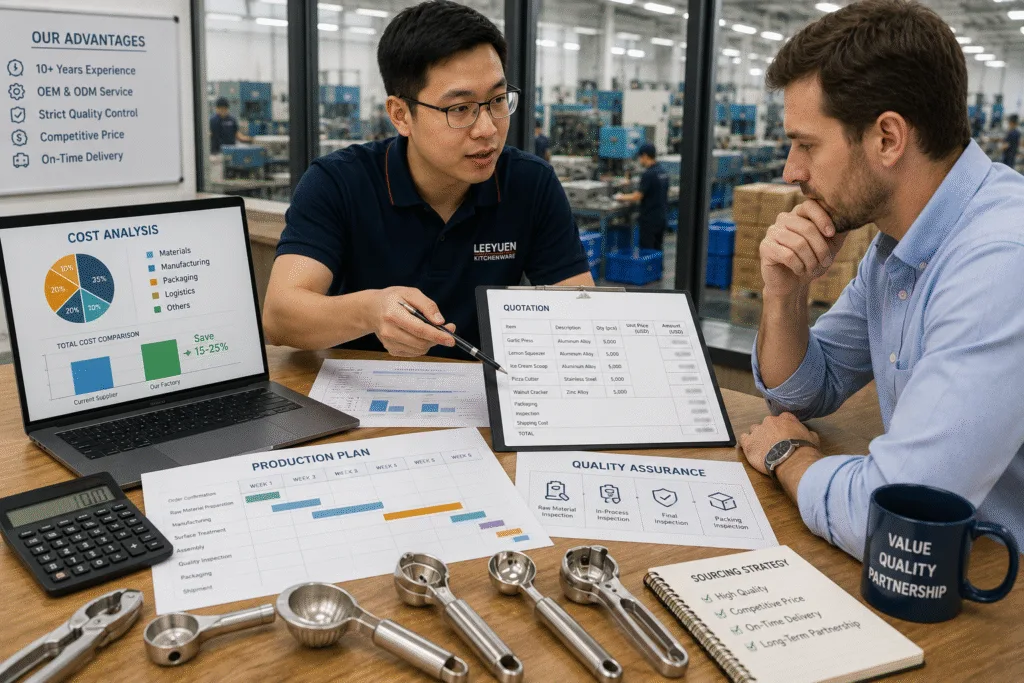
Reducing sourcing costs is a top priority for importers, wholesalers, retailers, and private label brands. However, focusing only on the lowest quotation can often result in poor product quality, delayed deliveries, or unexpected expenses that ultimately increase the total cost of ownership.
Successful sourcing is not about finding the cheapest supplier—it is about maximizing value. By choosing the right manufacturing partner, optimizing production planning, and improving purchasing strategies, businesses can significantly reduce costs while maintaining consistent product quality.
This guide explores practical ways to lower kitchen gadget sourcing costs without compromising performance, reliability, or customer satisfaction.
Understand Your Total Sourcing Cost
Many buyers focus only on unit price, but sourcing costs include much more than the factory quotation.
Your total sourcing cost may include:
- Product manufacturing
- Tooling or mold fees
- Raw materials
- Packaging
- Product testing
- Quality inspections
- Shipping
- Customs duties
- Warehousing
- Inventory management
Looking at the complete cost picture helps buyers make better sourcing decisions.
Choose the Right Manufacturing Partner
Working with an experienced manufacturer often creates long-term savings.
Reliable manufacturers typically offer:
- Stable production capacity
- Consistent product quality
- Better engineering support
- Faster communication
- Efficient production planning
Although the initial quotation may not always be the lowest, experienced manufacturers often reduce hidden costs throughout the project.
Balance MOQ and Unit Cost
Minimum Order Quantity (MOQ) directly affects unit pricing.
Generally:
- Small orders increase manufacturing costs per unit.
- Larger production runs improve manufacturing efficiency.
- Higher order quantities usually reduce overall production costs.
Rather than ordering the minimum quantity every time, buyers should evaluate long-term demand and inventory capacity.
Finding the right balance between MOQ and cash flow can significantly improve profitability.
Standardize Product Designs
Customized products often require:
- New molds
- Additional engineering
- More production setup
- Longer manufacturing time
Whenever possible, consider using existing product designs with only minor modifications such as:
- Logo engraving
- Color changes
- Retail packaging
- Surface finishing
This approach lowers development costs while still supporting brand differentiation.
Select Cost-Effective Materials
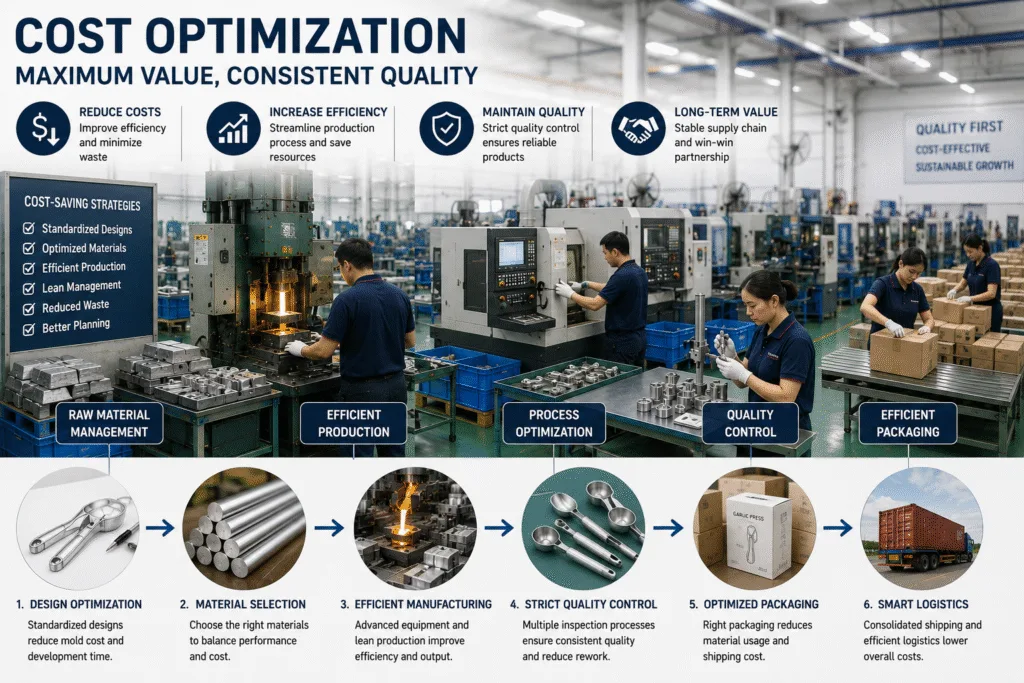
Material selection plays a major role in production costs.
For example:
- Aluminum alloy offers excellent strength, durability, and lightweight performance.
- Stainless steel provides corrosion resistance for functional components.
- Food-grade silicone improves user comfort for handles or grips.
The goal is not to choose the cheapest material but the most suitable material for the product’s intended use.
Manufacturers can often recommend alternative materials that reduce costs without sacrificing performance.
Optimize Packaging
Packaging affects both manufacturing and shipping costs.
Effective packaging should:
- Protect products during transportation.
- Minimize wasted space.
- Reduce carton weight.
- Support retail presentation.
- Meet sustainability requirements.
Using standardized carton sizes and efficient packing methods can reduce shipping expenses while improving logistics efficiency.
Plan Orders Early
Last-minute purchasing often increases costs.
Urgent production may require:
- Overtime manufacturing
- Express material purchasing
- Air freight instead of sea freight
- Production schedule adjustments
Forecasting demand and placing orders earlier allows manufacturers to optimize production schedules and often results in better pricing.
Consolidate Product Orders
Instead of placing multiple small orders throughout the year, consider combining products into larger shipments.
Order consolidation can:
- Reduce shipping costs.
- Improve production efficiency.
- Lower packaging expenses.
- Simplify customs procedures.
- Reduce administrative work.
Many manufacturers also provide better pricing for consolidated orders.
Improve Communication with Your Manufacturer
Miscommunication frequently leads to unnecessary costs.
Provide clear information regarding:
- Product specifications
- Packaging requirements
- Delivery schedules
- Quality expectations
- Branding details
Well-documented requirements reduce production errors and prevent costly rework.
Reduce Logistics Costs
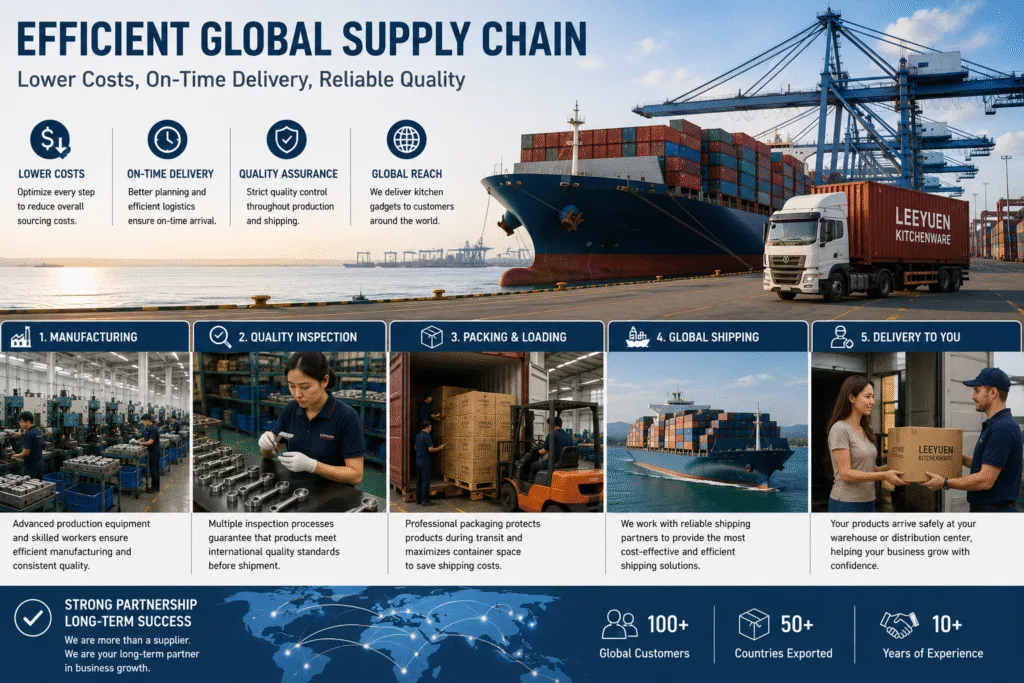
Transportation is a significant part of international sourcing.
Ways to improve logistics efficiency include:
- Planning shipments in advance.
- Choosing the appropriate shipping method.
- Optimizing carton dimensions.
- Maximizing container utilization.
- Coordinating shipments with multiple products.
Working closely with experienced freight forwarders can further reduce logistics expenses.
Avoid Hidden Costs
The lowest quotation is not always the lowest total cost.
Hidden costs may include:
- Product defects
- Production delays
- Warranty claims
- Poor communication
- Additional inspections
- Repackaging
- Product recalls
Evaluating suppliers based on reliability rather than price alone often creates greater long-term savings.
Invest in Long-Term Partnerships
Building long-term relationships with manufacturers benefits both parties.
Long-term cooperation often results in:
- Better pricing
- Stable production schedules
- Priority during peak seasons
- Improved quality consistency
- Faster problem resolution
- Continuous product improvement
Manufacturers are generally more willing to invest in customers with long-term purchasing plans.
Common Mistakes Buyers Make
Many businesses increase sourcing costs unintentionally.
Avoid these common mistakes:
- Selecting suppliers based only on price.
- Ordering quantities that are too small.
- Changing product specifications after production begins.
- Ignoring quality control.
- Underestimating shipping costs.
- Failing to forecast future demand.
A strategic sourcing approach reduces both direct and indirect costs.
FAQ
How can I reduce sourcing costs without lowering product quality?
Focus on improving production efficiency, selecting reliable manufacturers, optimizing MOQ, standardizing product designs, and planning purchases in advance rather than simply choosing the lowest-priced supplier.
Does ordering larger quantities always reduce costs?
In many cases, yes. Larger orders often reduce unit production costs, but buyers should balance order size with inventory capacity and cash flow.
Can OEM products still be cost-effective?
Yes. Using existing molds, simplifying customization, and working with experienced manufacturers can make OEM projects highly cost-efficient while maintaining brand differentiation.
What is the biggest hidden sourcing cost?
Poor quality and production delays are often more expensive than a slightly higher factory quotation. Rework, replacements, and missed sales opportunities can significantly increase overall sourcing costs.