For importers, wholesalers, distributors, and private label brands, product quality is just as important as price and delivery time. Even a small defect can lead to customer complaints, product returns, damaged brand reputation, and unexpected financial losses.
A professional quality inspection process helps identify potential issues before products leave the factory. Rather than relying solely on final inspections, experienced manufacturers implement quality control throughout the entire production process—from raw material sourcing to final packaging.
This guide explains how kitchen gadget quality inspections are performed, what buyers should check before shipment, and how a structured quality control system ensures consistent product performance.
Why Quality Inspection Matters
Quality inspection protects both buyers and manufacturers.
An effective inspection process helps to:
- Reduce defective products
- Maintain consistent product quality
- Improve customer satisfaction
- Minimize warranty claims
- Prevent shipment delays caused by quality issues
- Build long-term business relationships
For OEM and private label projects, quality inspection is especially important because every product reflects your brand.
Understanding the Quality Control Process
Professional manufacturers usually divide quality management into several stages.
These include:
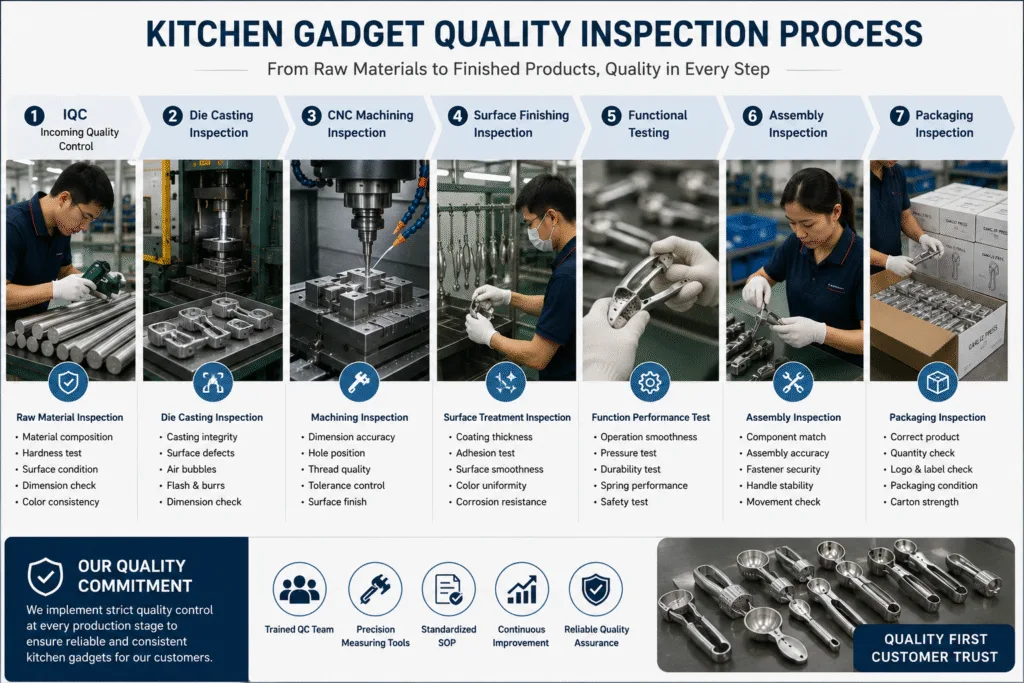
- Incoming Quality Control (IQC)
- In-Process Quality Control (IPQC)
- Final Quality Control (FQC)
- Outgoing Quality Control (OQC)
Each stage focuses on different aspects of product quality.
Incoming Quality Control (IQC)
Quality begins with raw materials.
Before production starts, manufacturers inspect materials such as:
- Aluminum alloy
- Stainless steel components
- Silicone parts
- Plastic accessories
- Packaging materials
Typical inspection items include:
- Material specifications
- Surface condition
- Dimensions
- Hardness
- Color consistency
Rejecting defective materials early prevents problems later in production.
In-Process Quality Control (IPQC)
During manufacturing, quality inspectors monitor every production stage.
For aluminum kitchen gadgets, inspections may include:
Die Casting Inspection
- Casting integrity
- Surface defects
- Air bubbles
- Flash removal
CNC Machining Inspection
- Hole position accuracy
- Thread quality
- Dimensional tolerance
Surface Finishing Inspection
- Powder coating quality
- Polishing consistency
- Sandblasting finish
- Oxidation treatment
Regular inspections help identify production issues before large quantities are affected.
Functional Testing
Appearance alone is not enough.
Kitchen gadgets should also perform correctly.
Examples include:
- Garlic presses should apply consistent pressure.
- Lemon squeezers should extract juice efficiently.
- Ice cream scoops should release smoothly.
- Pizza cutters should rotate freely.
- Nutcrackers should withstand repeated force without deformation.
Functional testing verifies that products meet real-world usage requirements.
Dimensional Inspection
Accurate dimensions ensure product compatibility and consistent assembly.
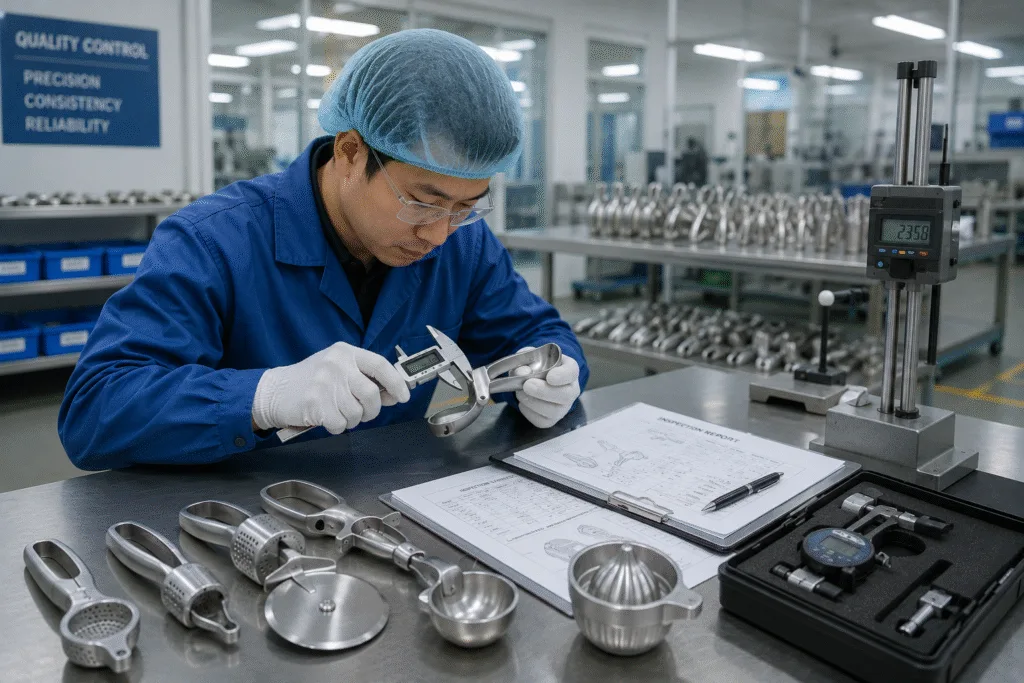
Inspection tools commonly include:
- Digital calipers
- Height gauges
- Thread gauges
- Radius gauges
- Measuring fixtures
Critical dimensions should match engineering drawings and customer specifications.
Surface Quality Inspection
Surface appearance directly affects customer perception.
Inspectors typically check for:
- Scratches
- Dents
- Sharp edges
- Color differences
- Burrs
- Coating defects
- Polishing quality
Products with visible cosmetic defects should be repaired or rejected.
Assembly Inspection
Many kitchen gadgets consist of multiple components.
Assembly inspections verify:
- Proper alignment
- Secure fasteners
- Smooth movement
- Component compatibility
- Handle stability
- Spring performance
Incorrect assembly may reduce product safety and durability.
Packaging Inspection
Packaging is the final protection before shipment.
Inspectors should verify:
- Correct product quantity
- Barcode accuracy
- Instruction manuals
- Logo placement
- Carton labeling
- Protective packaging
- Carton strength
Well-designed packaging reduces shipping damage and improves customer experience.
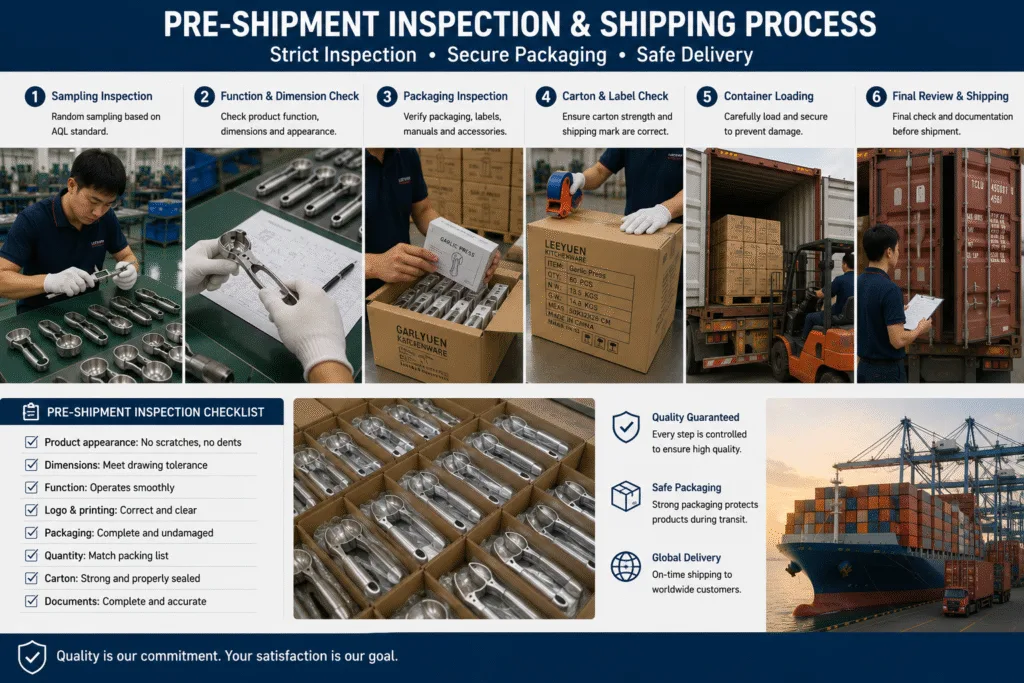
Pre-Shipment Inspection Checklist
Before products leave the factory, buyers or third-party inspectors should confirm the following:
Product Appearance
- No scratches
- No cracks
- No deformation
- Uniform finish
Dimensions
- Match approved drawings
- Meet tolerance requirements
Functional Performance
- Operate smoothly
- Meet design requirements
Logo & Branding
- Correct logo
- Correct printing
- Correct packaging artwork
Packaging
- Correct quantity
- Secure packing
- Shipping labels attached
Documentation
- Inspection reports
- Packing list
- Product specifications
- Compliance certificates (if applicable)
Using a standardized checklist reduces the risk of missing critical inspection items.
Understanding AQL Sampling
Many buyers use Acceptable Quality Limit (AQL) during pre-shipment inspections.
AQL determines:
- Sample size
- Acceptance limits
- Rejection criteria
Rather than inspecting every product, inspectors evaluate a statistically representative sample from the shipment.
The appropriate AQL level depends on product type, customer requirements, and acceptable risk.
Common Quality Problems in Kitchen Gadgets
Some of the most common issues include:
- Rough edges
- Loose handles
- Poor coating adhesion
- Incorrect dimensions
- Weak rivets
- Surface scratches
- Color inconsistency
- Packaging errors
Identifying these issues before shipment saves both time and money.
How Experienced Manufacturers Maintain Consistent Quality
Reliable manufacturers implement standardized quality systems.
Typical practices include:
- Standard operating procedures (SOPs)
- Employee training
- Production process monitoring
- Equipment maintenance
- Calibration of measuring tools
- Batch traceability
- Continuous improvement programs
Quality is achieved through consistent processes rather than relying solely on final inspections.
Questions to Ask Your Manufacturer
Before placing an order, ask:
- What quality management system do you use?
- Do you perform IQC, IPQC, FQC, and OQC?
- Can you provide inspection reports?
- Do you support third-party inspections?
- What measuring equipment is used?
- How are defective products handled?
- Can you provide product testing records?
These questions help buyers evaluate the manufacturer’s quality capabilities.
Common Mistakes Buyers Should Avoid
Avoid these common sourcing mistakes:
- Choosing suppliers based only on price.
- Skipping pre-shipment inspections.
- Failing to approve production samples.
- Ignoring packaging quality.
- Not defining inspection standards.
- Assuming every manufacturer follows the same QC process.
A clear quality agreement benefits both parties.
FAQ
When should quality inspections be performed?
Quality inspections should take place throughout production, including incoming material inspection, in-process inspection, final inspection, and pre-shipment inspection.
Is pre-shipment inspection enough?
No. While pre-shipment inspection is important, continuous quality control during production helps identify issues much earlier.
Should buyers hire third-party inspection companies?
For large or first-time orders, independent third-party inspections provide additional confidence before shipment.
What is the purpose of AQL sampling?
AQL sampling provides a practical method for evaluating shipment quality without inspecting every individual product.