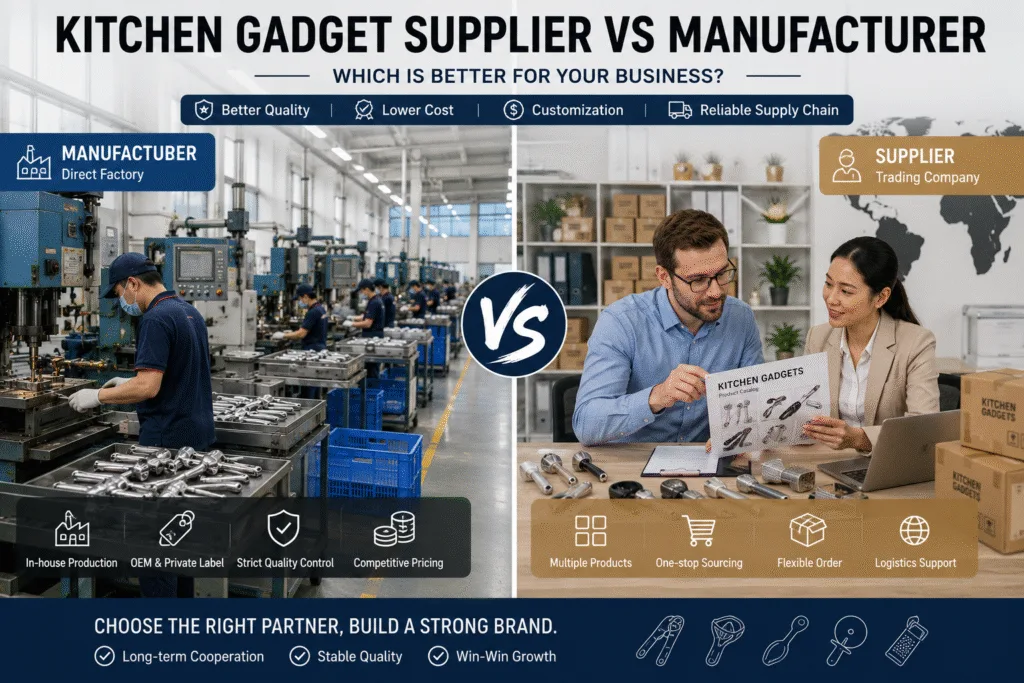
When sourcing kitchen gadgets, one of the first decisions buyers face is whether to work with a supplier, a trading company, or a direct manufacturer. While these terms are often used interchangeably, they represent different business models with distinct advantages and limitations.
Choosing the right sourcing partner can influence product quality, production costs, customization options, delivery schedules, and long-term business growth. Understanding these differences helps importers, wholesalers, retailers, and private label brands make better purchasing decisions.
This guide explains the key differences between suppliers and manufacturers and provides practical advice for selecting the right partner for your business.
What Is a Kitchen Gadget Manufacturer?
A manufacturer is a company that produces kitchen gadgets using its own production facilities, equipment, and workforce.
Manufacturers are responsible for:
- Product engineering
- Mold development
- Die casting
- CNC machining
- Surface finishing
- Assembly
- Quality inspection
- Packaging
Working directly with a manufacturer provides greater visibility into the production process and allows for better communication during product development.
What Is a Kitchen Gadget Supplier?
A supplier is a broader term that may refer to either a manufacturer or a trading company.
Many suppliers purchase products from multiple factories and sell them to international buyers.
Suppliers often provide:
- Product sourcing
- Export coordination
- Order consolidation
- Customer communication
- Logistics support
For buyers seeking a wide product range, suppliers may offer convenient one-stop sourcing solutions.
What Is a Trading Company?
A trading company does not usually own manufacturing equipment.
Instead, it works with multiple factories to source products on behalf of customers.
Trading companies may be suitable when buyers need:
- Multiple product categories
- Small mixed orders
- Simplified communication
- Consolidated shipments
However, buyers generally have less visibility into production and limited influence over manufacturing processes.
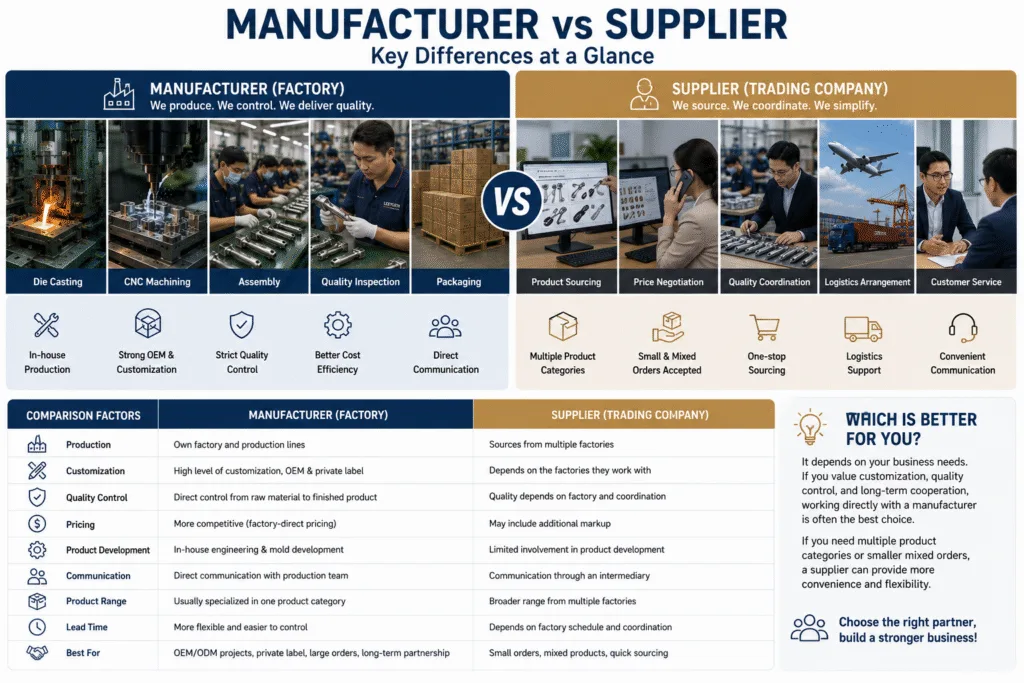
Manufacturer vs Supplier: Key Differences
| Factor | Manufacturer | Supplier / Trading Company |
|---|---|---|
| Production | Own factory | Sources from factories |
| Product Customization | Excellent | Depends on factory |
| OEM & Private Label | Strong capability | Varies |
| Product Development | Direct engineering support | Limited |
| Pricing | Often more competitive | May include additional markup |
| Quality Control | Direct management | Depends on factory coordination |
| Communication | Direct with production team | Through intermediary |
| Product Range | Usually specialized | Often broader |
When Should You Choose a Manufacturer?
Working directly with a manufacturer is often the best option if your business requires:
- OEM production
- Private label branding
- Custom product development
- Stable long-term supply
- Consistent product quality
- Competitive pricing for larger orders
Manufacturers also provide better technical support during product development.
When Should You Choose a Supplier?
A supplier may be more suitable when you need:
- Multiple product categories
- Small mixed orders
- Faster product sourcing
- Consolidated purchasing from different factories
For new businesses testing different product categories, suppliers can reduce sourcing complexity.
Product Customization
Customization is one of the biggest differences between manufacturers and suppliers.
Manufacturers usually offer:
- Logo engraving
- Color customization
- Surface treatment
- Packaging design
- Mold development
- Product improvements
Suppliers may support customization, but they often depend on the capabilities of their partner factories.
Quality Control
Quality management is essential for maintaining brand reputation.
Manufacturers typically inspect products throughout production, including:
- Raw materials
- Die casting
- CNC machining
- Surface finishing
- Assembly
- Functional testing
- Final packaging
When working with suppliers, buyers should understand how quality inspections are managed between the supplier and factory.
Pricing Considerations
Although manufacturers often provide more competitive factory-direct pricing, buyers should evaluate the total value rather than focusing only on unit cost.
Consider:
- Product quality
- Customization capability
- Production consistency
- Communication efficiency
- After-sales support
- Long-term cooperation
A reliable partner can reduce overall sourcing costs over time.
Questions to Ask Before Choosing a Partner
Before making your decision, ask potential partners:
- Do you own your factory?
- Can you provide OEM and private label services?
- Do you develop molds in-house?
- What quality inspections do you perform?
- Can I visit the production facility?
- Can you provide product samples?
- What is your production lead time?
- What is your minimum order quantity?
These questions help identify whether you are communicating directly with a manufacturer or through an intermediary.
Common Mistakes Buyers Make
Many sourcing problems occur because buyers misunderstand the differences between suppliers and manufacturers.
Avoid these common mistakes:
- Choosing the lowest quotation without evaluating production capability.
- Assuming every supplier owns a factory.
- Ignoring OEM capabilities.
- Skipping product sample evaluation.
- Failing to verify quality management procedures.
- Not discussing long-term production capacity.
FAQ
Is every supplier a manufacturer?
No. Some suppliers are manufacturers, while others are trading companies that source products from multiple factories.
Is buying directly from a manufacturer always better?
Not always. It depends on your business model. Manufacturers are ideal for OEM projects, private label products, and long-term cooperation, while suppliers may be more convenient for mixed product sourcing.
Can trading companies provide OEM services?
Some trading companies coordinate OEM projects through partner factories, but the actual manufacturing work is completed by the factory.
How can I confirm whether a supplier is a manufacturer?
Ask about production facilities, request factory photos or videos, inquire about in-house mold development, and discuss manufacturing processes. If possible, arrange a factory audit or visit.