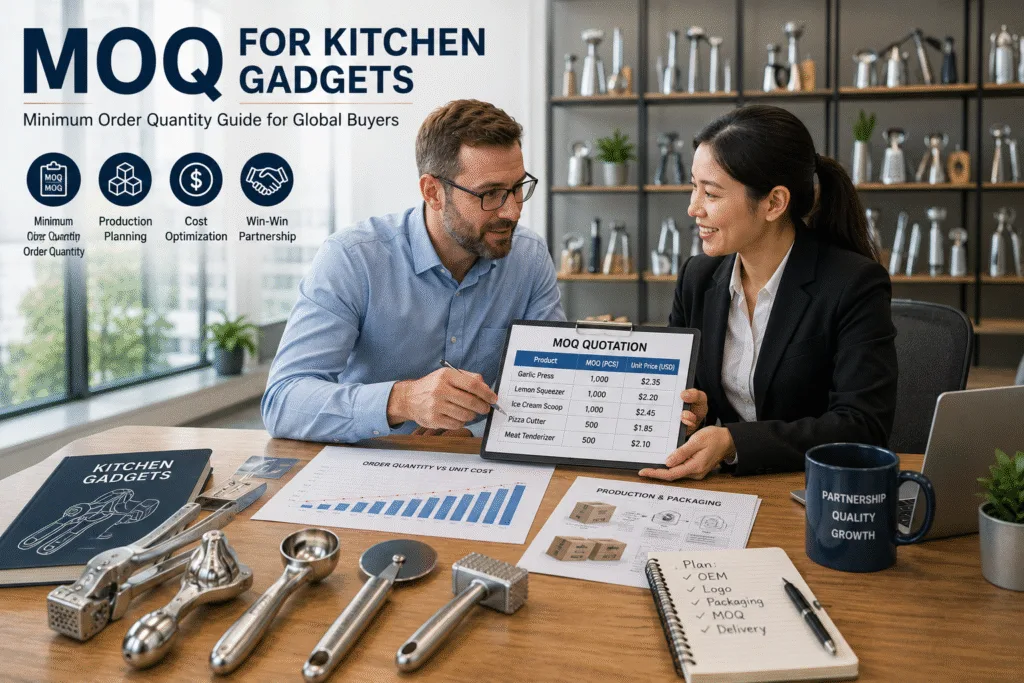
Minimum Order Quantity (MOQ) is one of the first topics discussed between buyers and manufacturers during the sourcing process. Whether you are launching a private label kitchen gadget brand, importing products for wholesale, or expanding an existing product line, understanding MOQ can help you plan inventory, manage costs, and negotiate more effectively.
Many buyers assume that MOQ is simply a fixed number, but in reality it depends on production costs, manufacturing processes, material sourcing, packaging requirements, and customization levels.
This guide explains how MOQ works, why manufacturers require it, and how buyers can negotiate reasonable order quantities while maintaining product quality and competitive pricing.
What Is MOQ?
MOQ stands for Minimum Order Quantity.
It refers to the smallest quantity of products that a manufacturer is willing to produce for a single order.
Manufacturers establish MOQs to ensure production remains economically efficient while covering costs such as:
- Raw materials
- Mold preparation
- Machine setup
- Labor
- Packaging
- Quality inspection
MOQ varies depending on the product and production method.
Why Do Manufacturers Require MOQ?
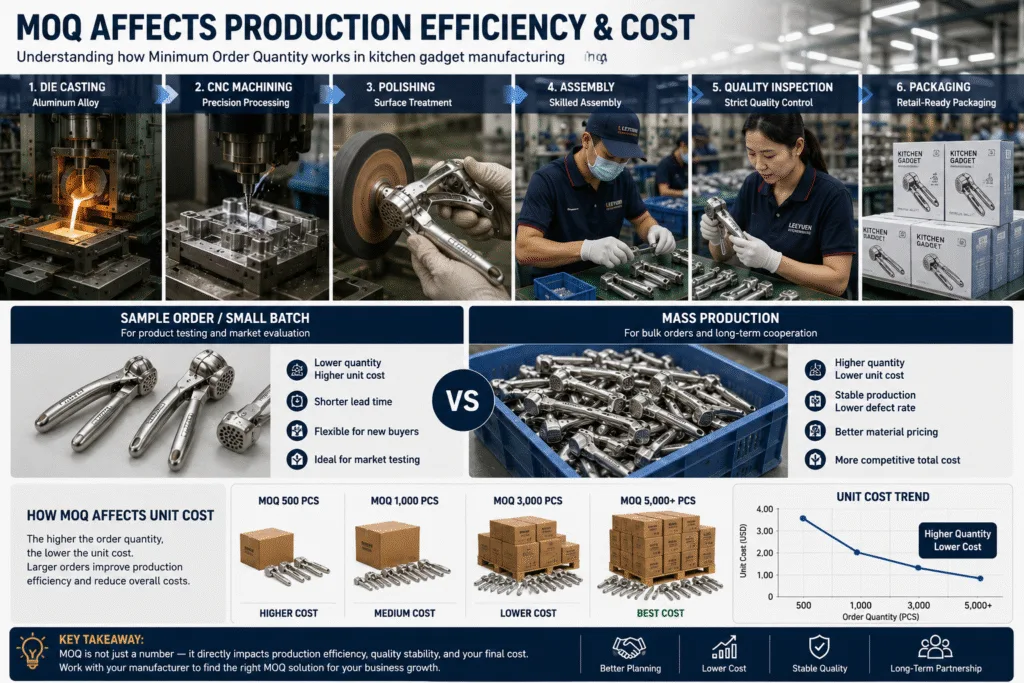
Manufacturing involves many fixed costs that remain the same regardless of order size.
Examples include:
- Machine setup
- Mold installation
- Engineering support
- Production scheduling
- Quality inspections
- Packaging preparation
If production quantities are too small, these fixed costs significantly increase the unit cost.
MOQ helps manufacturers balance production efficiency with competitive pricing.
Factors That Influence MOQ
Several factors affect minimum order quantities.
Product Complexity
Simple kitchen gadgets generally require lower MOQs than products with multiple components or complicated assembly.
Material Selection
Products made from aluminum alloy die casting often require different MOQs than products manufactured using stainless steel or plastic.
Material purchasing quantities also influence production planning.
Customization Requirements
Customized products usually require larger MOQs because manufacturers must prepare:
- Custom molds
- Logo engraving
- Packaging
- Color matching
- Printing plates
The more customization involved, the higher the MOQ may become.
Packaging
Retail-ready packaging often requires minimum printing quantities.
Examples include:
- Color boxes
- Gift boxes
- Barcode labels
- Instruction manuals
These packaging requirements can affect the final MOQ.
Typical MOQ for Kitchen Gadgets
MOQ varies by manufacturer and product category.
Common examples include:
| Product Type | Typical MOQ* |
|---|---|
| Garlic Press | 500–1,000 pcs |
| Lemon Squeezer | 500–1,000 pcs |
| Pizza Cutter | 500–1,000 pcs |
| Ice Cream Scoop | 500–1,000 pcs |
| Meat Tenderizer | 300–500 pcs |
*Actual MOQ depends on customization, packaging, and manufacturing requirements.
MOQ for OEM Products
OEM production generally requires higher MOQs because manufacturers must prepare dedicated production resources.
OEM projects may include:
- Custom logos
- Surface treatments
- Packaging design
- Product modifications
- New tooling
These additional production steps increase preparation costs.
MOQ for Private Label Orders
Private label products often involve:
- Brand identity
- Retail packaging
- Barcode labels
- Marketing inserts
- Product manuals
Although the product itself may remain unchanged, branding requirements usually increase production complexity.
How to Negotiate a Lower MOQ
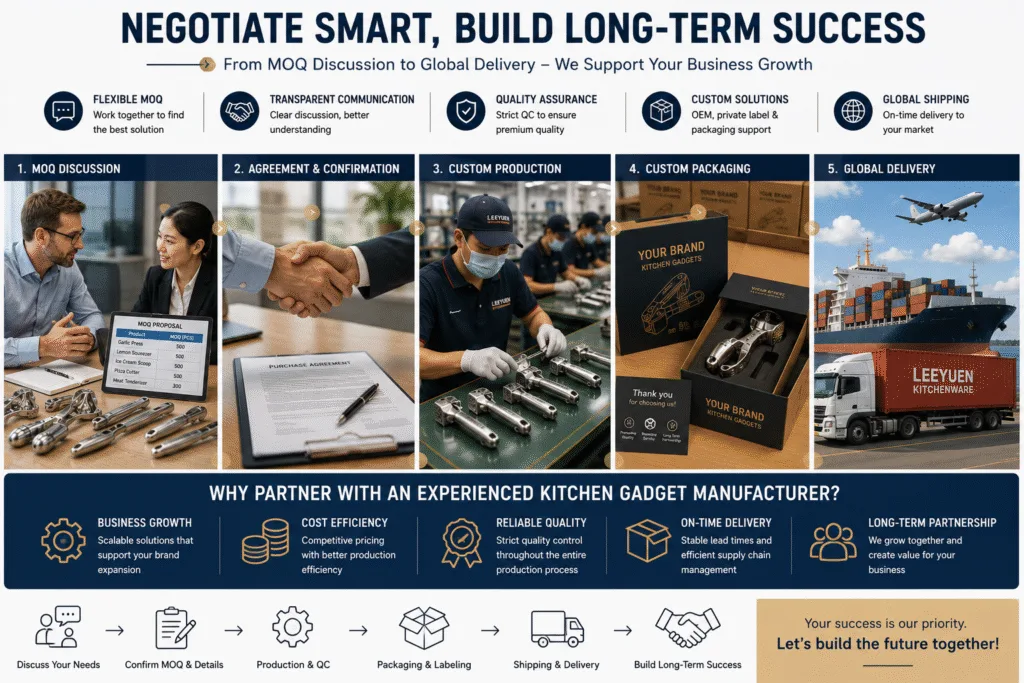
Professional manufacturers are often willing to discuss MOQ when both parties seek a long-term partnership.
Possible negotiation strategies include:
Choose Standard Products
Using existing product designs instead of creating entirely new products can reduce manufacturing costs and lower MOQ requirements.
Simplify Customization
Reducing the number of custom colors, packaging variations, or logo options may help decrease production complexity.
Combine Multiple Products
Some manufacturers allow buyers to combine different products into one production order, making it easier to meet minimum production requirements.
Build a Long-Term Relationship
Manufacturers are generally more flexible when buyers demonstrate consistent purchasing plans.
Long-term cooperation often creates opportunities for better pricing and more favorable MOQ arrangements.
MOQ vs Product Pricing
MOQ and pricing are closely connected.
Generally:
- Higher order quantities reduce unit costs.
- Lower quantities increase manufacturing costs per unit.
- Larger production runs improve production efficiency.
Buyers should evaluate total purchasing costs rather than focusing only on MOQ.
Should Small Businesses Worry About MOQ?
Not necessarily.
Many manufacturers support:
- Sample orders
- Trial production
- Small pilot runs
- Mixed product orders
Discuss your business plans openly with your supplier, as some factories may recommend flexible solutions based on your growth strategy.
Common Mistakes When Discussing MOQ
Avoid these common mistakes:
- Comparing MOQ without considering quality.
- Ignoring packaging requirements.
- Focusing only on the lowest price.
- Requesting excessive customization for very small orders.
- Not planning future purchasing volumes.
Successful sourcing requires balancing cost, quality, and long-term cooperation.
FAQ
Can MOQ be negotiated?
Yes. Depending on the product, customization level, and future business potential, manufacturers may offer flexible MOQ solutions.
Does OEM always require a higher MOQ?
In most cases, yes. OEM projects involve additional preparation, such as tooling, logo application, or custom packaging, which can increase production costs.
Can I order samples before meeting the MOQ?
Yes. Most manufacturers provide samples so buyers can evaluate product quality and confirm specifications before mass production.
Is a lower MOQ always better?
Not necessarily. Very low MOQs may result in higher unit costs. Buyers should balance inventory needs, production efficiency, and overall purchasing costs.