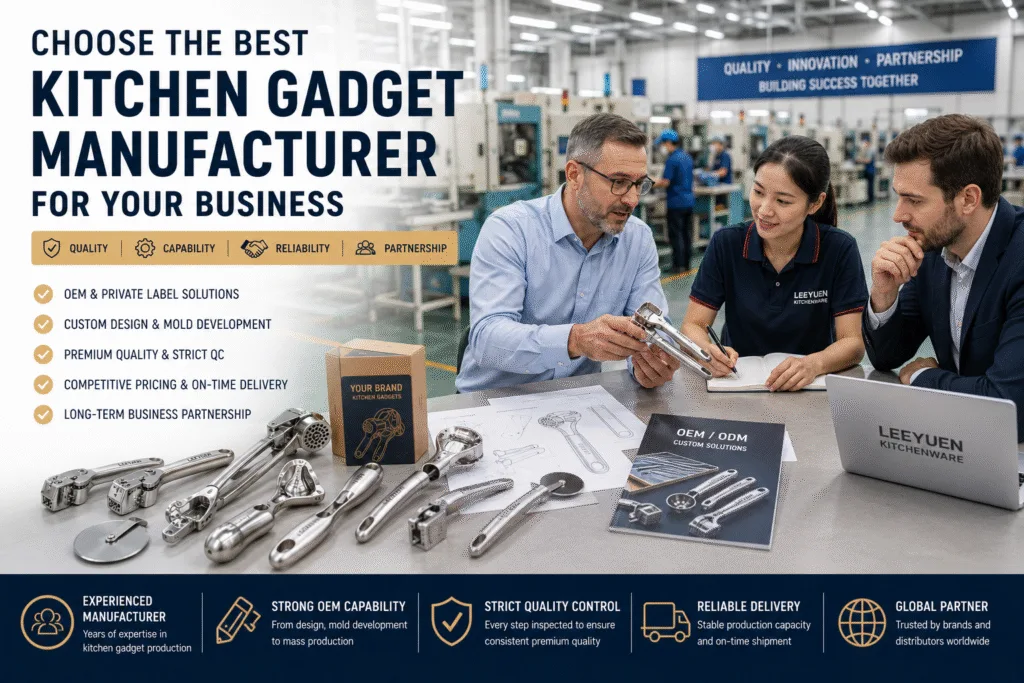
Choosing the right kitchen gadget manufacturer is one of the most important decisions for importers, wholesalers, retailers, and private-label brands. A reliable manufacturing partner does more than produce products—it helps improve product quality, maintain stable supply chains, support product innovation, and protect your brand reputation.
With thousands of manufacturers available worldwide, selecting the right partner requires more than comparing prices. Buyers should carefully evaluate production capabilities, engineering expertise, quality management systems, OEM services, and long-term business reliability.
This guide explains the most important factors to consider when choosing a kitchen gadget manufacturer and provides practical tips to help you build a successful sourcing partnership.
Why Choosing the Right Manufacturer Matters
A manufacturing partner directly influences:
- Product quality
- Customer satisfaction
- Delivery performance
- Production costs
- Brand reputation
- Business growth
The right supplier becomes an extension of your business, helping you develop products that meet market expectations while maintaining consistent quality.
Manufacturing Experience
Experience is often one of the strongest indicators of manufacturing reliability.
An experienced manufacturer usually offers:
- Stable production processes
- Better engineering knowledge
- Faster problem solving
- Consistent product quality
- Efficient production planning
Manufacturers with years of experience in aluminum die casting and kitchen gadget production are generally better equipped to handle customized OEM projects.
In-House Product Development & Mold Design
Product development capabilities determine how efficiently a manufacturer can transform ideas into production-ready products.
Look for manufacturers that provide:
- CAD design
- 3D modeling
- Prototype development
- Mold engineering
- Mold maintenance
Factories with in-house tooling departments can usually shorten development cycles while maintaining greater quality control.
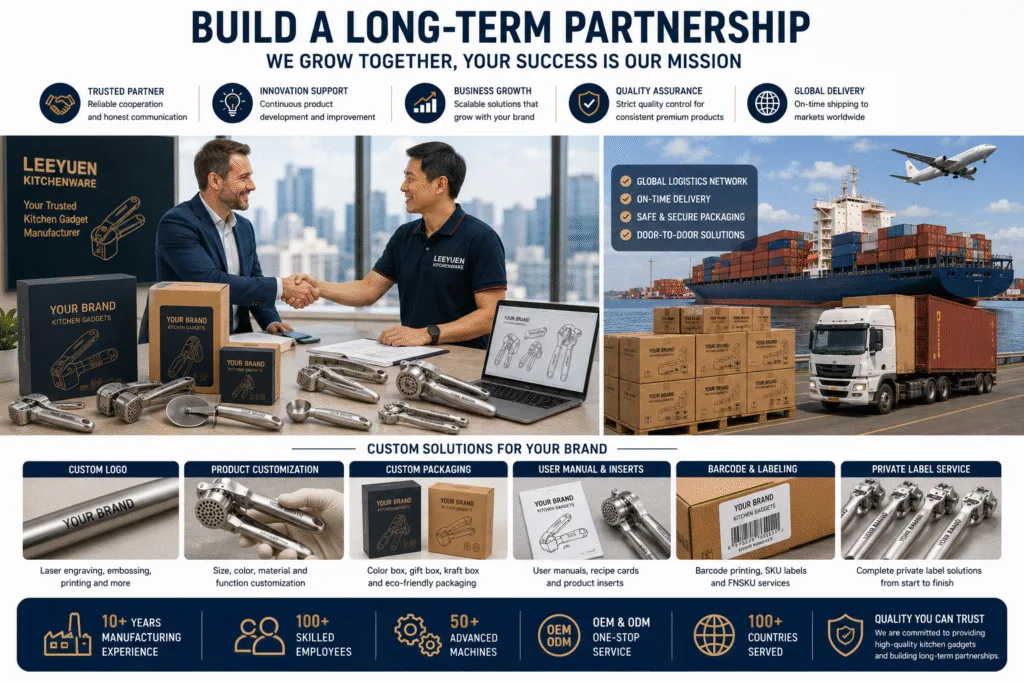
OEM & Private Label Capabilities
Many businesses require products customized under their own brands.
A professional manufacturer should support:
- Custom logos
- Product customization
- Surface finishes
- Color options
- Retail packaging
- User manuals
- Barcode labels
Flexible OEM services allow brands to create products that stand out in competitive markets.
Production Capacity
Production capacity determines whether a manufacturer can support your business as it grows.
Important considerations include:
- Number of production lines
- Die-casting equipment
- CNC machining capability
- Assembly capacity
- Warehouse management
- Lead time consistency
A scalable factory helps ensure stable deliveries during peak seasons.
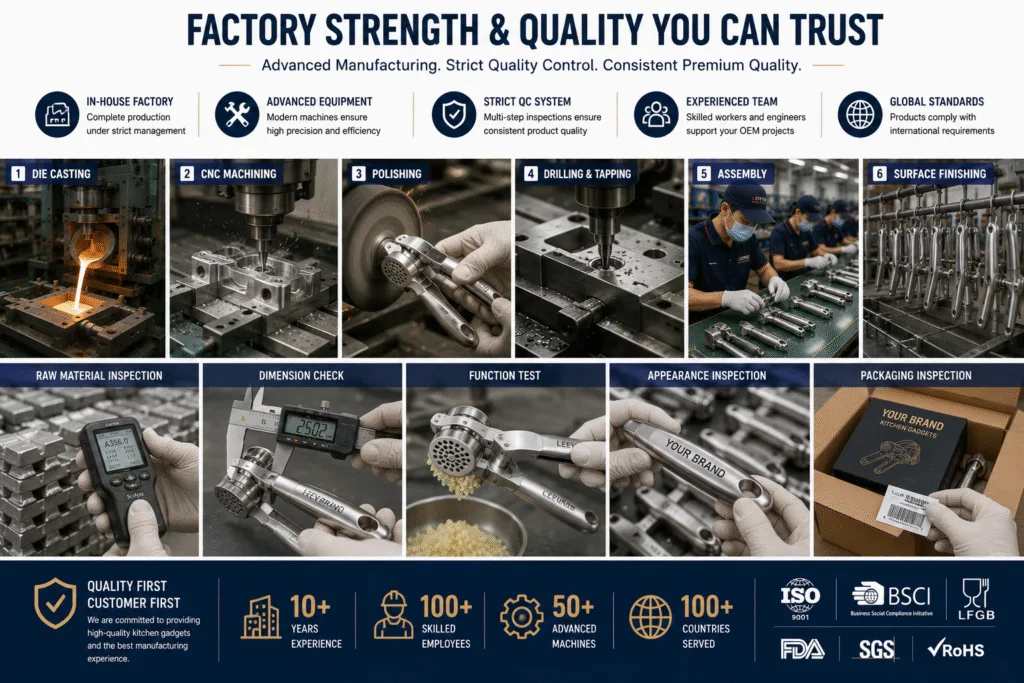
Quality Control System
Quality control should be integrated into every production stage.
Professional manufacturers typically perform inspections on:
- Raw materials
- Die-cast components
- CNC machining
- Surface finishing
- Assembly
- Functional testing
- Packaging
Consistent inspections reduce defects and improve customer satisfaction.
Materials & Product Safety
Kitchen gadgets must meet food-contact safety requirements.
Ask manufacturers about:
- Food-grade materials
- Aluminum alloy specifications
- Stainless steel components
- Surface coatings
- Compliance with international standards
Material transparency demonstrates professionalism and manufacturing responsibility.
Certifications & Compliance
Depending on your target market, manufacturers may provide certifications related to product safety or quality management.
Common documentation may include:
- Quality management certifications
- Food-contact compliance documentation
- Material testing reports
- Factory audit reports
Request relevant documentation based on your market requirements.
Communication & Technical Support
Effective communication reduces misunderstandings throughout the project.
Reliable manufacturers should:
- Respond promptly
- Provide technical recommendations
- Share production updates
- Explain manufacturing limitations honestly
- Support product improvements
Strong communication is often just as valuable as manufacturing capability.
Pricing Should Not Be the Only Decision Factor
The lowest quotation is not always the best choice.
Instead, evaluate the overall value by considering:
- Product quality
- Manufacturing experience
- Engineering support
- Quality inspections
- Packaging services
- Delivery reliability
A slightly higher manufacturing cost may reduce warranty claims and improve customer satisfaction.
Questions to Ask Before Choosing a Manufacturer
Before starting cooperation, consider asking:
- How many years have you manufactured kitchen gadgets?
- Do you provide OEM and private-label services?
- Do you have in-house mold development?
- What quality inspections are performed?
- What materials are used?
- Can you provide product samples?
- What is your production lead time?
- What is your monthly production capacity?
These questions help compare manufacturers objectively.
Common Mistakes Buyers Should Avoid
Many sourcing problems occur because buyers overlook important evaluation factors.
Common mistakes include:
- Choosing suppliers based only on price
- Ignoring production capabilities
- Skipping sample evaluation
- Failing to verify quality control systems
- Not discussing packaging requirements
- Poor communication during development
Taking time to evaluate suppliers thoroughly helps reduce risks later.
FAQ
Should I choose a trading company or a manufacturer?
For businesses requiring OEM services and long-term product consistency, working directly with an experienced manufacturer often provides better communication, customization, and quality control.
Is factory size the most important factor?
Not necessarily. Production management, engineering capability, quality systems, and communication are often more important than factory size alone.
How can I verify product quality?
Request samples, review quality inspection procedures, discuss materials, and evaluate the manufacturer’s production process before placing large orders.
Why is OEM capability important?
OEM services allow businesses to customize products, strengthen brand identity, and differentiate themselves in competitive markets.