Table of Contents
A Practical Guide for Kitchenware Brands, Importers, and Wholesale Buyers
As the global kitchenware market becomes increasingly competitive, more brands are turning to China for OEM and ODM manufacturing solutions. However, many buyers still misunderstand the differences between these two production models.
Choosing the right manufacturing method affects product customization, branding opportunities, development costs, and speed to market.
For wholesalers, retailers, and private label brands, understanding OEM and ODM manufacturing is essential before working with a kitchenware supplier.
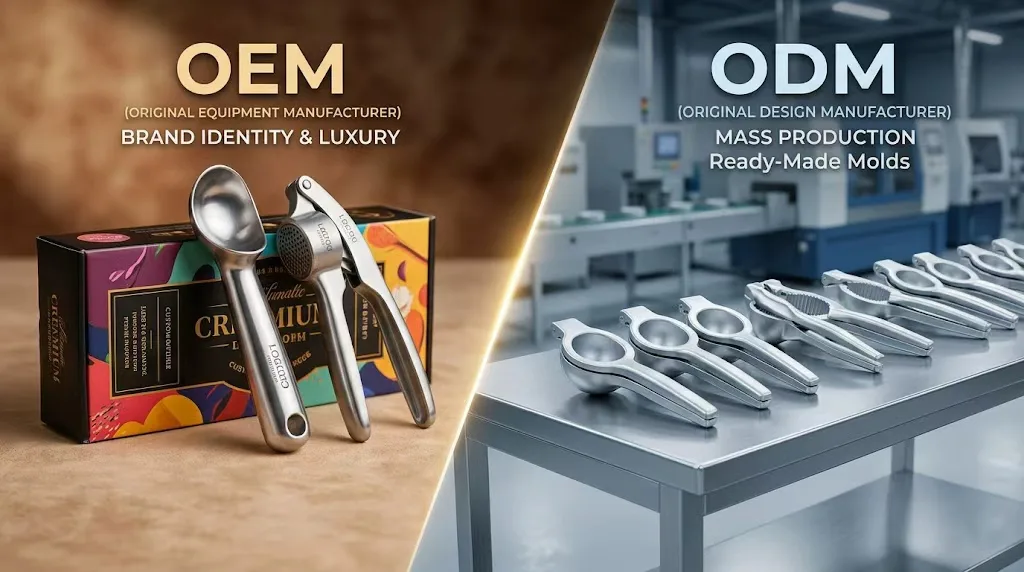
Key Takeaways
- OEM manufacturing offers higher customization and stronger brand identity.
- ODM manufacturing helps businesses launch products faster with lower investment.
- OEM is ideal for long-term private label brands.
- ODM is suitable for startups and fast market testing.
- Professional kitchenware factories often support both OEM and ODM services.
What Is OEM Manufacturing?
OEM stands for Original Equipment Manufacturing.
In OEM kitchenware manufacturing, the buyer provides product ideas, drawings, specifications, or branding requirements, while the factory produces products according to those custom requirements.
OEM manufacturing is commonly used by:
- Kitchenware brands
- Supermarket suppliers
- Amazon private label sellers
- Hospitality suppliers
- Commercial distributors
One of the biggest advantages of OEM manufacturing is product exclusivity.
Buyers can customize:
- Product dimensions
- Materials
- Colors
- Logos
- Packaging
- Surface finishes
- Product structure
For example, a buyer may develop a custom aluminum garlic press with a unique ergonomic design and branded retail packaging for European supermarkets.
This helps brands create differentiated products and reduce direct price competition.
Benefits of OEM Kitchenware Manufacturing
Stronger Brand Identity
OEM manufacturing helps brands create unique products that reflect their own positioning and design language.
Instead of competing with generic products, companies can build stronger recognition through customized kitchen tools and packaging.
Higher Product Customization
OEM projects allow buyers to customize nearly every detail, including:
- Product structure
- Material selection
- Surface finishes
- Packaging design
- Brand logos
This flexibility is especially valuable for premium kitchenware brands.
Long-Term Market Differentiation
Exclusive OEM products are harder for competitors to copy.
This helps businesses reduce price competition and improve long-term profit margins.
What Is ODM Manufacturing?
ODM stands for Original Design Manufacturing.
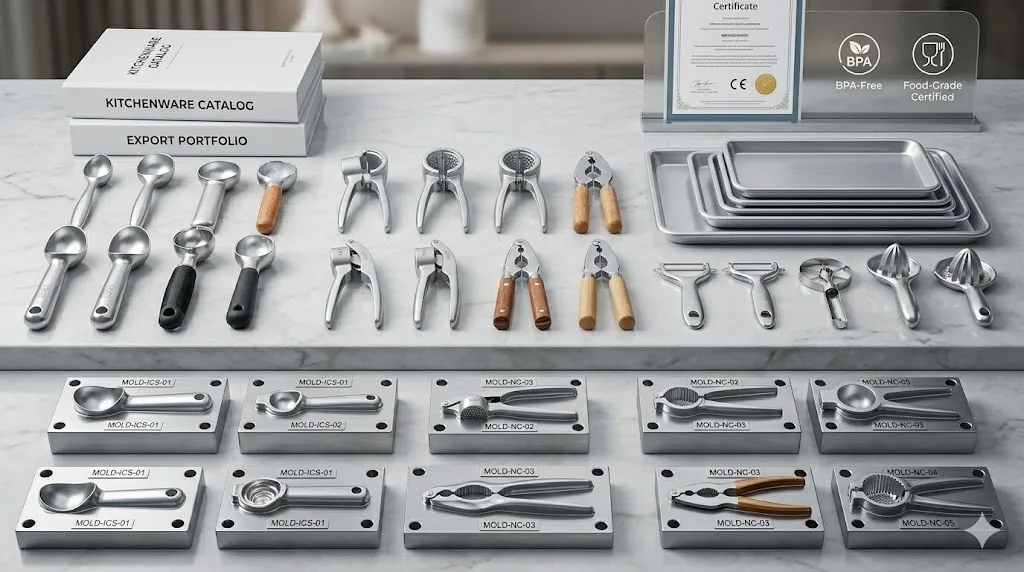
In ODM manufacturing, the factory already owns the product design and molds. Buyers select existing products and customize logos, packaging, or colors.
ODM manufacturing is often preferred by:
- Startup brands
- Small importers
- Online sellers
- Fast-moving retail projects
Compared with OEM production, ODM usually requires lower upfront investment and shorter development time.
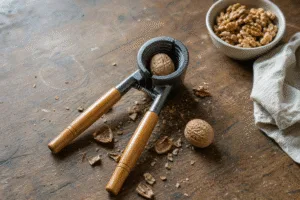
For example, buyers may choose an existing lemon squeezer or nutcracker design from a supplier catalog and simply add private label branding.
This approach allows businesses to enter the market more quickly without developing entirely new products.
Benefits of ODM Kitchenware Manufacturing
Faster Product Launch
Because molds and product structures already exist, ODM manufacturing significantly reduces development time.
This allows products to reach the market faster.
Lower Initial Investment
ODM projects usually avoid high upfront costs related to:
- Mold development
- Engineering
- Product testing
- Structural design
This makes ODM suitable for businesses with smaller budgets.
Easier Product Selection
Professional kitchenware manufacturers often provide ready-made product catalogs covering:
- Lemon squeezers
- Nutcrackers
- Pizza cutters
- Ice cream scoops
- Coffee tools
Buyers can quickly select products without starting development from zero.
OEM vs ODM Kitchenware Manufacturing
Key Differences Between OEM and ODM
| Comparison | OEM Manufacturing | ODM Manufacturing |
|---|---|---|
| Product Design | Buyer provides design | Factory provides design |
| Customization Level | High | Moderate |
| Product Exclusivity | Strong | Limited |
| Development Cost | Higher | Lower |
| Time to Market | Longer | Faster |
| Best For | Established brands | Startup sellers |
OEM manufacturing is usually better for brands building long-term market differentiation.
ODM manufacturing is more suitable for businesses seeking faster product launches and lower sourcing risk.
OEM vs ODM Cost Comparison
Understanding Development and Production Costs
| Cost Factor | OEM | ODM |
|---|---|---|
| Mold Development | Required | Usually unnecessary |
| Product Engineering | Required | Minimal |
| Initial Investment | Higher | Lower |
| Product Uniqueness | High | Moderate |
| Launch Speed | Slower | Faster |
Although OEM projects require higher upfront costs, they often create stronger long-term brand value.
ODM manufacturing reduces short-term financial risk and simplifies product sourcing.
Which Manufacturing Model Is Better for Your Business?
The right solution depends on your business goals.
When to Choose OEM Manufacturing
OEM manufacturing is usually better if you want:
- Exclusive products
- Strong branding
- Premium positioning
- Long-term market growth
OEM projects are ideal for businesses focused on private label development and brand differentiation.
When to Choose ODM Manufacturing
ODM manufacturing may be better if you want:
- Faster product launches
- Lower investment
- Easier sourcing
- Rapid testing of new markets
Many successful kitchenware brands start with ODM products and later transition into OEM manufacturing as their business grows.
Why Aluminum Kitchenware Is Popular in OEM Manufacturing
Aluminum remains one of the most widely used materials in kitchenware production.
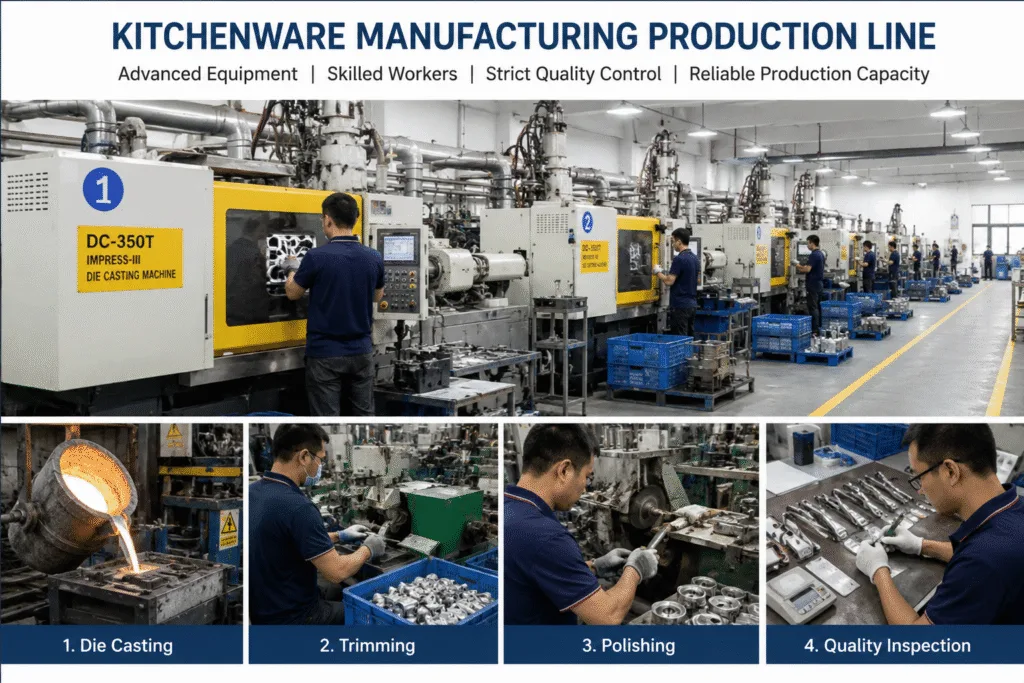
Many OEM kitchen tools are made using aluminum die-casting because it offers excellent production efficiency and cost control.
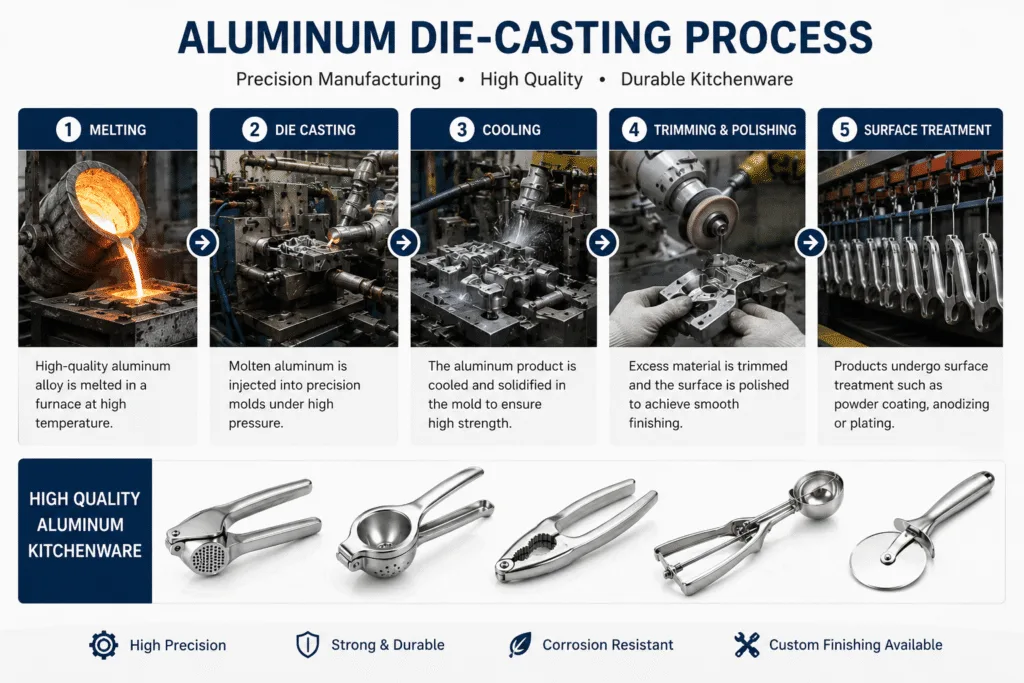
Advantages of Aluminum Die-Casting Kitchen Tools
Lightweight and Durable
Aluminum kitchen tools are lightweight while maintaining strong structural durability.
This improves daily usability and handling comfort.
Cost-Effective Mass Production
Aluminum die-casting supports efficient large-scale production with consistent product quality.
This makes it highly suitable for OEM manufacturing projects.
Flexible Surface Finishing
Aluminum products support various surface treatments, including:
- Powder coating
- Polishing
- Matte finishes
- Electroplating
This helps brands create premium product appearances.
Common Mistakes Buyers Make
Many buyers focus only on pricing and overlook long-term supplier reliability.
This often creates sourcing problems later.
Choosing Suppliers Only by Price
Extremely low pricing may indicate poor materials or weak quality control systems.
Reliable manufacturing requires stable production standards and experienced factory management.
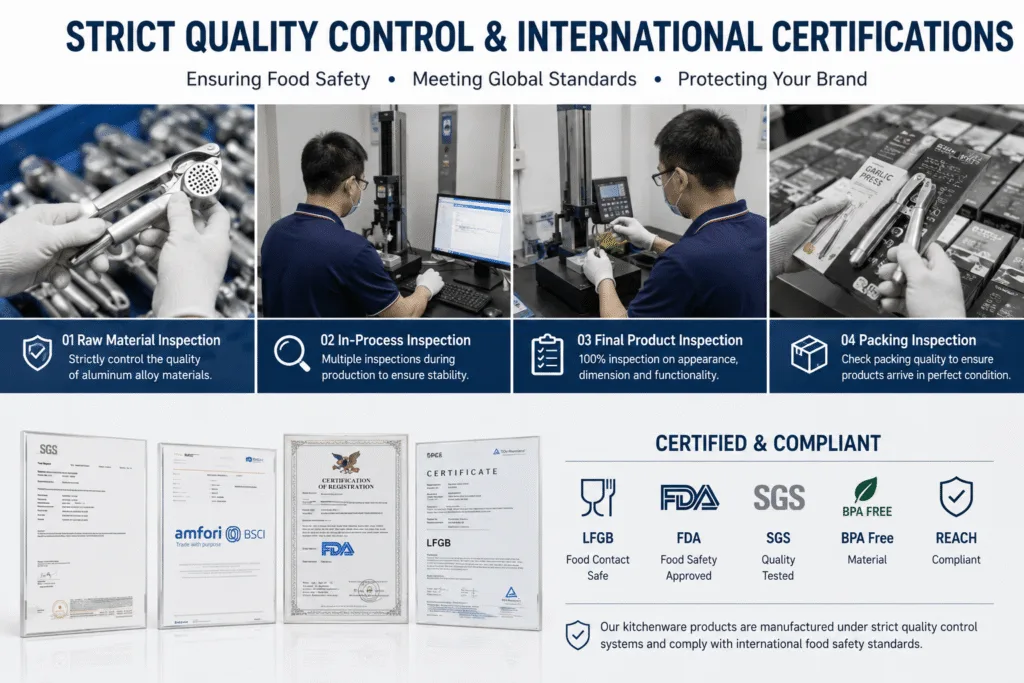
Ignoring Product Certifications
Kitchenware products should comply with food-contact regulations such as:
- FDA
- LFGB
- SGS testing
Ignoring certification requirements may create import risks and compliance problems.
Skipping Product Sample Testing
Samples help buyers evaluate:
- Product quality
- Surface finish
- Functionality
- Packaging standards
Bulk orders should never proceed without proper sample approval.
Poor Communication During Development
Professional communication is essential during OEM development.
Factories with weak communication often create production delays and quality misunderstandings.
How to Choose the Right Kitchenware Manufacturer
Choosing the right supplier is just as important as choosing OEM or ODM manufacturing. If you are sourcing products globally, you can also read our guide on how to choose a reliable kitchenware manufacturer in China.
Evaluate Manufacturing Experience
Experienced manufacturers usually provide more stable production systems and better problem-solving capabilities.
Factories with long-term export experience are often more reliable for international buyers.
Check Quality Control Systems
Reliable kitchenware manufacturers should maintain clear QC procedures covering:
- Raw material inspection
- Production inspection
- Packaging inspection
- Final quality checks
Strong QC systems help reduce product defects and shipment issues.
Confirm Export and OEM Capabilities
Professional suppliers should support:
- OEM and ODM services
- International export standards
- Food-grade certifications
- Stable lead times
- Custom packaging solutions
Long-term supplier stability is often more valuable than simply finding the lowest price.
FAQ
What is the main difference between OEM and ODM?
OEM manufacturing uses buyer-provided designs, while ODM manufacturing uses factory-owned designs.
Which is cheaper: OEM or ODM?
ODM manufacturing usually requires lower upfront investment because existing molds are used.
Which model is better for private label brands?
OEM manufacturing is generally better for long-term private label brand development.
Can OEM kitchenware products be fully customized?
Yes. OEM manufacturing supports customization of logos, packaging, materials, colors, and product structure.
Why do startups often choose ODM manufacturing?
ODM manufacturing reduces development costs and shortens time to market.