Introduction
Modern kitchen gadgets may look simple from the outside, but many metal kitchen tools require carefully controlled manufacturing processes to achieve the required dimensions, functionality, and appearance.
CNC machining is one of the technologies used by professional kitchen gadget manufacturers to produce precise metal components and finish critical product features.
CNC, which stands for Computer Numerical Control, allows computer-controlled machines to remove material from a workpiece according to a programmed design. Depending on the product, CNC machining can be used to create holes, threads, mounting surfaces, connection points, and other precision features.
In aluminum kitchen gadget manufacturing, CNC machining is often used together with aluminum die casting rather than as a replacement for it. Die casting can efficiently create the basic product geometry, while CNC machining can provide additional precision where it is required.
For kitchenware brands, wholesalers, importers, and private label businesses, understanding how CNC machining fits into the manufacturing process can help them evaluate suppliers and develop better products.
This article explains how CNC machining works, why it is used in kitchen gadget manufacturing, its common applications, benefits, quality control requirements, and the relationship between CNC machining and aluminum die casting.
What Is CNC Machining?
CNC machining is a computer-controlled manufacturing process used to remove material from metal, plastic, or other materials to create a specific shape or dimension.
Instead of relying entirely on manual operation, CNC machines follow programmed instructions generated from digital product designs.
A typical CNC machining workflow includes:
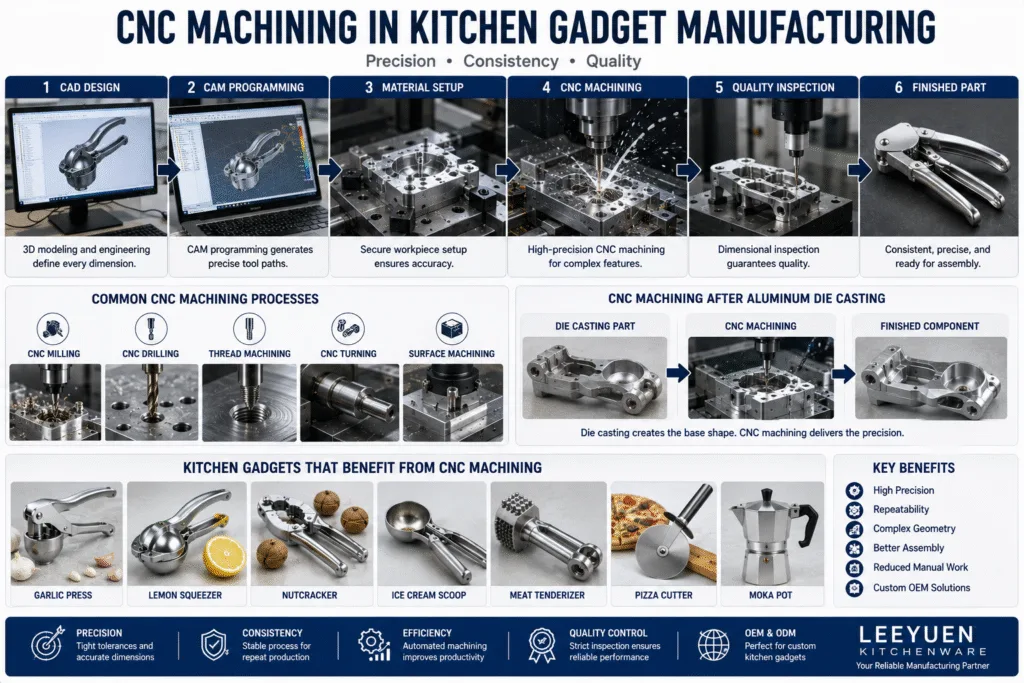
CAD Design → CAM Programming → Material Setup → Tool Selection → CNC Machining → Inspection
The machine can precisely control factors such as:
- Tool movement
- Cutting depth
- Cutting speed
- Feed rate
- Position
- Machining sequence
This level of control allows manufacturers to produce repeatable components with consistent dimensions.
For kitchen gadget manufacturing, CNC machining is particularly useful when a product contains functional areas that require greater dimensional accuracy than the casting process alone can provide.
Why CNC Machining Is Important for Kitchen Gadgets
Kitchen gadgets are frequently used by hand, which means small dimensional differences can sometimes affect assembly, operation, or user experience.
CNC machining can provide several important manufacturing advantages.
High Precision
CNC machines can manufacture specific features according to defined dimensions and tolerances.
This is useful for components such as:
- Holes
- Threads
- Shafts
- Mounting surfaces
- Connection points
Consistent Production
Once the CNC program and machining process have been properly established, the same operation can be repeated across large numbers of components.
This helps reduce variation between products.
Complex Machining Capability
CNC equipment can produce geometries that may be difficult to achieve through manual machining.
Better Assembly Accuracy
Precision-machined connection points can help different components fit together more consistently.
Flexible Customization
CNC machining can be adapted for different product dimensions and designs, making it useful for OEM and ODM development.
How CNC Machining Works
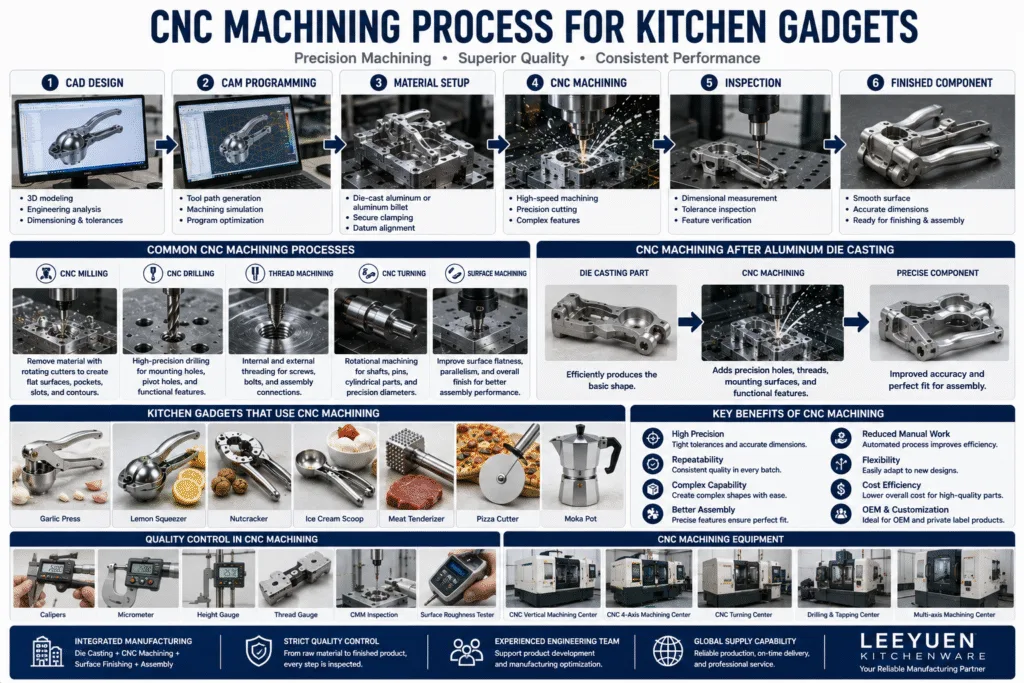
Step 1: CAD Product Design
CNC machining usually starts with a digital product model.
Engineers use CAD software to define:
- Product dimensions
- Geometric features
- Hole locations
- Threads
- Tolerances
- Machining surfaces
The digital model provides the foundation for the machining process.
Step 2: CAM Programming
The CAD model is converted into machining instructions using CAM software.
Engineers determine:
- Cutting paths
- Tool selection
- Machining sequence
- Cutting parameters
- Workpiece positioning
The resulting program tells the CNC machine how to manufacture the component.
Step 3: Material Setup
The workpiece is securely positioned on the CNC machine.
For aluminum kitchen gadgets, the material may be:
- Die-cast aluminum components
- Aluminum blocks
- Aluminum profiles
- Other suitable aluminum components
Correct positioning is important because inaccurate setup can affect the final dimensions.
Step 4: Tool Selection
Different machining operations require different cutting tools.
Depending on the product, manufacturers may select tools for:
- Milling
- Drilling
- Threading
- Slot machining
- Surface machining
Tool selection can affect machining efficiency, surface quality, and dimensional accuracy.
Step 5: CNC Machining
The machine follows the programmed tool paths and removes material from the workpiece.
Depending on the product, CNC machining may involve multiple operations.
For example, a die-cast aluminum kitchen tool may first receive precision drilling, followed by threading and machining of selected mounting surfaces.
Step 6: Inspection
After machining, the finished component should be inspected to confirm that critical dimensions meet the required specifications.
Inspection may include:
- Dimensional measurement
- Hole diameter measurement
- Thread inspection
- Surface inspection
- Tolerance verification
This ensures that the machined component is ready for subsequent finishing or assembly.
CNC Machining After Aluminum Die Casting
One of the most important applications of CNC machining in kitchen gadget manufacturing is post-die-casting machining.
Aluminum die casting is highly efficient for producing the basic geometry of metal kitchen gadgets.
However, some areas may require additional precision.
For example, a die-cast component may contain:
- Screw holes
- Axle holes
- Threads
- Bearing locations
- Assembly interfaces
- Precision mounting surfaces
Instead of machining the entire product from a solid block of aluminum, manufacturers can first create the basic shape through die casting and then use CNC machining only where precision is required.
This combination can provide an effective balance between manufacturing efficiency and dimensional accuracy.
Common CNC Machining Processes for Kitchen Gadgets
Different CNC processes are used according to the structure and requirements of the product.
CNC Milling
CNC milling uses rotating cutting tools to remove material from the workpiece.
It can be used for:
- Flat surfaces
- Slots
- Contours
- Pockets
- Complex geometries
For aluminum kitchen tools, milling can be used to create or refine specific functional surfaces.
CNC Drilling
CNC drilling creates precise holes in a component.
Accurate hole positioning is particularly important for products that require:
- Pins
- Screws
- Shafts
- Fasteners
- Hinges
CNC Threading
Some kitchen gadgets contain threaded connections.
CNC machining can create accurate internal or external threads according to the product specification.
Proper thread dimensions help improve assembly consistency and component reliability.
Surface Machining
CNC machining can also be used to refine selected surfaces that require greater dimensional accuracy.
This can be useful when two components must fit together closely.
Kitchen Gadgets That May Require CNC Machining
Not every kitchen gadget requires CNC machining.
The need depends on product design, material, manufacturing method, and required tolerances.
Several types of kitchen tools may benefit from CNC machining.
Garlic Presses
Garlic presses may require precision holes, connection points, or machined surfaces to ensure that moving components operate correctly.
Lemon Squeezers
Manual lemon squeezers can contain pivot points or connection areas that benefit from accurate machining.
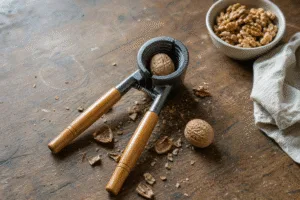
Nutcrackers
Nutcrackers may require precise connection points and holes because the product is subjected to repeated mechanical loads.
Ice Cream Scoops
Some premium ice cream scoop designs may use CNC machining for selected components or precision surfaces.
Meat Tenderizers
Meat tenderizers may contain mounting or connection features that require accurate machining.
Pizza Cutters
Depending on the design, CNC machining can be used for selected aluminum components, mounting points, or structural features.
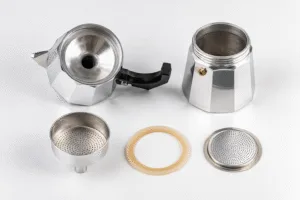
Moka Pots
Certain aluminum moka pot components may require precision machining for functional interfaces, threads, or sealing-related areas.
Benefits of CNC Machining for Kitchen Gadget Manufacturers
CNC machining offers several advantages for manufacturers developing metal kitchen tools.
1. High Dimensional Accuracy
CNC machining allows manufacturers to control critical product dimensions accurately.
This is particularly useful for components that must fit together with other parts.
2. Repeatability
Once the machining process has been validated, the same program can be used repeatedly.
This helps manufacturers maintain consistency across production batches.
3. Complex Design Capability
CNC machines can manufacture many complex geometries that would be difficult to produce manually.
4. Reduced Manual Machining
Automated machine movements reduce dependence on manual cutting operations.
This can improve production consistency and efficiency.
5. Flexible Product Development
CNC machining is useful during product development because digital programs can be modified when designs change.
6. Improved Assembly Accuracy
Precision machining of connection areas can help improve the fit between different components.
CNC Machining and OEM Kitchen Gadget Development
CNC machining is especially useful for OEM and ODM kitchen gadget projects.
When a brand develops a customized kitchen tool, the product may require unique:
- Dimensions
- Holes
- Threads
- Structural features
- Connection systems
- Branding elements
CNC machining provides manufacturers with the flexibility to produce these customized features.
During prototype development, CNC machining can also help manufacturers produce functional samples for testing.
After the product design has been validated, the manufacturing process can be optimized for larger-scale production.
CNC Machining Quality Control
Precision machining is only valuable when manufacturers can verify the results.
A professional quality control process should include inspection of critical dimensions and functional features.
Dimensional Inspection
Manufacturers may measure:
- Length
- Width
- Height
- Hole diameter
- Thickness
- Distance between features
Tolerance Inspection
Critical dimensions should be compared with the engineering drawings and specified tolerances.
Hole Inspection
Hole diameter and position may need to be checked when components are designed for screws, shafts, or pins.
Thread Inspection
Threaded components should be checked to ensure proper fit and function.
Surface Inspection
Machined surfaces should also be inspected for:
- Scratches
- Burrs
- Tool marks
- Uneven surfaces
- Other visible defects
CNC Machining vs Aluminum Die Casting
CNC machining and aluminum die casting serve different purposes in kitchen gadget manufacturing.
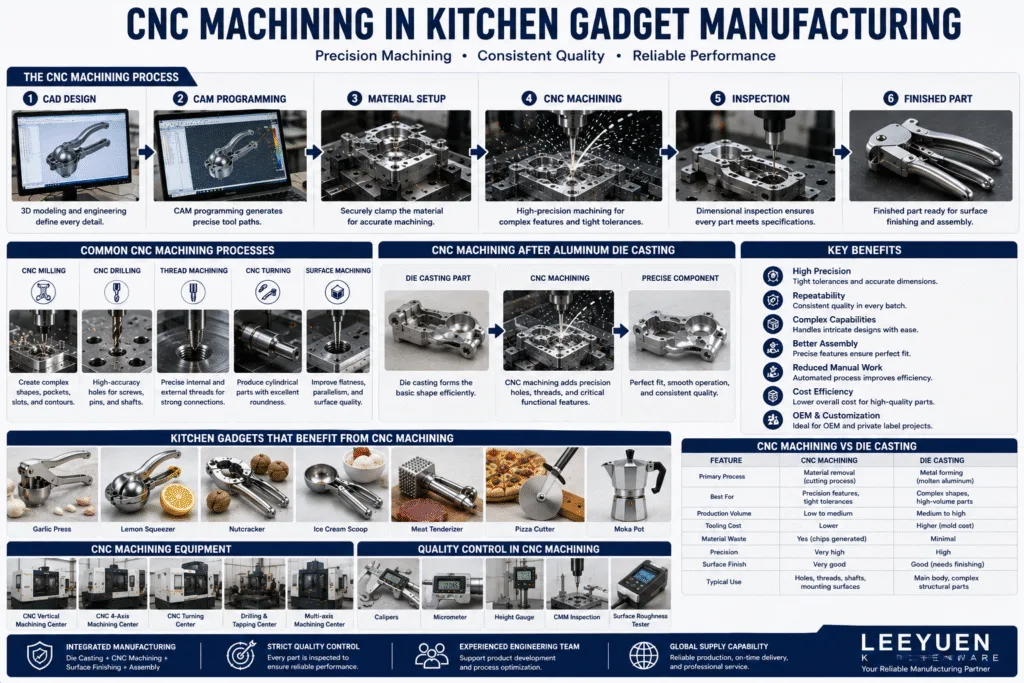
| Factor | CNC Machining | Aluminum Die Casting |
|---|---|---|
| Precision | Very high | High |
| Production volume | Low to medium | Medium to high |
| Initial tooling | Relatively low | Higher mold investment |
| Complex shapes | Excellent | Excellent |
| Mass production efficiency | Moderate | High |
| Material removal | Yes | Minimal |
| Best use | Precision features and components | Efficient production of complex metal bodies |
These processes should not always be viewed as competing technologies.
In many kitchen gadget applications, they work together.
Aluminum Die Casting → CNC Machining → Surface Finishing → Assembly
This manufacturing combination can provide an effective balance between productivity, precision, and product quality.
CNC Machining vs Manual Machining
Manual machining can be suitable for simple operations, repairs, or certain low-volume applications.
However, CNC machining provides important advantages for repeat production.
| Factor | CNC Machining | Manual Machining |
|---|---|---|
| Automation | High | Lower |
| Repeatability | High | Operator dependent |
| Complex geometries | Strong capability | More limited |
| Production consistency | High | Variable |
| Programmed production | Yes | Generally no |
| Large-volume repeat production | More suitable | Less efficient |
For international kitchen gadget manufacturers, CNC machining can help maintain consistent production quality as order quantities increase.
How to Choose a CNC Machining Manufacturer
For B2B buyers, selecting a capable CNC machining supplier requires more than checking machine quantity.
Consider the following factors.
CNC Equipment
Ask what types of CNC machines the manufacturer operates and whether the equipment is appropriate for the product.
Engineering Capability
Experienced engineers should be able to review product drawings and identify potential manufacturing problems.
Machining Tolerance
The supplier should clearly understand the dimensional tolerances required for critical product features.
Inspection Equipment
Quality control equipment should be appropriate for measuring the required dimensions and tolerances.
Aluminum Processing Experience
For aluminum kitchen gadgets, experience machining die-cast aluminum components can be valuable.
Die Casting Integration
A manufacturer that can coordinate die casting and CNC machining can simplify production management.
Surface Finishing
Integrated or closely coordinated finishing capabilities can reduce unnecessary transportation between suppliers.
OEM Experience
Experience with customized products helps manufacturers understand the requirements of international brands and private label customers.
Questions B2B Buyers Should Ask
Before selecting a CNC machining manufacturer, buyers should ask:
- What CNC equipment is available?
- What machining tolerances can be achieved?
- Can the manufacturer machine aluminum die-cast components?
- What inspection equipment is available?
- Can the supplier work from 3D CAD drawings?
- Can prototypes be produced?
- What is the expected machining lead time?
- Can CNC machining be combined with die casting?
- What surface finishing options are available?
- Can the manufacturer provide assembly and packaging?
Clear communication about these requirements can help prevent production problems.
How CNC Machining Affects Kitchen Gadget Manufacturing Cost
CNC machining costs depend on several factors.
Product Complexity
More complex geometries generally require more machining operations.
Machining Time
Longer machining cycles increase production costs.
Material Removal
Components requiring extensive material removal may take longer to manufacture.
Tooling
Specialized cutting tools may increase initial setup costs.
Tolerances
Tighter tolerances may require additional machining and inspection.
Production Volume
Higher production volumes can help distribute programming and setup costs across more units.
For this reason, manufacturers often combine die casting with CNC machining when appropriate.
Die casting creates most of the required geometry efficiently, while CNC machining focuses on critical precision areas.
The Role of CNC Machining in Modern Kitchen Gadget Manufacturing
As kitchen gadgets become more sophisticated, manufacturing processes must also become more precise.
Consumers expect products to:
- Fit together properly
- Operate smoothly
- Look consistent
- Feel comfortable
- Remain durable
For manufacturers, CNC machining provides an important tool for meeting these expectations.
Combined with modern CAD design, aluminum die casting, precision mold development, surface finishing, and quality inspection, CNC machining forms part of a complete modern kitchen gadget manufacturing system.
Frequently Asked Questions
What is CNC machining?
CNC machining is a computer-controlled manufacturing process that uses programmed machine tools to remove material and create precise components.
Can aluminum be CNC machined?
Yes. Aluminum is widely used in CNC machining because it is relatively lightweight and can be efficiently processed using suitable cutting tools and machining parameters.
Why is CNC machining used for kitchen gadgets?
CNC machining is used when specific product features require greater dimensional accuracy, repeatability, or complex machining than the primary manufacturing process can provide.
Is CNC machining expensive?
The cost depends on product complexity, machining time, tolerances, material removal, tooling, inspection requirements, and production volume. Combining die casting with CNC machining can be more efficient than machining an entire product from a solid block when the product design is suitable.
What is the difference between CNC machining and die casting?
Die casting forms molten metal into a mold to create the basic product geometry, while CNC machining removes material using computer-controlled cutting tools to achieve specific dimensions and features.
Do all aluminum kitchen gadgets require CNC machining?
No. The need for CNC machining depends on product design and precision requirements. Some products can be manufactured primarily through die casting and finishing, while others require additional precision machining.
Can CNC machining be used for OEM kitchen gadgets?
Yes. CNC machining is well suited to customized OEM and ODM products because digital machining programs can be developed according to specific product drawings and requirements.