Table of Contents
Why Material Selection Matters in Kitchenware Manufacturing
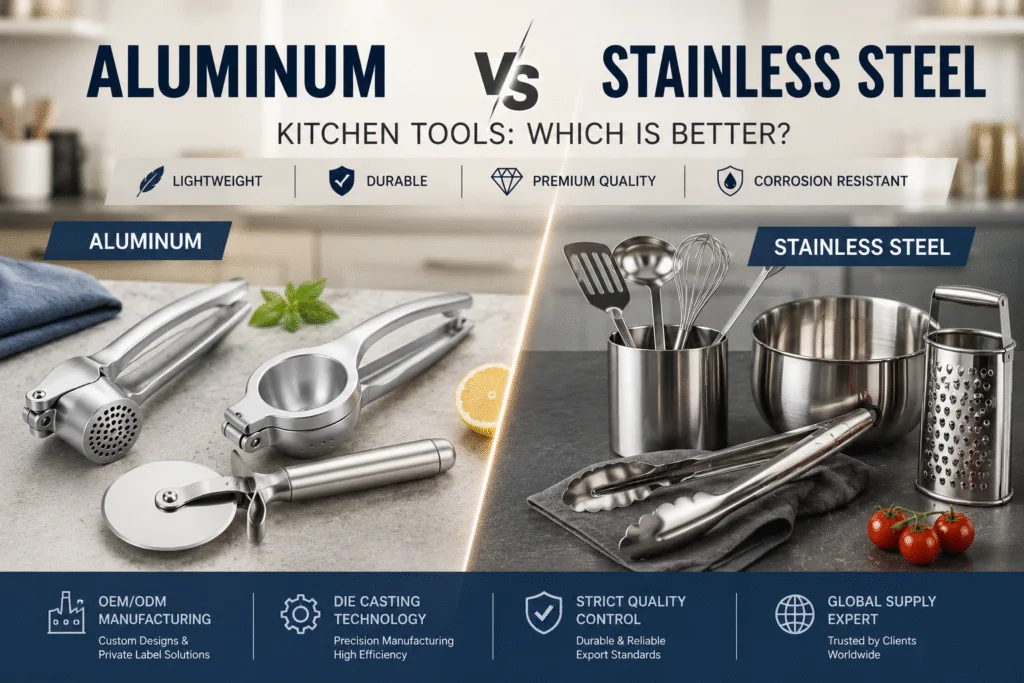
Choosing the right material is one of the most important decisions in kitchenware manufacturing. The material directly affects product durability, appearance, weight, corrosion resistance, and production cost.
Among the most widely used materials in the kitchenware industry, aluminum and stainless steel are the two most common choices.
For kitchenware brands, wholesalers, and OEM buyers, understanding the differences between aluminum and stainless steel kitchen tools can help improve product selection and reduce sourcing risks.
Key Takeaways
- Aluminum kitchen tools are lightweight and cost-effective.
- Stainless steel kitchen tools provide stronger corrosion resistance.
- Aluminum die casting supports efficient OEM manufacturing.
- Stainless steel is commonly used for premium heavy-duty products.
- The best material depends on product application and market positioning.
What Are Aluminum Kitchen Tools?
Aluminum kitchen tools are products manufactured using aluminum alloy materials, often through die-casting production methods.
Common aluminum kitchen tools include:
- Garlic presses
- Lemon squeezers
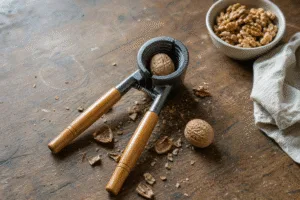
- Nutcrackers
- Meat tenderizers
- Pizza cutters
- Ice cream scoops
Aluminum is widely used because it combines lightweight performance, manufacturing efficiency, and good structural durability.
Many OEM kitchenware manufacturers prefer aluminum die casting because it supports high-volume production and flexible product customization.
Advantages of Aluminum Kitchen Tools
Lightweight and Easy to Use
Aluminum kitchen tools are lighter than many stainless steel products, improving user comfort during daily kitchen use.
Cost-Effective Manufacturing
Aluminum die casting supports efficient mass production with stable product consistency.
This helps reduce production costs for OEM and ODM kitchenware projects.
Flexible Surface Finishing
Aluminum products support various surface treatments, including:
- Powder coating
- Polishing
- Matte finishing
- Electroplating
These finishes help brands create premium product appearances.
What Are Stainless Steel Kitchen Tools?
Stainless steel kitchen tools are products manufactured using corrosion-resistant steel materials.
Stainless steel is widely used for:
- Kitchen utensils
- Cookware
- Mixing tools
- Commercial kitchen equipment
Because of its strong corrosion resistance and premium appearance, stainless steel is commonly used for high-end kitchen products.
Advantages of Stainless Steel Kitchen Tools
Excellent Corrosion Resistance
Stainless steel performs well in humid kitchen environments and is highly resistant to rust.
Premium Appearance
Many buyers prefer stainless steel products because they provide a clean and modern appearance.
Strong Structural Durability
Stainless steel products are often suitable for heavy-duty commercial kitchen applications.
Aluminum vs Stainless Steel Kitchen Tools
Main Differences Between Aluminum and Stainless Steel
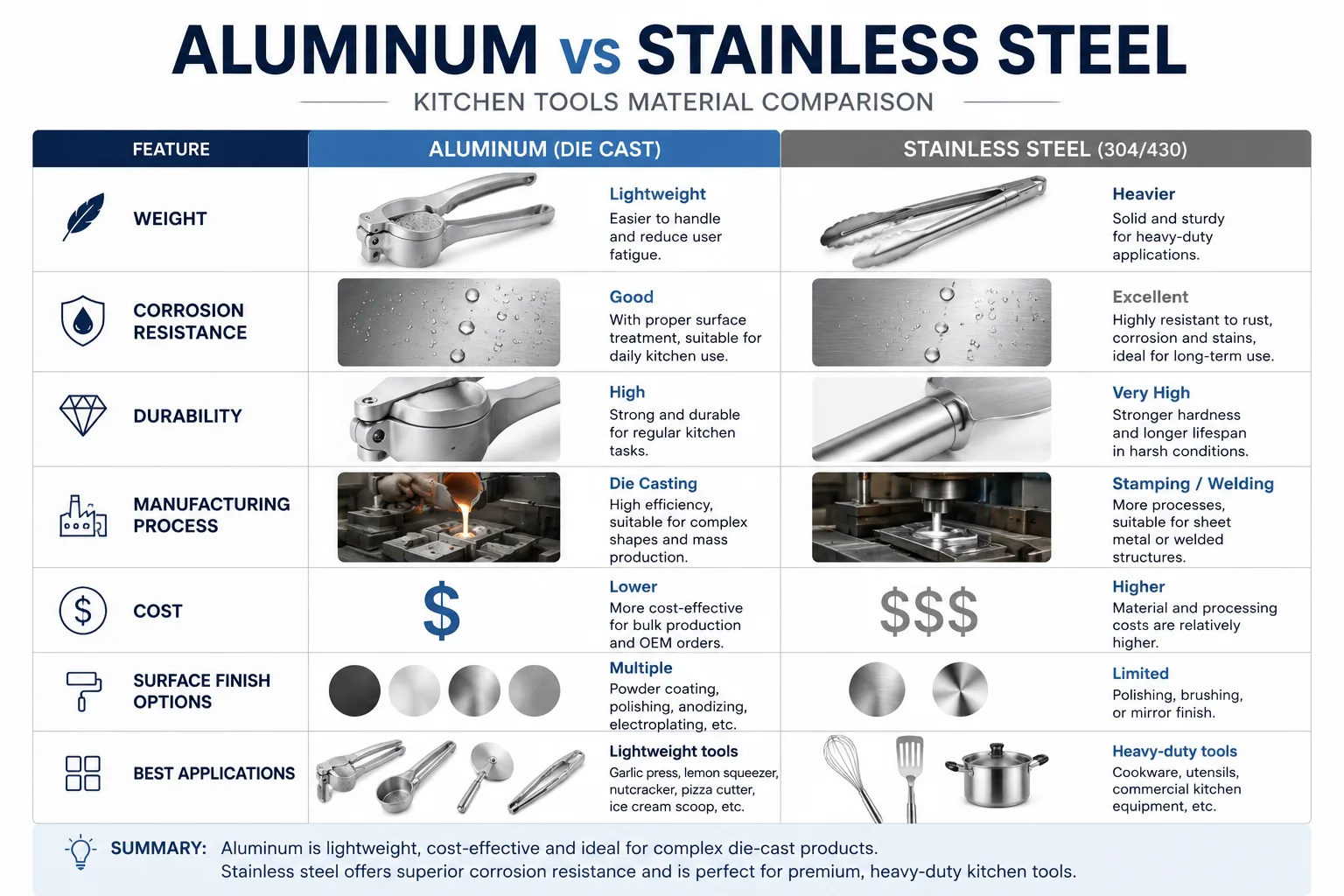
| Feature | Aluminum Kitchen Tools | Stainless Steel Kitchen Tools |
|---|---|---|
| Weight | Lightweight | Heavier |
| Manufacturing Method | Die Casting | Stamping / Welding |
| Production Cost | Lower | Higher |
| Corrosion Resistance | Good | Excellent |
| Surface Finish Options | Multiple | Limited |
| OEM Customization | Excellent | Moderate |
| Production Efficiency | High | Medium |
Both materials offer advantages, but aluminum is often preferred for OEM kitchenware manufacturing because it supports flexible product design and efficient mass production.
Which Material Is Better for OEM Kitchenware Manufacturing?
For many OEM kitchenware projects, aluminum provides better production flexibility and lower manufacturing costs.
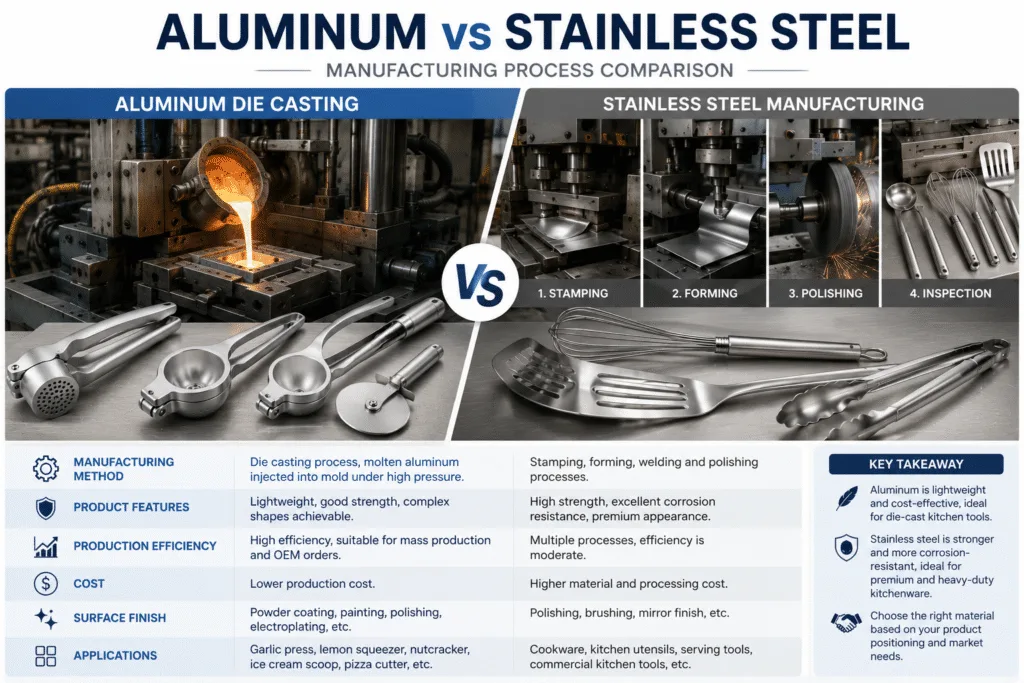
Aluminum die casting allows manufacturers to create:
- Complex product structures
- Ergonomic handles
- Customized branding
- Premium coatings
This makes aluminum highly suitable for private label kitchenware production.
However, stainless steel remains popular for products requiring stronger corrosion resistance or premium market positioning.
The best material depends on:
- Product type
- Market positioning
- Budget
- Production volume
- Customer preferences
Best Applications for Aluminum Kitchen Tools
Aluminum kitchen tools are commonly used for products requiring:
- Lightweight handling
- Complex shapes
- Cost-efficient production
- Comfortable daily use
Typical applications include:
- Garlic presses
- Lemon squeezers
- Nutcrackers
- Pizza cutters
- Ice cream scoops
Many die-cast aluminum kitchen tools combine good durability with modern product appearance.
Best Applications for Stainless Steel Kitchen Tools
Stainless steel is commonly used for:
- Commercial kitchen tools
- Heavy-duty utensils
- High-temperature cookware
- Corrosion-resistant products
Because of its strong rust resistance, stainless steel is often preferred for professional kitchen environments.
How Manufacturers Choose Kitchenware Materials
Professional kitchenware manufacturers usually select materials based on:
- Product functionality
- Manufacturing efficiency
- Surface treatment requirements
- Market positioning
- Export standards
- Production costs
Experienced OEM manufacturers often recommend aluminum die casting for products requiring lightweight structure and customized designs.
Common Mistakes Buyers Make When Choosing Kitchenware Materials
Many buyers focus only on appearance without understanding manufacturing differences.
This can create sourcing problems later.
Choosing Materials Only by Price
Extremely low-cost products may sacrifice durability and surface quality.
Long-term product reliability is more important than short-term savings.
Ignoring Surface Treatment Quality
Poor surface finishing can affect both appearance and corrosion resistance.
Professional manufacturers should maintain stable coating and polishing standards.
Not Evaluating Manufacturing Capability
Experienced factories usually provide:
- Better mold precision
- Stable production quality
- Professional QC systems
- Better OEM support
Factory capability strongly affects final product quality.
FAQ
Which is better: aluminum or stainless steel kitchen tools?
Both materials offer advantages. Aluminum is lightweight and cost-effective, while stainless steel provides stronger corrosion resistance.
Are aluminum kitchen tools durable?
Yes. High-quality die-cast aluminum kitchen tools are durable and suitable for daily kitchen use.
Why do OEM manufacturers use aluminum die casting?
Because aluminum die casting supports efficient mass production and flexible product customization.
Is stainless steel more expensive than aluminum?
In most cases, stainless steel products have higher material and production costs.
Which material is better for private label kitchenware?
Aluminum is often preferred for OEM and private label projects because it supports customized product structures and surface finishes.