Table of Contents
For B2B distributors and kitchenware retailers, understanding the market landscape is crucial for maintaining healthy margins. A comprehensive wholesale manual meat grinder price guide is not just about the lowest number; it’s about understanding the value behind every dollar spent. When you are sourcing products for professional kitchens or retail shelves, the initial investment must align with long-term durability and customer satisfaction.
At LeeYuen, we have over a decade of experience as a hardware manufacturer. We know that navigating the complexities of international trade requires transparency. This article aims to break down the primary factors that influence bulk production costs and help you make an informed procurement decision.
Factors Influencing Manual Grinder Production Costs
When reviewing any wholesale manual meat grinder price guide, you will notice a wide range of quotes. These variations are typically driven by three core elements: material quality, production technology, and functional attachments.
- Raw Material Costs: The choice between aluminum alloy, stainless steel, or cast iron is the biggest price driver. Stainless steel units sit at the top of the pricing hierarchy due to their rust resistance and food-grade hygiene. Aluminum offers a cost-effective, lightweight alternative that is still durable enough for most retail markets.
- Manufacturing Precision: High-pressure die-casting results in a smoother finish and better structural integrity. A reliable cost analysis reflects the precision engineering required to ensure the internal auger and blades fit perfectly for efficient grinding.
Volume and Customization in the Wholesale Manual Meat Grinder Price Guide
The beauty of B2B sourcing is the economy of scale. Most factories use a tiered structure where the unit cost drops as the order volume increases.
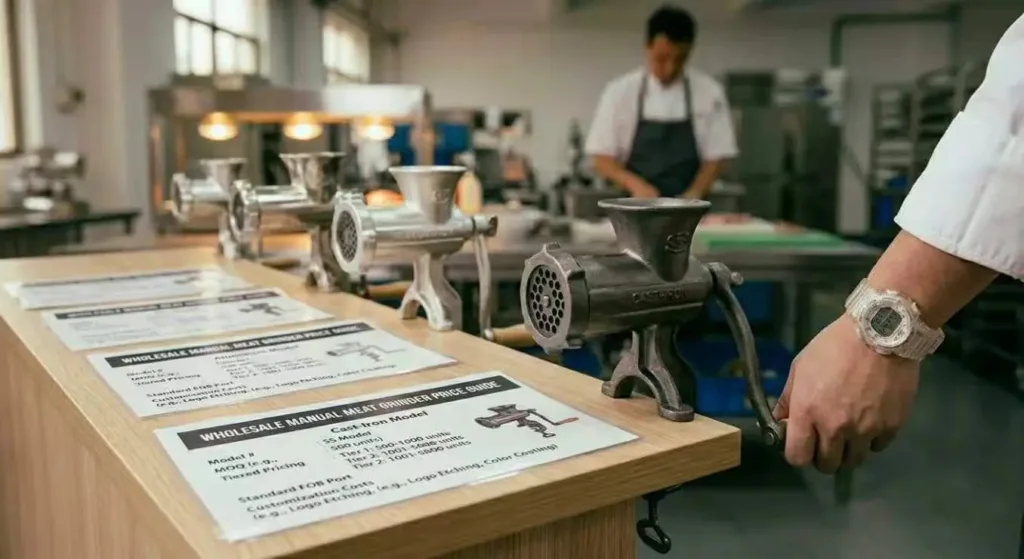
- MOQ Impact: Minimum Order Quantities (MOQ) play a vital role in your final quote. Buying 500 units versus 5,000 units can change the per-unit price by 15% to 20%. This is a crucial detail often highlighted in a professional wholesale manual meat grinder price guide.
- OEM Customization: Adding your logo, custom color coatings, or specialized packaging will add a premium to the base price. However, these features are essential for brand differentiation. A transparent budget plan should clearly outline these additional costs so there are no surprises during the final billing.
Why LeeYuen Provides a Competitive Wholesale Manual Meat Grinder Price Guide
As a direct factory based in Jiangmen, China, LeeYuen eliminates the middleman. This allows us to provide a highly competitive wholesale manual meat grinder price guide without compromising on the quality standards expected by global retailers like Walmart and Costco.
We leverage advanced automation and a stable local supply chain to keep production costs low. When you consult our wholesale manual meat grinder price guide, you are seeing the result of optimized manufacturing processes and a commitment to B2B excellence. We help you balance your budget while delivering a product that your customers will trust for years.
FAQ
Why do prices fluctuate in a wholesale manual meat grinder price guide?
Fluctuations are often caused by the global market price of raw metals (like aluminum or steel) and changes in international shipping rates or currency exchange.
Does the wholesale manual meat grinder price guide include shipping?
Usually, price guides provide EXW or FOB prices. Shipping and customs duties are calculated separately based on the destination port.
Can I get a sample before committing to the wholesale manual meat grinder price guide?
Yes. We recommend testing a sample to verify the material quality and grinding efficiency before finalizing a large-scale bulk order.
How often should I check for an updated wholesale manual meat grinder price guide?
It is wise to request a fresh quote every quarter or whenever there is a significant shift in the global materials market.