Table of Contents
In the fast-paced environment of a commercial kitchen, the efficiency of food preparation is dictated by the precision of its equipment. Slicing tools for the kitchen are more than just accessories; they are essential instruments that impact portion control, presentation, and safety. For global wholesalers and professional buyers, sourcing these tools requires a deep understanding of metallurgy, ergonomics, and international safety compliance.
As a specialized manufacturer with years of experience in high-pressure die-casting and precision metalwork, we understand what makes a slicing tool truly professional-grade.
The Engineering Behind High Performance Slicing Tools
When evaluating slicing tools for the kitchen, the difference between a retail-grade gadget and a commercial-grade tool lies in the manufacturing process.
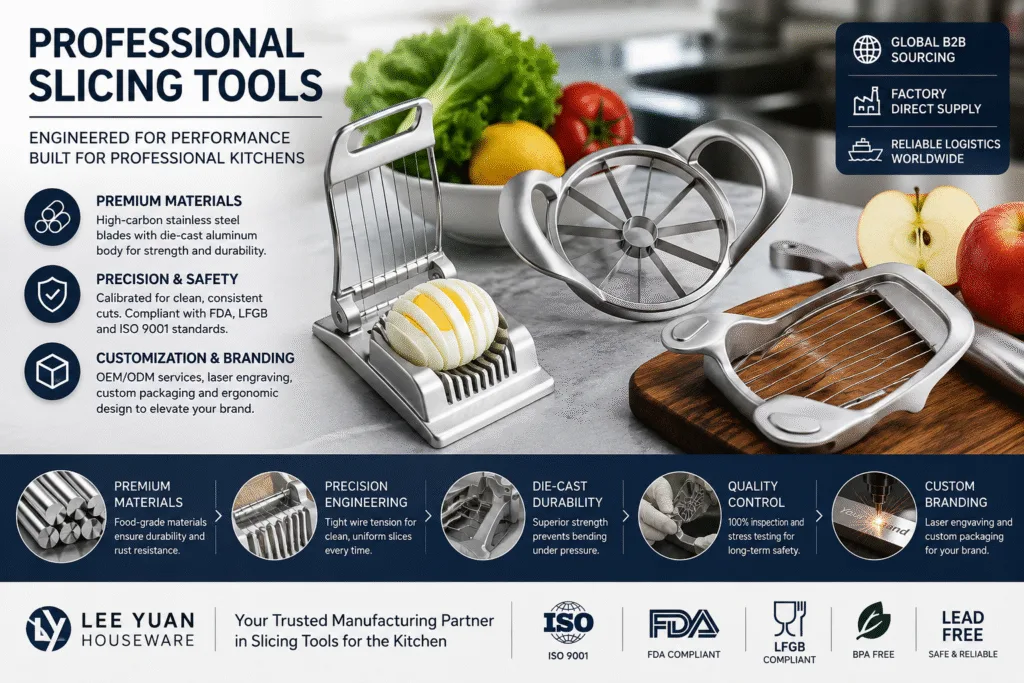
- Premium Material Selection: Professional tools utilize a combination of high-carbon stainless steel for blades and food-grade aluminum or zinc alloys for the body. This provides the necessary weight for effortless slicing while ensuring the tool remains rust-resistant in humid kitchen environments.
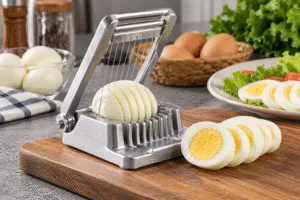
- Precision Wire and Blade Tension: For tools like egg wedgers or specialized fruit slicers, the tension of the stainless steel wires is critical. A reliable manufacturer uses mechanical calibration to ensure every wire provides a clean, consistent cut without shredding the food.
- Die-Cast Durability: Unlike stamped metal tools, die-cast aluminum frames offer superior structural integrity. This prevents the tool from bending under the high-pressure demands of a busy restaurant kitchen.
Safety Standards and Global Compliance in Tool Manufacturing
Trustworthiness is built on a foundation of safety. In the B2B market, ensuring that slicing tools for the kitchen meet international food contact regulations is a non-negotiable requirement for successful import and export.
At LeeYuan Houseware, our production facility in Jiangmen City is governed by the ISO 9001 quality management system. We ensure that our products are lead-free and fully compliant with FDA and LFGB standards. Every batch of slicing tools undergoes rigorous quality control, including surface smoothness checks to eliminate any metallic residue and stress tests on pivot points to ensure long-term operational safety.
Customization for Brand Differentiation and Market Growth
The right manufacturing partner should empower your brand to stand out. Sourcing slicing tools for the kitchen directly from a factory allows for significant customization that appeals to specific market segments.
- OEM and Private Label Services: We provide laser-engraved branding on handles and bespoke packaging solutions that make your products shelf-ready for major retailers like Walmart or Costco.
- Ergonomic Enhancements: We specialize in designing handles that reduce repetitive strain for kitchen staff. Whether it is a soft-grip coating or a heavy-duty balanced handle, ergonomics play a vital role in the end-user’s satisfaction.
- Scalable Logistics: Our proximity to major shipping hubs allows us to offer efficient lead times and optimized logistics for B2B partners across Europe, the Middle East, and Africa.
FAQ
What is the advantage of aluminum handles in slicing tools?
Aluminum provides a premium, heavy-duty feel compared to plastic, while offering better hygiene as it is easier to sanitize and does not harbor bacteria in cracks or scratches over time.
How do you ensure the blades stay sharp in bulk orders ?
We utilize specialized hardening processes for our stainless steel components, ensuring they maintain their edge through thousands of cycles before needing replacement or sharpening.
Can you customize slicing tools for specific regional needs ?
Yes. As a versatile manufacturer, we can adjust dimensions, materials, and surface finishes to meet the unique culinary preferences of different global markets.