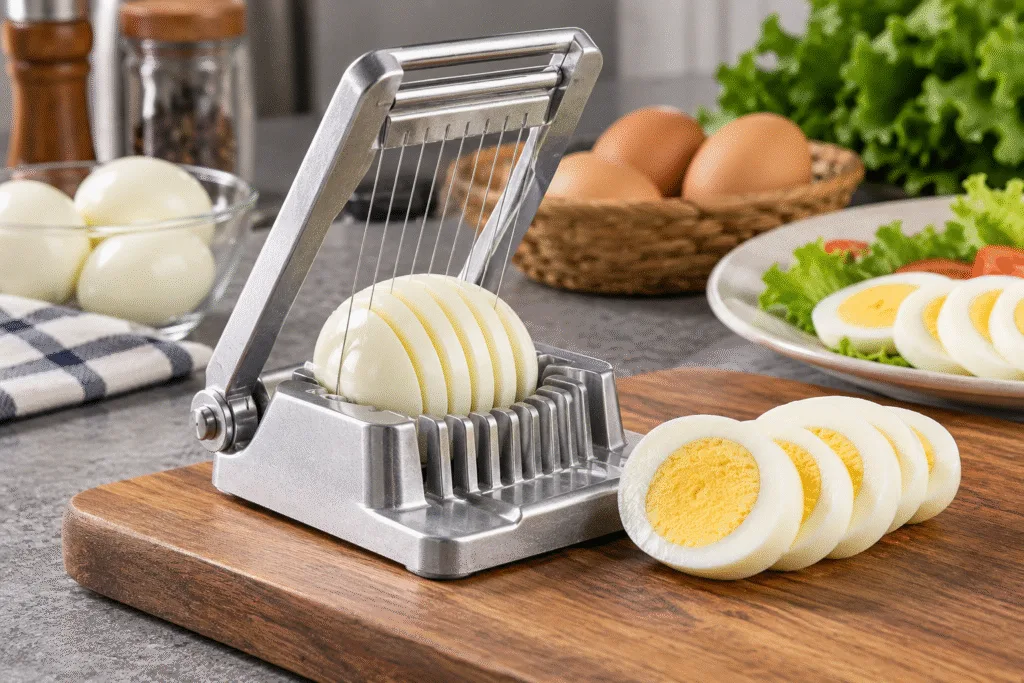
A heavy duty egg slicer may look like a simple kitchen gadget, but its durability depends on much more than a solid-looking frame. The quality of the cutting wires, the strength of the hinge, the alignment of the slicing mechanism, and the materials used in production all influence how well an egg slicer performs over time.
For home cooks, a reliable egg slicer makes food preparation easier and produces neat, consistent slices. For restaurants, catering businesses, kitchenware retailers, and wholesale buyers, durability also affects replacement costs, customer satisfaction, and long-term product value.
So, what actually separates a durable egg slicer from a basic model?
This guide examines the materials, construction details, and performance factors that matter most when evaluating a heavy duty egg slicer. It also explains how manufacturers and wholesale buyers can assess product quality before committing to larger orders.
What Is a Heavy Duty Egg Slicer?
A heavy duty egg slicer is designed to provide stable cutting performance and withstand repeated use under its intended operating conditions.
Unlike lightweight models that rely primarily on thin plastic components, many heavy-duty designs use a metal frame, stainless steel cutting wires, and a reinforced hinge mechanism.
However, the term heavy duty does not refer to a single industry-wide performance standard. A metal egg slicer is not automatically more durable simply because it weighs more.
A well-designed model should offer:
- A stable frame that resists bending during normal use
- Cutting wires with suitable strength and tension
- A hinge that opens and closes smoothly
- Accurate alignment between the wires and the supporting base
- Surfaces that are easy to clean and maintain
- Consistent performance across repeated cutting cycles
These features work together. A strong frame cannot compensate for poorly installed cutting wires, and high-quality wires cannot perform reliably if the hinge causes them to move out of alignment.
Metal vs. Plastic Egg Slicers: Which Is More Durable?
Material selection is one of the first factors to consider when comparing egg slicers.
Both metal and plastic models can work effectively, but their construction, intended use, and manufacturing quality can vary considerably.
Aluminum Egg Slicer Frames
Aluminum alloys are commonly used in metal kitchen gadgets because they offer a useful balance of strength, relatively low weight, and manufacturing flexibility.
Depending on the product design, aluminum components can be manufactured through processes such as die casting, followed by trimming, finishing, machining, and assembly.
A well-manufactured aluminum egg slicer frame can provide a stable base for the cutting mechanism without making the product unnecessarily heavy.
Important quality considerations include:
- Consistent frame dimensions
- Adequate strength around the hinge and wire supports
- Smooth edges and accessible cleaning surfaces
- Suitable surface finishing for the intended food-contact application
- Resistance to deformation under normal operating loads
Aluminum quality should be evaluated alongside the overall design. Casting defects, poorly finished edges, or insufficient material around critical connection points can affect product performance.
Stainless Steel Egg Slicer Components
Stainless steel is especially important in the cutting mechanism.
Thin stainless steel wires are widely used because they can provide precise cutting action when properly selected, tensioned, and installed.
Some egg slicers also use stainless steel in other components, including hinge pins or structural parts.
The exact stainless steel grade, wire diameter, and construction should be confirmed with the manufacturer rather than assumed from the product’s appearance.
Plastic Egg Slicer Frames
Plastic egg slicers are often lighter and can be economical to produce.
Well-engineered plastic designs may be suitable for regular household use, particularly when they incorporate appropriate reinforcement and reliable cutting wires.
However, plastic frames can be more sensitive to design weaknesses around hinges and concentrated loading points. Material selection, wall thickness, and molding quality all affect their performance.
Material Comparison
| Feature | Aluminum Frame | Plastic Frame |
|---|---|---|
| Weight | Relatively lightweight for a metal design | Usually lightweight |
| Structural stability | Can be strong with appropriate design | Depends on polymer and reinforcement |
| Manufacturing | Often die casting and finishing | Commonly injection molding |
| Appearance | Metallic, professional presentation | Wide range of colors and finishes |
| Typical positioning | Mid-range or premium metal kitchenware | Value to premium household products |
| Main quality concerns | Casting quality, finishing, hinge design | Cracking, deformation, hinge reinforcement |
The takeaway: Material alone does not determine durability. Buyers should evaluate the complete product structure and actual test results rather than relying on a metal-versus-plastic label.
Why Stainless Steel Cutting Wires Matter
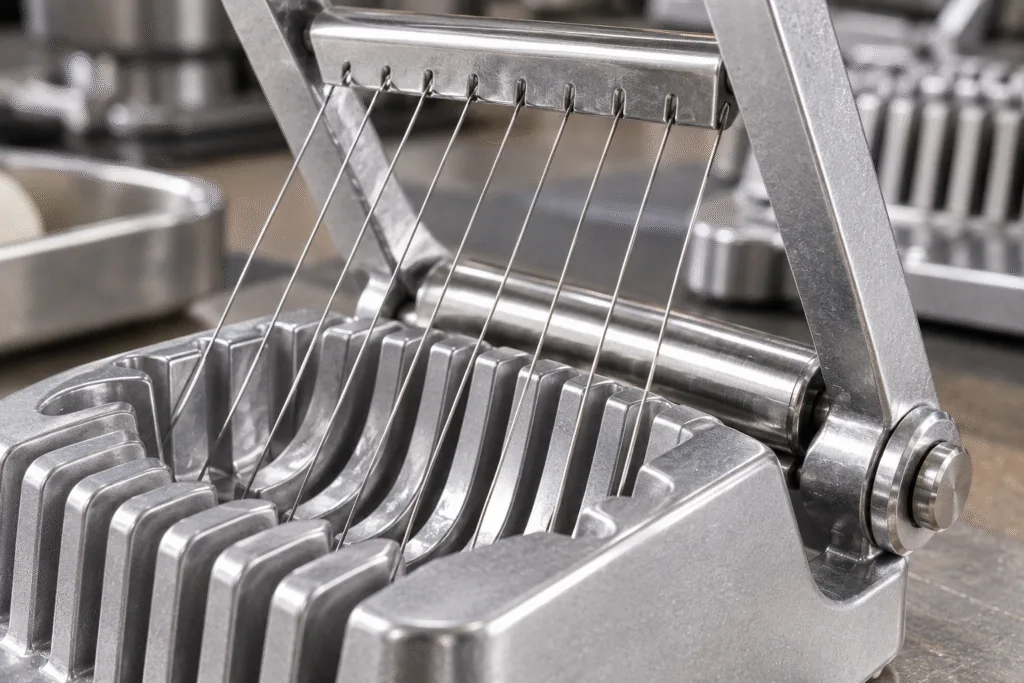
The cutting wires are among the most important working components of a heavy duty egg slicer.
When the upper frame closes, the wires pass through the cooked egg and create individual slices. Their condition and alignment directly influence cutting quality.
Wire Strength and Tension
Cutting wires must be strong enough to withstand the loads associated with their intended use.
Insufficient tension can cause uneven slices or allow the wires to deflect during cutting. Excessive tension, however, may place unnecessary stress on the frame and attachment points.
A reliable design balances wire properties, frame rigidity, and installation tension.
Wire Alignment and Spacing
Consistent wire spacing helps produce uniform slices.
If the wires are incorrectly positioned, some slices may be noticeably thicker than others. Poor alignment can also cause the wires to contact the base or supporting structure incorrectly.
For manufacturers, wire installation accuracy should be part of the assembly and inspection process.
Wire Attachment and Replacement
The way cutting wires connect to the frame also matters.
Attachment points should hold the wires securely during normal operation without introducing sharp bends or unnecessary stress concentrations.
For commercial or frequently used products, replaceable cutting assemblies may be an advantage. However, not every egg slicer supports wire replacement, so buyers should confirm the actual design before advertising this feature.
The Importance of Frame and Hinge Design
An egg slicer’s hinge connects the upper cutting mechanism to the base. Although it is a small component, it plays a major role in cutting stability.
A Stable Hinge Improves Cutting Accuracy
When the hinge operates correctly, the upper frame follows a consistent path as it closes.
Excessive movement or misalignment may cause the cutting wires to shift away from their intended positions.
This can affect slice consistency and increase stress on the wires.
A quality hinge should open and close smoothly while maintaining the alignment required by the product design.
Reinforced Connection Points
The areas surrounding the hinge and cutting-wire supports experience repeated loading.
For metal egg slicers, manufacturers should pay particular attention to the shape and dimensions of these areas.
A thicker frame is not always better. The objective is to distribute loads appropriately while avoiding unnecessary weight or difficult-to-clean features.
Base Stability
A stable base helps keep the egg in position while cutting.
The egg cradle should support the intended food size without excessive movement. Its shape should also allow the cutting wires to pass through their intended path without interference.
Poorly designed support grooves can reduce cutting accuracy even when the wires themselves are correctly installed.
Common Problems That Reduce Egg Slicer Durability
Understanding common product failures can help buyers distinguish between attractive designs and reliable products.
1. Broken or Loose Cutting Wires
Wire problems may result from inappropriate material selection, incorrect tension, poor attachment, manufacturing defects, or use beyond the intended application.
A durable product should maintain wire position and function during repeated normal use.
2. Loose or Misaligned Hinges
A hinge that develops excessive play can affect cutting accuracy and place additional stress on the cutting assembly.
Repeated opening and closing tests can help reveal this weakness.
3. Rough Edges and Poor Surface Finishing
Metal components with sharp edges, burrs, or inconsistent finishing may create handling and cleaning problems.
For food-contact kitchenware, manufacturers should evaluate surface quality and the suitability of the finished material for the intended market.
4. Uneven Cutting Results
Uneven slices may indicate problems with wire spacing, tension, hinge alignment, or the egg support structure.
A single successful cutting demonstration is not enough to establish long-term product consistency.
5. Difficult Cleaning and Maintenance
Egg residue can accumulate around wire attachment points, narrow grooves, and hinge areas.
Products designed with accessible surfaces and clear cleaning instructions may be easier for users to maintain.
Buyers should not assume an egg slicer is dishwasher-safe unless the manufacturer has verified that claim for the complete product.
How to Test a Heavy Duty Egg Slicer Before Buying
A product’s appearance provides useful clues, but functional testing offers stronger evidence of its quality.
Whether you are purchasing one egg slicer or evaluating a wholesale sample, the following checks can help.
Check the Frame and Surface
Inspect the product for visible cracks, deformation, sharp edges, and inconsistent surface finishing.
Place the slicer on a flat surface and check whether the base sits securely.
Evaluate the Hinge Movement
Open and close the slicer several times without applying excessive force.
The movement should feel controlled and consistent, without unusual looseness, binding, or scraping.
Inspect the Cutting Wires
Look at the wire spacing and alignment.
The wires should be properly secured, without obvious sagging, kinks, or damage.
Do not pull or bend the wires by hand to test their strength, as this may damage the cutting mechanism.
Perform a Cutting Test
Use a properly cooked and cooled hard-boiled egg that fits the product’s intended capacity.
Position the egg correctly and close the cutting mechanism using the manufacturer’s recommended method.
Evaluate:
- Slice thickness consistency
- Whether the wires pass through the egg cleanly
- Whether the egg remains stable in the cradle
- Whether the cutting mechanism closes smoothly
- Whether residue can be removed easily afterward
A hard-boiled egg slicer should not be assumed suitable for cutting hard vegetables, frozen foods, or other items unless the manufacturer specifically supports those uses.
Review Repeated-Use Performance
For wholesale procurement, repeated-use testing can be more informative than a single demonstration.
The manufacturer and buyer should agree on a documented test method, including the test sample, number of cycles, acceptance criteria, and inspection points.
After testing, check for wire loosening, hinge movement, deformation, and changes in cutting performance.
There is no universal cycle count that automatically proves every egg slicer is heavy duty. Acceptance limits should be appropriate to the product design and intended application.
What Wholesale Buyers Should Look for in Manufacturing Quality
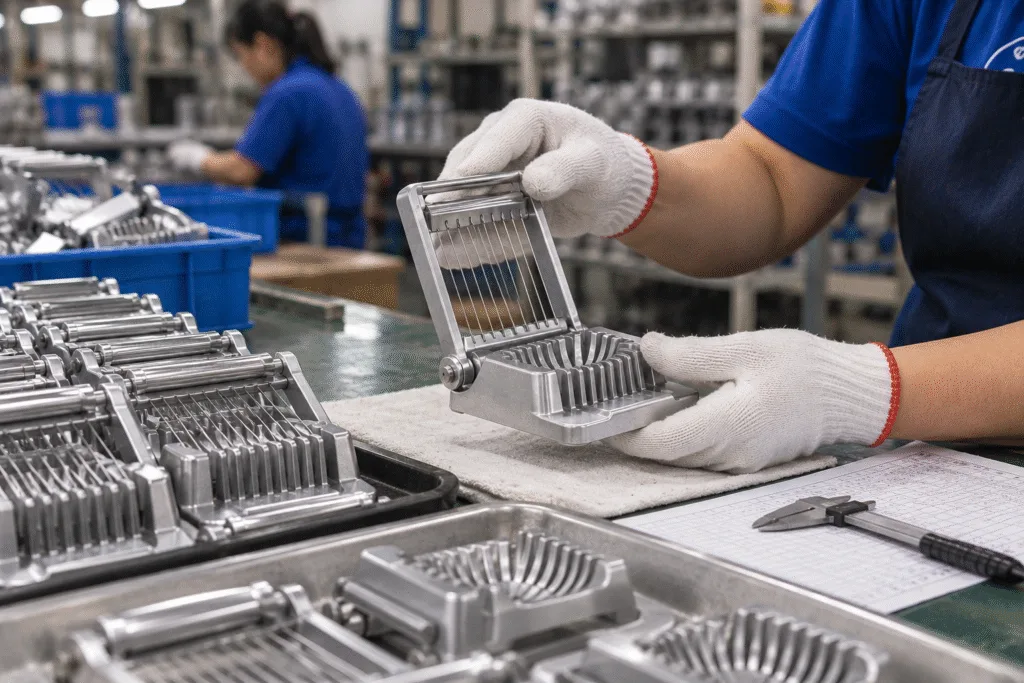
For importers, distributors, and private label brands, the main challenge is not simply finding a good sample. It is ensuring that production units consistently match the approved specifications.
Material and Component Specifications
Buyers should request clear specifications for the frame, cutting wires, hinge components, and any surface treatments.
These details help prevent unapproved material substitutions during production.
Manufacturing and Assembly Control
For an aluminum-frame egg slicer, relevant manufacturing stages may include metal forming or die casting, trimming, surface finishing, component inspection, and final assembly.
Wire installation and hinge alignment deserve particular attention because small assembly variations can affect product performance.
Quality Control During Production
A practical quality-control plan may cover:
| Inspection Stage | Key Checks |
|---|---|
| Incoming materials | Material specifications and component condition |
| Frame production | Dimensions, defects, surface condition |
| Wire assembly | Spacing, tension consistency, attachment |
| Hinge assembly | Movement, fit, alignment |
| Final inspection | Appearance, cutting function, stability |
| Packaging | Product protection, labeling, accessories |
The exact inspection method and sampling plan should be agreed upon before mass production.
OEM and Private Label Customization
Wholesale buyers may also need customization beyond the basic product design.
Depending on the manufacturer’s capabilities and order requirements, options may include logo application, retail packaging, color or finish variations, and modifications to product dimensions or components.
Any structural changes should be evaluated for their effect on cutting performance, tooling, assembly, and testing requirements.
At LeeYuen Kitchenware, buyers can discuss aluminum-alloy kitchen gadget manufacturing and OEM/ODM project requirements. Product-specific materials, customization feasibility, minimum order quantities, and testing arrangements should be confirmed during quotation and sample development.
Is a Heavy Duty Egg Slicer Worth It?
A durable egg slicer may offer better long-term value than a cheaper alternative when the product is used frequently and maintained correctly.
For individual customers, the benefits may include stable slicing performance, comfortable operation, and fewer premature replacements.
For retailers and wholesale buyers, product durability can influence customer complaints, warranty costs, repeat purchases, and brand reputation.
However, the best option is not necessarily the heaviest or most expensive model.
A well-designed egg slicer should match its intended use, offer dependable cutting performance, and meet the relevant material and safety requirements.
The most useful purchasing decision is based on verified product quality rather than marketing descriptions alone.
Frequently Asked Questions
What is the best material for a heavy duty egg slicer?
Aluminum alloy frames combined with suitable stainless steel cutting wires can provide a strong, lightweight construction. However, durability also depends on hinge design, wire attachment, manufacturing quality, and intended use.
Are metal egg slicers better than plastic ones?
Metal egg slicers can offer structural advantages, but material alone does not guarantee better performance. A well-designed plastic model may outperform a poorly manufactured metal one. Compare construction details and functional test results.
Can a heavy duty egg slicer cut vegetables?
Only if the manufacturer specifies that the product is suitable for those vegetables. Many egg slicers are designed primarily for cooked eggs, and cutting harder foods may damage the wires or frame.
Why do egg slicer wires break?
Possible causes include excessive loading, incorrect wire tension, poor attachment, manufacturing defects, corrosion, or use outside the product’s intended application.
Can egg slicer cutting wires be replaced?
Some models have replaceable wires or cutting assemblies, while others do not. Check the manufacturer’s specifications and replacement-part availability before purchasing.
Are aluminum egg slicers dishwasher-safe?
Not necessarily. Dishwasher compatibility depends on the aluminum alloy, surface treatment, other components, and the manufacturer’s validation. Follow the cleaning instructions for the specific model.