Introduction
Kitchenware manufacturing is a broad industry covering the design, production, finishing, assembly, inspection, packaging, and distribution of products used for food preparation, cooking, serving, and kitchen organization.
From simple kitchen utensils to precision-engineered aluminum tools, modern kitchenware can involve multiple materials and manufacturing technologies.
For brands, wholesalers, importers, distributors, and private label companies, choosing the right kitchenware manufacturer is an important part of building a reliable supply chain.
A professional manufacturer does more than produce individual products. The manufacturing process may involve product development, material selection, mold manufacturing, die casting, CNC machining, surface finishing, assembly, quality control, packaging, and international order management.
Understanding the kitchenware manufacturing process can therefore help B2B buyers evaluate suppliers, control product quality, reduce production risks, and develop competitive products for their target markets.
This guide explains the major stages of kitchenware manufacturing, common materials and production technologies, OEM and ODM capabilities, quality control requirements, and the factors buyers should consider when selecting a kitchenware manufacturing partner.
What Is Kitchenware Manufacturing?
Kitchenware manufacturing refers to the industrial production of tools, utensils, cookware, accessories, and other products designed for use in kitchens.
Depending on the product category, kitchenware manufacturing may include:
- Product design
- Engineering development
- Prototype production
- Material selection
- Mold development
- Metal forming
- Die casting
- CNC machining
- Stamping
- Injection molding
- Surface finishing
- Assembly
- Quality inspection
- Packaging
Different kitchenware products require different combinations of these processes.
For example, a die-cast aluminum garlic press may require mold development, aluminum die casting, trimming, machining, polishing, assembly, and final inspection.
A plastic kitchen accessory may instead require injection molding, trimming, assembly, and packaging.
Therefore, kitchenware manufacturing is not a single production method but a complete manufacturing system that combines different technologies according to the product requirements.
Why Kitchenware Manufacturing Matters to B2B Buyers
For consumers, the most visible aspects of kitchenware are appearance, price, and functionality.
For B2B buyers, the manufacturing process behind the product is equally important.
A reliable manufacturing partner can influence:
- Product consistency
- Production capacity
- Product development speed
- Manufacturing cost
- Quality stability
- Delivery reliability
- Customization capability
- Packaging quality
- Long-term supply continuity
This is especially important for brands and wholesalers ordering products in large quantities.
A supplier that can provide consistent production across multiple batches can reduce the risk of product returns, customer complaints, and supply interruptions.
The Kitchenware Manufacturing Process
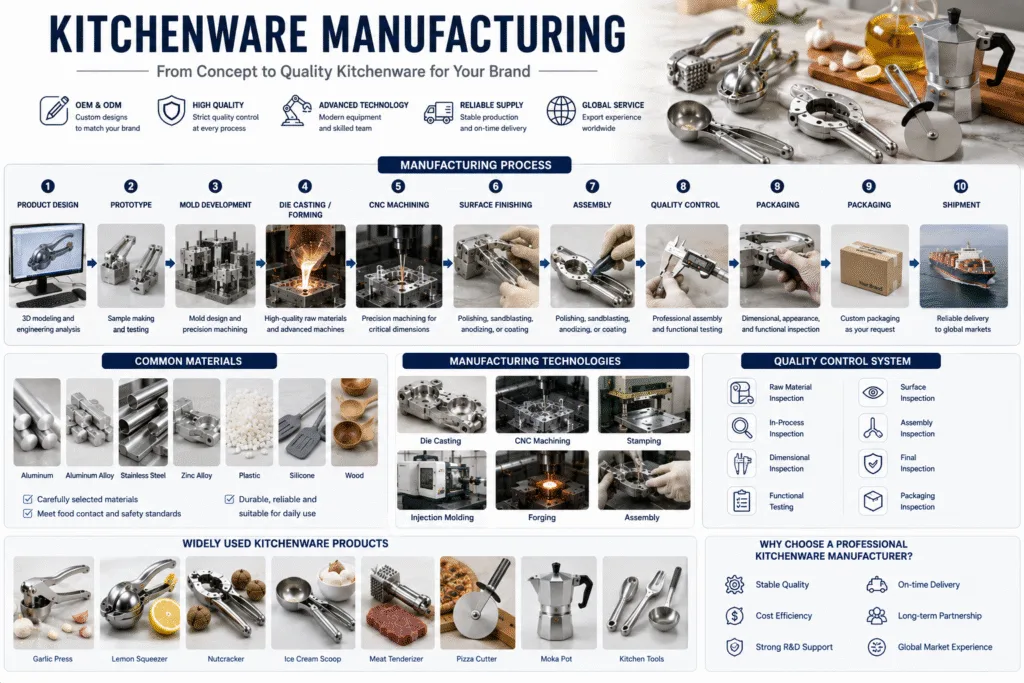
Although production processes differ by product, a typical kitchenware manufacturing project may follow this sequence:
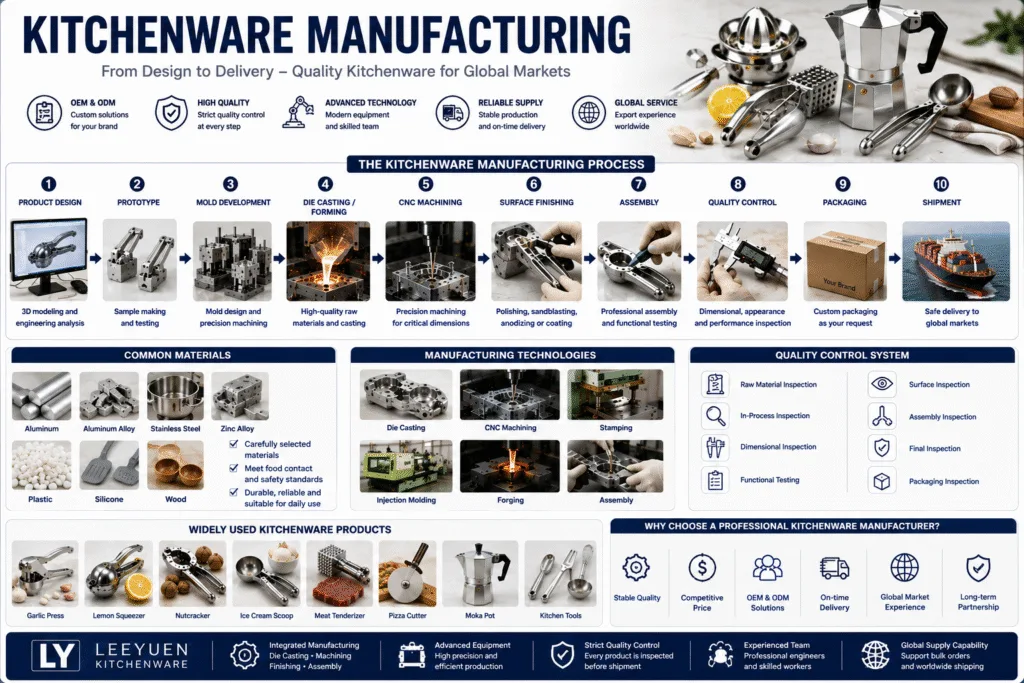
Product Concept → Product Design → Material Selection → Prototype → Mold Development → Manufacturing → Machining → Surface Finishing → Assembly → Quality Control → Packaging → Shipment
Each stage plays a role in the final product.
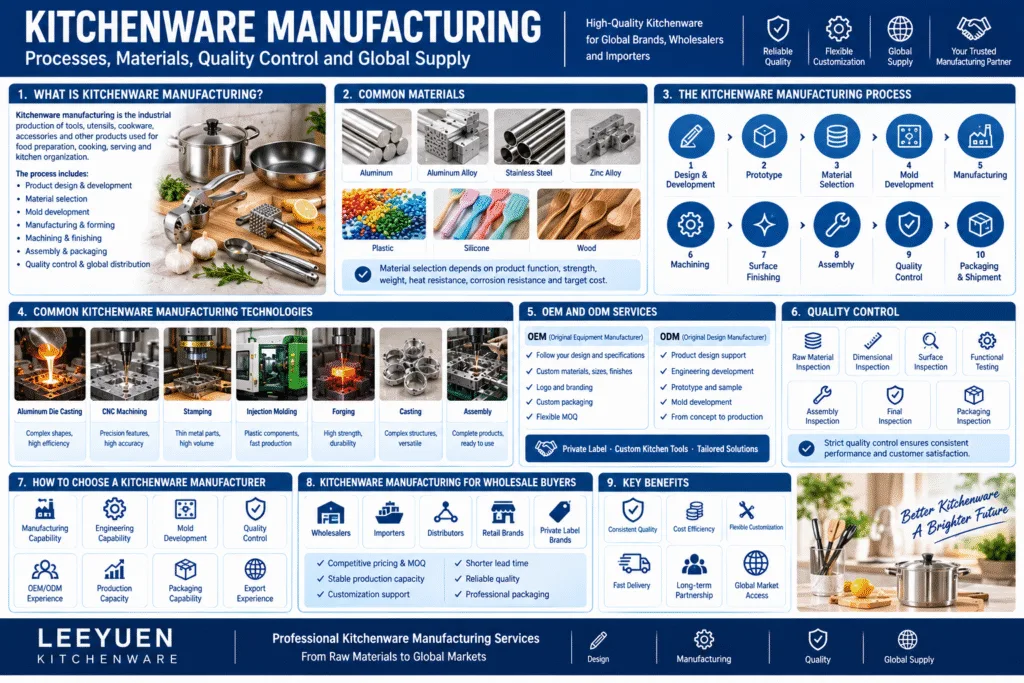
Step 1: Product Design and Development
Every kitchenware product begins with a product concept.
The design team considers:
- Product function
- Dimensions
- Ergonomics
- Material
- Appearance
- Manufacturing method
- Assembly requirements
- Target production cost
For OEM projects, the buyer may provide drawings, 3D models, samples, or product specifications.
The manufacturer then evaluates whether the proposed design is suitable for mass production.
A good design should not only look attractive but also be practical to manufacture.
Step 2: Material Selection
Material selection is an important part of kitchenware manufacturing.
Different products require different material characteristics.
Common materials include:
- Aluminum
- Aluminum alloy
- Stainless steel
- Zinc alloy
- Carbon steel
- Plastic
- Silicone
- Wood
The appropriate material depends on:
- Product function
- Required strength
- Product weight
- Heat resistance
- Corrosion resistance
- Surface requirements
- Manufacturing process
- Target cost
- Intended market
For example, aluminum alloy is commonly considered for lightweight metal kitchen tools, while stainless steel is widely used for products requiring corrosion resistance and specific structural properties.
Common Materials Used in Kitchenware Manufacturing
Aluminum and Aluminum Alloy
Aluminum alloy is an important material for many kitchen tools because it combines relatively low weight with useful mechanical properties.
It can be processed through technologies such as:
- Die casting
- CNC machining
- Forging
- Extrusion
- Other forming processes
Aluminum die casting is particularly useful for kitchen tools with complex shapes and high production requirements.
Applications can include:
- Garlic presses
- Lemon squeezers
- Nutcrackers
- Ice cream scoops
- Meat tenderizers
- Selected cookware components
Stainless Steel
Stainless steel is widely used throughout the kitchenware industry.
It can be processed through:
- Stamping
- Cutting
- Forming
- Welding
- Machining
- Polishing
Stainless steel kitchen products can include utensils, cookware components, strainers, and other kitchen accessories.
Zinc Alloy
Zinc alloy can be used for selected kitchen tools and hardware components where its casting characteristics and design possibilities are suitable.
It can support detailed shapes and decorative surfaces.
Plastic
Plastic remains an important material in kitchenware manufacturing.
Injection molding allows manufacturers to produce large quantities of plastic components efficiently.
Common applications include:
- Handles
- Storage accessories
- Measuring tools
- Kitchen organizers
- Small kitchen accessories
Silicone
Silicone is used for various kitchen products requiring flexibility, heat resistance, or soft-touch characteristics.
Applications may include:
- Kitchen spatulas
- Baking accessories
- Heat-resistant tools
- Sealing components
Material selection should always be based on the intended application and applicable market requirements.
Common Kitchenware Manufacturing Technologies
Different products require different manufacturing technologies.
Aluminum Die Casting
Aluminum die casting is suitable for producing complex metal components at relatively high production volumes.
The process involves injecting molten aluminum alloy into a reusable metal mold under pressure.
It can produce:
- Complex shapes
- Integrated structures
- Consistent dimensions
- Lightweight metal components
For more information about this manufacturing technology, buyers can refer to the company’s related article on aluminum die casting in kitchen gadget manufacturing.
CNC Machining
CNC machining uses computer-controlled cutting tools to produce precise features.
It may be used for:
- Precision holes
- Threads
- Mounting surfaces
- Connection points
- Functional surfaces
CNC machining can also be combined with die casting.
The die casting process creates the basic geometry, while CNC machining refines selected areas requiring greater precision.
Stamping
Metal stamping uses dies and presses to form sheet metal.
It is commonly used for products requiring thin metal components and high-volume production.
Injection Molding
Injection molding is widely used for plastic kitchenware components.
Plastic material is melted and injected into a mold cavity before cooling and solidifying.
It is particularly suitable for high-volume production.
Forging
Forging forms metal using controlled pressure or force.
Depending on the product design, forging can be used where high structural performance is required.
Mold Development in Kitchenware Manufacturing
For products manufactured through die casting or injection molding, mold development is an important stage.
A mold determines the basic shape and many dimensional characteristics of the finished component.
A typical mold development process includes:
3D Product Design → Mold Design → CNC Machining → EDM → Mold Assembly → Trial Production → Mold Optimization
A well-designed mold can improve:
- Product consistency
- Surface quality
- Production efficiency
- Mold life
- Dimensional accuracy
Poor mold design, on the other hand, can create repeated production problems.
For customized kitchenware products, buyers should therefore consider the manufacturer’s mold development capabilities before placing large orders.
Surface Finishing in Kitchenware Manufacturing
Surface finishing affects both product appearance and the customer’s perception of quality.
Depending on the material and product requirements, common finishing processes include:
- Polishing
- Brushing
- Sandblasting
- Powder coating
- Painting
- Anodizing where appropriate
- Other suitable surface treatments
For aluminum kitchen tools, polishing can create a smooth metallic appearance, while other finishing processes can provide different visual and functional characteristics.
Surface finishing should be selected according to:
- Product material
- Intended application
- Appearance requirements
- Durability requirements
- Applicable regulations
Assembly in Kitchenware Manufacturing
Many kitchenware products contain multiple components.
Assembly may involve:
- Handles
- Screws
- Pins
- Springs
- Blades
- Moving components
- Decorative components
For example, a manual kitchen gadget may contain a metal body, pivot components, fasteners, and other functional parts.
Consistent assembly is important because even accurately manufactured components can perform poorly if they are incorrectly assembled.
A professional manufacturing process therefore includes assembly inspection as part of overall quality control.
Quality Control in Kitchenware Manufacturing
Quality control is one of the most important parts of the manufacturing process.
A professional kitchenware manufacturer should establish quality checks throughout production rather than relying only on final inspection.
Raw Material Inspection
Incoming materials should be checked according to the required specifications.
This may include:
- Material type
- Dimensions
- Appearance
- Supplier documentation
- Batch information
Production Inspection
During manufacturing, production staff and quality inspectors can monitor:
- Product dimensions
- Casting quality
- Machining accuracy
- Surface quality
- Production consistency
Early detection can reduce the number of defective products reaching later production stages.
Functional Testing
Kitchen tools should be tested according to their intended function.
For example:
- A garlic press can be checked for pressing performance.
- A lemon squeezer can be checked for operating smoothness.
- A nutcracker can be checked under repeated mechanical loads.
- A scoop can be checked for structural integrity and surface quality.
The exact testing method should correspond to the product design and intended use.
Final Inspection
Before shipment, finished products should be inspected for:
- Appearance
- Dimensions
- Function
- Assembly
- Quantity
- Packaging
- Labeling
Final inspection helps ensure that the products shipped to the customer meet the agreed specifications.
OEM and ODM Kitchenware Manufacturing
OEM and ODM services are important for many international kitchenware brands.
OEM Kitchenware Manufacturing
In an OEM project, the buyer typically provides product specifications, drawings, designs, or other requirements.
The manufacturer produces the product according to those specifications.
OEM services can include:
- Custom product dimensions
- Custom materials
- Custom finishes
- Custom logos
- Custom packaging
- Custom components
ODM Kitchenware Manufacturing
ODM manufacturing generally involves greater participation from the manufacturer in product development.
The manufacturer may provide:
- Product concepts
- Engineering design
- Existing product platforms
- Mold development
- Prototyping
- Production optimization
ODM can be useful for brands that want to develop new products without managing every stage of engineering themselves.
Private Label Kitchenware Manufacturing
Private label manufacturing allows brands to sell products under their own brand identity.
A private label kitchenware project may include:
- Existing product selection
- Custom logo
- Custom colors
- Custom packaging
- Product modifications
- Retail-ready packaging
For private label brands, consistent quality and reliable production are especially important because the manufacturer’s products are sold under the brand owner’s name.
Kitchenware Manufacturing for Wholesale Buyers
Wholesale buyers typically have different requirements from individual consumers.
They may prioritize:
- MOQ
- Unit cost
- Production capacity
- Lead time
- Packaging
- Quality consistency
- Product customization
- Shipping efficiency
Before selecting a supplier, wholesale buyers should evaluate whether the manufacturer’s production capacity matches their expected order volume.
A manufacturer may be suitable for small orders but unable to support large-scale distribution.
Conversely, a factory specializing in high-volume manufacturing may have MOQ requirements that are too high for smaller brands.
The right supplier should therefore match the buyer’s business model and expected growth.
How to Choose a Kitchenware Manufacturer
Selecting the right kitchenware manufacturer is one of the most important decisions in the sourcing process.
1. Manufacturing Capability
Evaluate whether the manufacturer has the equipment and production processes required for the products you want to develop.
2. Engineering Capability
A capable engineering team can help identify manufacturing problems before production begins.
3. Mold Development
For die-cast or injection-molded products, mold development capability can significantly affect development efficiency.
4. Quality Control
Ask how the supplier manages raw materials, production inspection, functional testing, and final inspection.
5. OEM and ODM Experience
If you need customized products, previous OEM/ODM experience can reduce development risks.
6. Production Capacity
The manufacturer should have enough capacity to support both current and potential future orders.
7. Packaging Capability
Packaging should protect the product during transportation and meet the buyer’s retail or distribution requirements.
8. Export Experience
International buyers should consider whether the manufacturer has experience supplying overseas markets.
Kitchenware Factory vs Trading Company
B2B buyers may encounter both manufacturers and trading companies during sourcing.
A direct manufacturer may provide advantages such as:
- Greater production control
- Direct engineering communication
- Faster manufacturing feedback
- Better control over customization
- Direct quality management
However, the most important factor is not simply whether a supplier calls itself a factory.
Buyers should verify actual manufacturing capabilities, production equipment, quality systems, engineering resources, and product experience.
A reliable sourcing decision should be based on evidence rather than marketing claims alone.
How Kitchenware Manufacturers Improve Production Efficiency
Manufacturers can improve efficiency through several methods.
Process Standardization
Standardized production procedures help reduce unnecessary variation.
Automated Equipment
Modern production equipment can improve repeatability and productivity.
Integrated Manufacturing
Combining mold development, die casting, machining, finishing, assembly, and inspection within one manufacturing system can reduce unnecessary logistics between suppliers.
Preventive Maintenance
Regular equipment and mold maintenance can reduce unexpected downtime.
Quality Management
Detecting defects early can reduce material waste and rework.
Global Kitchenware Manufacturing and Supply Chains
The kitchenware industry serves a global market.
Brands may source products from manufacturers and distribute them across:
- Europe
- North America
- Asia
- Australia
- The Middle East
- Latin America
- Other international markets
Global buyers should therefore evaluate more than factory price.
Other considerations include:
- Production lead time
- Packaging
- Shipping requirements
- Product documentation
- Quality standards
- Communication
- Order management
- Supply continuity
A slightly lower unit price does not necessarily produce the lowest total sourcing cost.
Reliable quality and stable delivery can be equally important.
Trends in Kitchenware Manufacturing
The kitchenware manufacturing industry continues to evolve as brands and consumers demand better functionality, durability, and design.
Several trends are becoming increasingly important.
Durable Products
Consumers are increasingly interested in products that can withstand repeated use.
This creates opportunities for manufacturers producing durable metal kitchen tools.
Ergonomic Design
Kitchen tools need to be comfortable and easy to operate.
Manufacturers therefore increasingly consider:
- Handle shape
- Weight distribution
- Grip
- Operating force
- User comfort
Product Customization
Brands increasingly seek unique products rather than completely generic products.
OEM and ODM manufacturing can help companies differentiate themselves.
Manufacturing Efficiency
Manufacturers continue to improve production efficiency through:
- Automation
- CNC machining
- Better mold design
- Process optimization
- Quality management
Global B2B Sourcing
International sourcing remains an important part of the kitchenware supply chain.
Manufacturers that can support product development, customization, quality control, packaging, and international orders can provide greater value to B2B buyers.
FAQ
What is kitchenware manufacturing?
Kitchenware manufacturing is the industrial production of tools, utensils, cookware, accessories, and other products designed for kitchen use.
What materials are commonly used in kitchenware manufacturing?
Common materials include aluminum, aluminum alloy, stainless steel, zinc alloy, plastic, silicone, carbon steel, and wood. The appropriate material depends on the product’s function and manufacturing requirements.
What manufacturing processes are used for kitchenware?
Depending on the product, manufacturers may use die casting, CNC machining, stamping, injection molding, forging, polishing, assembly, and other processes.
What is the difference between OEM and ODM kitchenware manufacturing?
OEM manufacturing generally follows the buyer’s specifications or design, while ODM manufacturing involves greater participation from the manufacturer in product design and development.
How do I choose a kitchenware manufacturer?
Evaluate manufacturing capabilities, engineering resources, quality control, production capacity, OEM/ODM experience, mold development, packaging, and international supply experience.
Is aluminum suitable for kitchenware manufacturing?
Aluminum and aluminum alloys can be suitable for many kitchen tools because they can provide a useful combination of low weight and mechanical performance. The appropriate alloy and manufacturing process depend on the specific application.
Why is quality control important in kitchenware manufacturing?
Quality control helps manufacturers maintain consistent dimensions, appearance, functionality, assembly, and packaging across production batches.
Can kitchenware manufacturers provide custom products?
Many manufacturers offer OEM and ODM services that can include custom product designs, dimensions, materials, finishes, branding, and packaging.