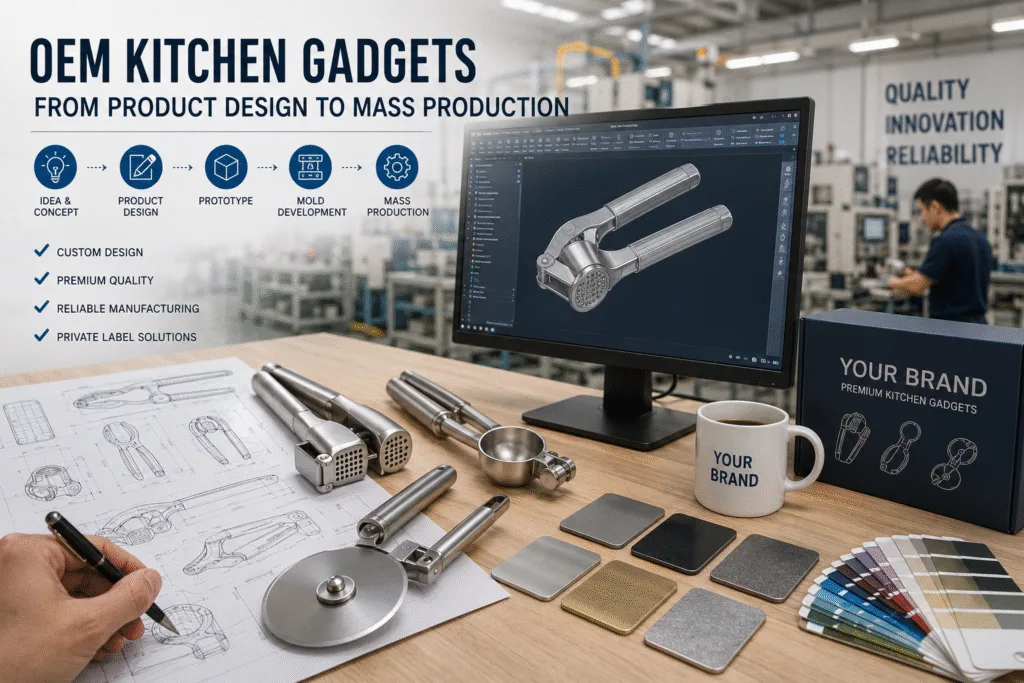
For kitchenware brands, distributors, importers, and retailers, launching a successful product requires more than a great idea—it requires a reliable OEM manufacturing partner. From the initial concept to mass production, every stage of the process plays a critical role in determining product quality, production efficiency, and long-term market success.
China has become one of the world’s leading OEM manufacturing hubs for kitchen gadgets thanks to its mature supply chain, advanced die-casting technology, skilled workforce, and competitive production costs. Understanding the complete OEM process helps buyers make informed sourcing decisions and build stronger partnerships with manufacturers.
What Are OEM Kitchen Gadgets?
OEM (Original Equipment Manufacturing) refers to products manufactured according to a customer’s specifications and sold under the customer’s own brand.
Unlike standard off-the-shelf products, OEM kitchen gadgets can be customized in terms of:
- Product design
- Dimensions
- Materials
- Surface finishes
- Brand logo
- Packaging
- Product colors
- Retail presentation
OEM manufacturing enables businesses to create differentiated products that strengthen brand identity and improve market competitiveness.
Step 1: Product Concept & Market Research
Every successful product starts with a clear understanding of market demand.
Before production begins, buyers should define:
- Target customers
- Product positioning
- Price range
- Competitor analysis
- Functional requirements
Manufacturers often work closely with customers during this stage, providing technical recommendations that improve manufacturability while maintaining the original product concept.
Step 2: Product Design & Engineering
After confirming the concept, engineers create detailed CAD drawings and 3D models.
This stage includes:
- Structural design
- Ergonomic improvements
- Material selection
- Production feasibility analysis
A well-designed product reduces production costs while improving functionality and durability.
Step 3: Prototype Development
Before investing in production tooling, manufacturers typically produce prototypes.
Prototype development allows buyers to evaluate:
- Product appearance
- Dimensions
- Functionality
- User experience
- Assembly performance
Necessary adjustments can be completed before mold production begins.
Step 4: Mold Development
For aluminum alloy kitchen gadgets, precision mold development is one of the most important investments.
Professional mold development provides:
- Consistent dimensions
- Stable production
- High efficiency
- Longer mold lifespan
Factories with in-house tooling departments can usually shorten development time while maintaining higher quality standards.
Step 5: Die Casting Production
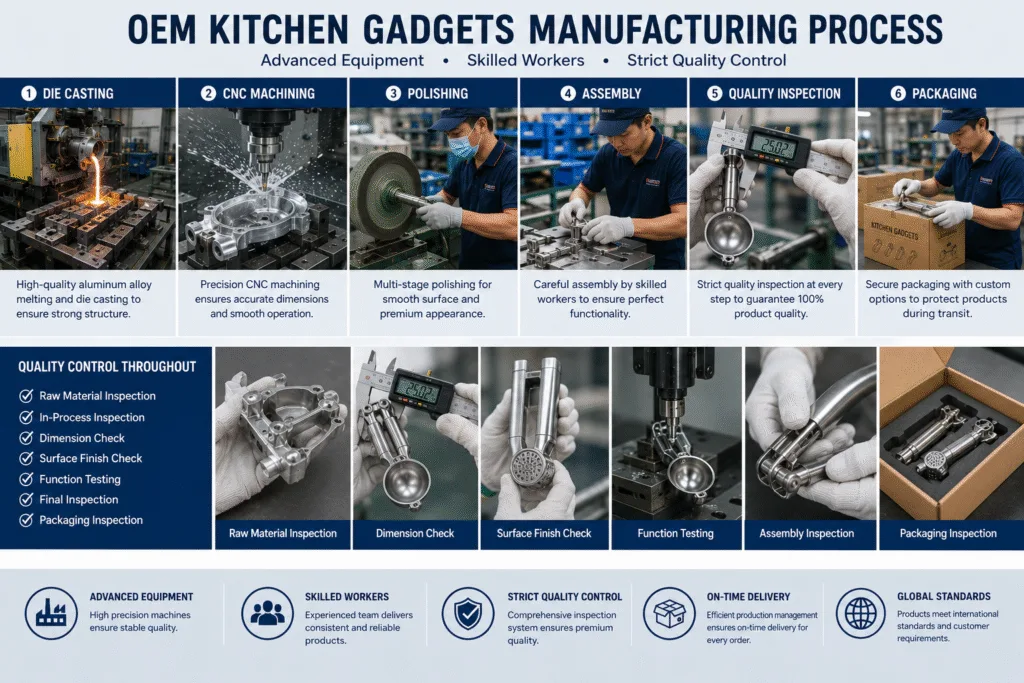
Die casting is widely used for manufacturing aluminum kitchen gadgets such as:
- Garlic Presses
- Lemon Squeezers
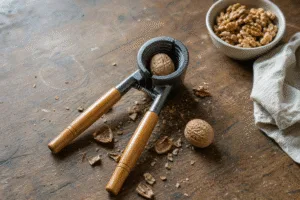
- Nutcrackers
- Ice Cream Scoops
Molten aluminum alloy is injected into precision molds under high pressure, producing strong, lightweight components with excellent dimensional accuracy.
Step 6: CNC Machining & Surface Finishing
After die casting, products undergo precision machining to achieve accurate dimensions and smooth operation.
Common finishing processes include:
- CNC machining
- Polishing
- Sandblasting
- Powder coating
- Painting
- Anodizing (when applicable)
High-quality surface treatments improve both appearance and durability.
Step 7: Assembly & Functional Testing
Once all components are completed, trained workers assemble the products according to standardized procedures.
Each product is tested to ensure:
- Smooth operation
- Proper alignment
- Secure fastening
- Consistent functionality
Assembly accuracy directly affects customer satisfaction and product lifespan.
Step 8: Quality Control
Professional manufacturers implement quality inspections throughout production rather than only at the end.
Typical inspections include:
- Raw material inspection
- Dimensional measurement
- Surface finish inspection
- Functional testing
- Corrosion resistance testing
- Packaging inspection
A comprehensive quality control system minimizes defects and ensures product consistency.
Step 9: Private Label & Packaging
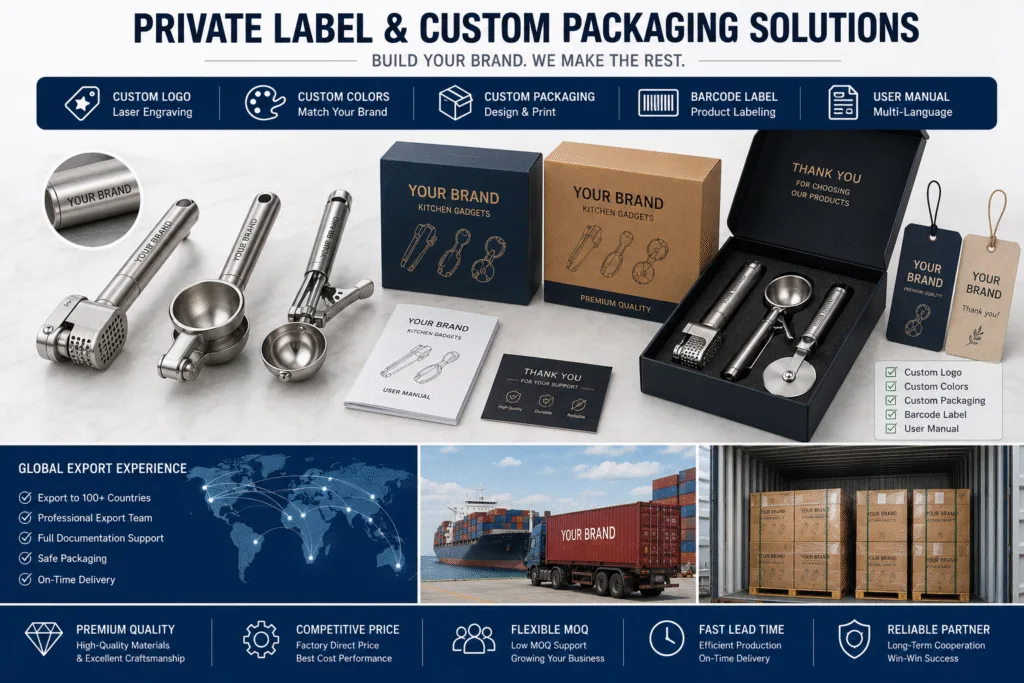
Packaging is an essential part of OEM manufacturing because it directly influences retail presentation and brand recognition.
Manufacturers commonly provide:
- Laser logo engraving
- Custom color options
- Retail gift boxes
- Color boxes
- Hang cards
- Barcode labels
- User manuals
- Eco-friendly packaging
Complete private-label services help brands build a professional image in competitive markets.
Step 10: Mass Production & Global Delivery
Once samples receive customer approval, production moves into full-scale manufacturing.
Experienced factories ensure:
- Stable production schedules
- Consistent quality
- Efficient inventory management
- Reliable delivery timelines
Products are then packed according to international shipping standards and prepared for export worldwide.
Why Choose China for OEM Kitchen Gadgets?
China remains one of the most competitive manufacturing locations because of its:
- Mature industrial supply chains
- Advanced manufacturing equipment
- Skilled engineering teams
- Competitive production costs
- Strong export experience
- Flexible OEM and private-label services
These advantages make China a preferred sourcing destination for global kitchenware brands.
Questions to Ask an OEM Manufacturer
Before selecting an OEM supplier, buyers should ask:
- Do you have in-house mold development?
- What materials do you use?
- How is quality controlled?
- Can you provide custom packaging?
- What certifications are available?
- What is your production capacity?
- What is the average lead time?
- Can you provide product samples?
Clear communication at the beginning of a project helps prevent misunderstandings later.
FAQ
What is the difference between OEM and ODM?
OEM products are manufactured according to the buyer’s specifications, while ODM products are based on designs already developed by the manufacturer and customized for branding.
How long does OEM product development take?
The timeline depends on product complexity, tooling requirements, and order quantity. Projects involving new molds generally require additional development time.
Can manufacturers help improve product designs?
Yes. Experienced OEM manufacturers often provide engineering recommendations that improve manufacturability, reduce costs, and enhance product performance.
Can OEM manufacturers provide private-label packaging?
Most professional manufacturers offer complete private-label solutions, including logo engraving, packaging design, barcode labels, and retail-ready presentation.