Table of Contents
Why Quality Control Matters in Kitchenware Manufacturing?
Quality control plays a critical role in kitchenware manufacturing. For OEM buyers, wholesalers, and private label brands, stable product quality directly affects customer satisfaction, brand reputation, and long-term business success.
Poor quality control can lead to:
- Surface defects
- Product breakage
- Coating problems
- Loose assembly
- Corrosion issues
- High return rates
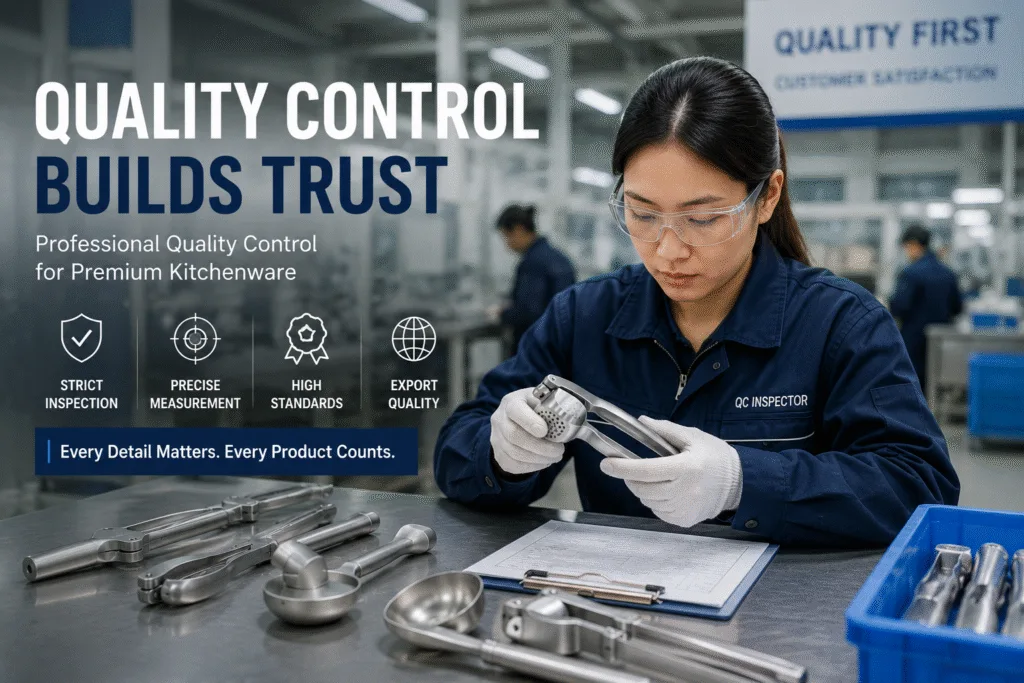
Professional kitchenware manufacturers use strict quality control systems to ensure every product meets export standards and customer expectations.
Common Quality Problems in Kitchenware Products
Different kitchenware products may experience different manufacturing defects during production.
Common problems include:
| Quality Issue | Possible Cause |
|---|---|
| Scratches | Poor handling during production |
| Uneven coating | Unstable surface finishing |
| Loose parts | Incorrect assembly process |
| Sharp edges | Poor polishing |
| Surface bubbles | Low-quality die casting |
| Rust problems | Poor material quality |
Identifying these problems early helps reduce manufacturing risks and improve production consistency.
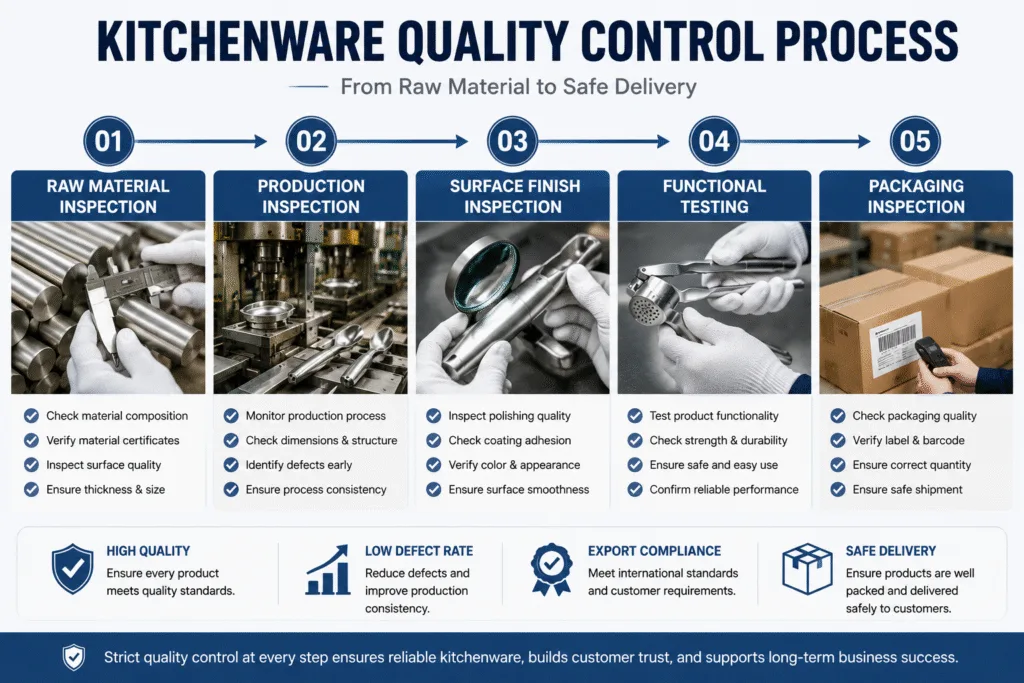
Key Steps in Kitchenware Quality Control
Professional OEM kitchenware factories usually follow multiple inspection procedures during manufacturing.
Incoming Material Inspection
Raw material inspection is the first step in quality control.
Manufacturers inspect:
- Aluminum alloy quality
- Stainless steel composition
- Surface condition
- Material thickness
- Supplier certifications
Stable raw materials help reduce production defects later.
Production Line Inspection
During manufacturing, QC teams monitor:
- Die casting precision
- Product dimensions
- Structural consistency
- Assembly accuracy
This helps identify defects before mass production continues.
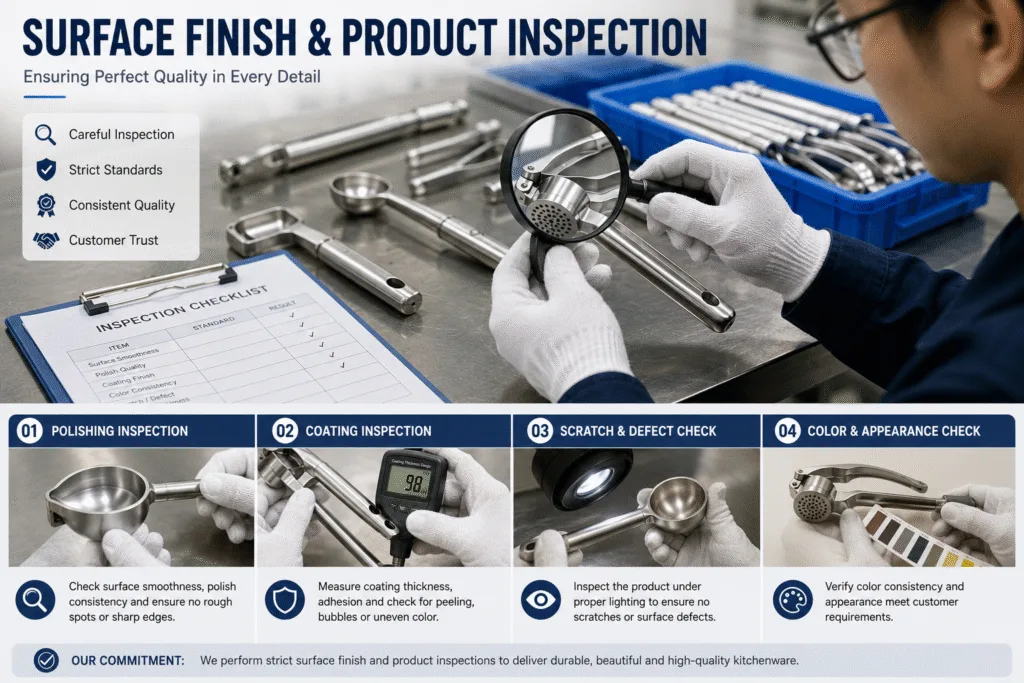
Surface Finish Inspection
Surface quality strongly affects product appearance and customer satisfaction.
Factories inspect:
- Polishing consistency
- Powder coating quality
- Scratches
- Color consistency
- Surface smoothness
Professional surface treatment improves both durability and visual quality.
Functional Testing
Kitchen tools should also pass functional performance tests.
Examples include:
- Garlic press pressure testing
- Nutcracker strength testing
- Pizza cutter blade alignment
- Handle stability testing
Functional inspection helps ensure long-term product reliability.
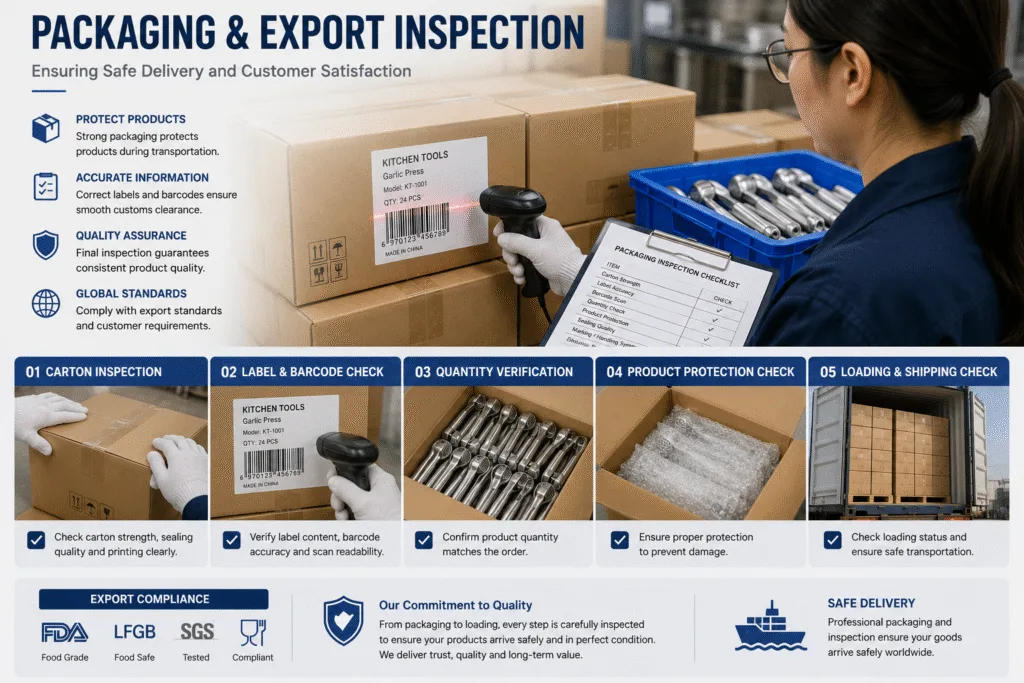
Packaging Inspection
Export packaging is also part of quality control.
Factories inspect:
- Carton strength
- Label accuracy
- Barcode placement
- Product protection
- Shipping safety
Proper packaging reduces transportation damage.
Quality Control Standards for Export Markets
Professional kitchenware manufacturers must comply with international safety and quality standards.
Common export requirements include:
- FDA compliance
- LFGB certification
- SGS testing
- Food-grade material standards
Different markets may require different compliance procedures.
European buyers usually focus more on food-contact safety and environmental standards.
How OEM Manufacturers Reduce Product Defects?
Experienced OEM manufacturers reduce defects through:
- Automated production systems
- Mold precision control
- Stable supplier management
- Standardized QC procedures
- Employee training
- Production line monitoring
Modern factories often combine automated inspection with manual quality checks to improve consistency.
Quality Inspection Tools Used in Kitchenware Factories
Professional factories use specialized inspection tools to maintain stable quality.
Common QC equipment includes:
- Vernier calipers
- Surface smoothness testers
- Coating thickness testers
- Hardness testing tools
- Salt spray testing equipment
These tools help manufacturers maintain accurate production standards.
How to Choose a Kitchenware Factory with Strong QC Systems?
For importers and wholesalers, selecting a factory with professional quality control systems is extremely important.
Reliable manufacturers usually provide:
- QC inspection reports
- Material certifications
- Production testing procedures
- Stable lead times
- Export experience
- OEM project support
Buyers should also evaluate factory production capability and communication efficiency before long-term cooperation.
Common Mistakes Buyers Make When Evaluating Product Quality
Some buyers focus only on low pricing and ignore quality management systems.
This often creates:
- Product inconsistency
- Customer complaints
- High return rates
- Delayed shipments
Long-term sourcing success depends on stable manufacturing quality rather than short-term pricing advantages.
FAQ
Why is quality control important in kitchenware manufacturing?
Quality control helps ensure product durability, safety, appearance, and manufacturing consistency.
What certifications are important for kitchenware products?
FDA, LFGB, and SGS certifications are commonly required for export kitchenware products.
How do factories reduce product defects?
Factories reduce defects through raw material inspection, production monitoring, surface inspection, and functional testing.
What is the most common quality issue in kitchenware production?
Surface defects, coating problems, and assembly issues are among the most common manufacturing problems.
Why is packaging inspection important?
Proper packaging helps protect products during international transportation and reduces shipping damage.